A visit to China by the Zimbabwe Army chief days before the military seized control and placed President Robert Mugabe under house arrest has raised eyebrows and even led to speculation that Gen Constantino Chiwenga may have sought Beijing’s tacit approval for his move.
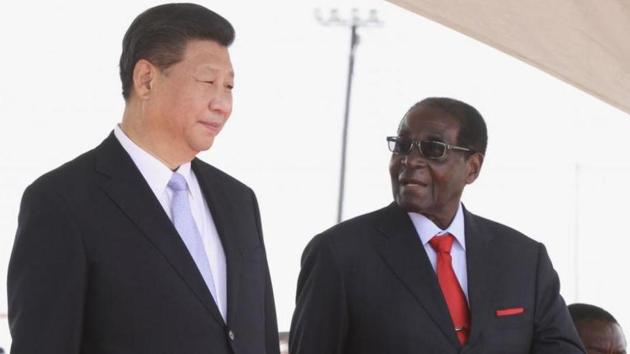
China is Zimbabwe’s largest foreign investor and has had a presence in the southern African country since the 1970s, when it secretly supplied ammunition and funds to Mugabe’s guerrilla force during the war of independence.
Chiwenga, seen as an ally of ousted vice president Emmerson Mnangagwa who was sacked by Mugabe to strengthen the hands of his wife Grace Mugabe, held meetings in Beijing last week with two of the most senior members of the Chinese armed forces, including Li Zuocheng, chief of the Joint Staff Department of the People’s Liberation Army, and defence minister Gen Chang Wanquan.
According to a defence ministry report, Li told Chiwenga: “China and Zimbabwe are all-weather friends.” Chiwenga said Zimbabwe was willing to deepen exchanges and cooperation in all field to promote bilateral state and military relations.
Cobus Van Staden, senior researcher on foreign policy at the South African Institute of International Affairs, told CNN that the issue of whether China knew in advance of the military takeover in Zimbabwe was a “billion dollar question”.
{{/usCountry}}Cobus Van Staden, senior researcher on foreign policy at the South African Institute of International Affairs, told CNN that the issue of whether China knew in advance of the military takeover in Zimbabwe was a “billion dollar question”.
{{/usCountry}}Some experts have contended that Chiwenga may have wanted to ensure that political changes in Zimbabwe would not affect bilateral ties because of China’s long-standing support for Mugabe.
As Mugabe’s relations with the West deteriorated in the past decade, he increasingly turned to China for political and financial support. When Mugabe met Xi Jinping in Beijing on January 9 this year, the Chinese President told him: “China will never forget its old friend, and the Chinese people cherish the profound friendship with the Zimbabwean people.”
Observers, however, acknowledged there was no way of knowing whether China had any role in the apparent coup or had received advance warning from Chiwenga.
"The fact there were these kind of visits to Beijing right before (the takeover) certainly seems indicative of something, but who knows what that was?" Van Staden told CNN.
As with several other African countries, China has pumped billions of dollars into Zimbabwe in exchange for unfettered access to natural resources such as diamonds and agricultural products such as tobacco. In 2015 alone, China pumped in over $450 million in investments in Zimbabwe, more than half of the total foreign investments. It is also the second largest trading partner and has invested in 128 projects in Zimbabwe during 2000-12.
The military-to-military ties between the two countries are also very strong. Chinese state-run firms have helped build the $100-million Zimbabwe National Defence College and leaked US diplomatic cables showed the Zimbabwean government had purchased military hardware such as aircraft, armaments and air defence radars from China since 1980.
China also sends technical military advisers to work in Zimbabwe and Emmerson Mnangagwa was among the first Zimbabwean Zanu Party guerilla fighters to go to China for military training in the 1960s.
China’s foreign ministry has played downed the significance of Chiwenga’s visit, saying it was part of the “normal military-to-military” exchanges. Asked about Chiwenga’s visit during a news briefing at the foreign ministry this week, spokesperson Geng Shuang said: “As for the details of his visit, I have little to share…Since the defence ministry hosted him, I don’t have other details.”
A statement issued by the Chinese foreign ministry after the military takeover focussed on stability rather than a possible change of regime in Harare. “We sincerely hope that the situation will remain stable in Zimbabwe and relevant affairs can be handled in a peaceful and proper way," the statement read.
“We will continue to develop friendly cooperation with Zimbabwe following the principle of equal and mutually beneficial cooperation with win-win results,” it added.