
 E-Paper



The Brutal Maduro Enforcer Standing in Trump’s Way in Venezuela
Diosdado Cabello looms as the biggest obstacle to Trump’s hopes for a stable, U.S.-friendly oil state.


 Prefer HTon Google


Standing between President Trump and his vision for a stable, U.S.-friendly oil power looms one man: Diosdado Cabello, the belligerent and eccentric de facto leader of Venezuela’s security forces and brutal militias, and a wild card in the country’s future.
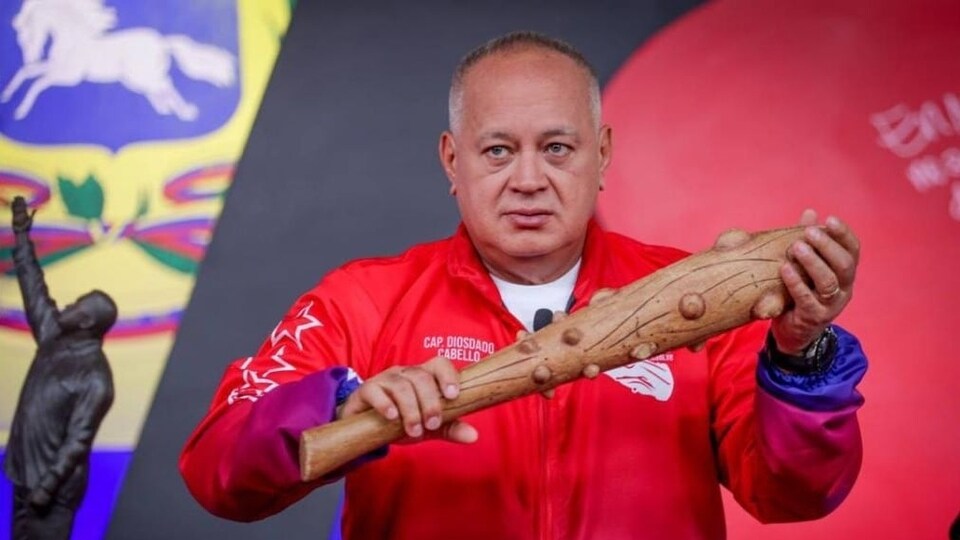
Cabello, whose first name means “God-given” in Spanish, has long positioned himself as the regime’s fiercest defender, commanding some of the “colectivos”—armed gangs who roared through Caracas on motorbikes this week in a menacing show of force.
Indicted by the U.S. alongside ousted Nicolás Maduro, Cabello faces a choice: back the fledgling government of his rival, acting President Delcy Rodríguez, or make a bold play for power himself, toppling her and risking face-to-face conflict with American commandos.
“Cabello has a great deal to lose and is likely to recognize that among Washington’s demands, his removal could surface sooner rather than later,” said Daniel Lansberg-Rodriguez of Aurora Macro Strategies.
Fond of swinging a spiked club while spouting conspiracy theories on his hourslong weekly show on state television called “Bringing Down the Hammer,” now on its 556th episode, Cabello is hard to predict.
Cabello, a 62-year-old whose official title is minister of interior, justice and peace, has so far signaled unity, taking part in Rodriguez’s swearing-in ceremony on Monday, where various factions of Venezuela’s ruling socialist party were present.
But that night, Cabello was toting a rifle and riling up black-uniformed security forces before they patrolled Caracas to prevent citizens from protesting.

“Doubting is treason!” he said, before telling the armed group, “Now, off to battle in the streets for victory.”
Under a state of emergency that the government declared after Maduro’s capture, security forces were ordered to hunt down U.S. sympathizers, according to the Official Gazette, where the Venezuelan government publishes new laws and decrees. Residents in the capital reported new roadblocks around the city where armed, masked men checked the phones of ordinary Venezuelans for antigovernment messages.
The fear campaign spearheaded by Cabello appeared to conflict with Trump’s comments Tuesday suggesting the regime might be easing its repressive ways.
“They have a torture chamber in the middle of Caracas that they’re closing up,” Trump said in a news conference.
Cabello has personified Venezuela’s ruling socialist movement like few others. An Army captain, he first befriended the late Hugo Chávez on a baseball team during their days in the military academy. He later became one of the firebrand’s most loyal lieutenants.
During Chavez’s failed 1992 coup, Cabello commanded tanks in an attack on the Miraflores presidential palace. He served a couple of years in jail until he and other conspirators were granted clemency. In 2002 Cabello helped Chavez, then president, return to power after a coup.

Over the years, his family has taken influential positions in the government. At least five members of the Cabello family are blacklisted by the U.S. Treasury for alleged graft and facilitating the military dictatorship, allegations that Cabello and his relatives deny as part of a smear campaign against the government. They include his younger brother, José Cabello, who heads the country’s tax agency, and his daughter, Daniella Cabello, a socialite who runs a state-backed initiative to promote Venezuelan exports such as coffee and chocolate.
In 2016, Cabello filed a defamation lawsuit in Manhattan against Dow Jones & Co., the publisher of The Wall Street Journal, after the paper reported that he was under investigation by the Justice Department for alleged drug trafficking and money laundering. A judge dismissed the suit the following year, and he was eventually indicted on drug charges.
Today, while much of the regime’s top brass faces U.S. financial sanctions, Cabello is one of only two high cabinet members formally charged in the U.S. with drug trafficking. He is named as a co-defendant in the U.S. indictment of Maduro, which was unsealed just before the deposed Venezuelan strongman was brought to court in New York this week. Cabello denies the charges.
Cabello showed how vital he is as an enforcer after the July 2024 presidential election where Maduro declared victory despite ballot tallies showing he had lost in a landslide to opposition candidate Edmundo Gonzalez, a retired diplomat. Cabello was appointed interior minister weeks later as the regime used paramilitary forces to clamp down on the slums, jailed human rights activists and forced political rivals into exile.

His very name strikes fear. Venezuelans inside the country Tuesday largely refused to talk about Cabello for fear of reprisals. Many who did asked not to be named.
A 50-year-old woman in the northwestern city of Maracaibo said Cabello is seen as someone who knows the country and all its movements, fueling rumors that he would try to seize power.
Many Venezuelans know him from his frequent appearances at public events and from his TV show, which has run more than a decade.
Cabello expounds for hours at a time, mixing political commentary with dark humor as a small audience claps and laughs. He plays surreptitiously recorded phone conversations between opposition leaders. He boasts of holding prisoners accused of being U.S. spies.
In Washington, U.S. officials and lawmakers are hoping Rodriguez can contain Cabello. “The next few days are going to be key,” said Senate Majority Leader John Thune (R., S.D.) Of Rodriguez, he said: “I’m told that she’s a practical person, a pragmatic person.”
While Cabello has signaled he won’t rock the boat, some predict that won’t last long, especially as Maduro’s old allies begin squabbling for control.
“Diosdado is the hardest one to deal with. Nothing about him suggests he would be willing to negotiate,” said Ryan Berg, Americas director at the Center for Strategic and International Studies, a Washington-based policy group.
“I don’t see a U.S.-Delcy Rodriguez relationship being able to work long term,” Berg said. “It has been 27 years of this regime using the U.S. as an excuse for everything that’s gone wrong.”

Cabello has come close to leading the country on multiple occasions. He formally held the presidential seat for a few hours on the night of April 13, 2002, until Chavez was reinstated following the attempted coup. And in Chavez’s last televised appearance before dying of cancer in 2013, Cabello and Maduro flanked him as he told loyalists to support the latter as president upon his death.
Geoff Ramsey, a nonresident senior fellow at the Atlantic Council in Washington, said Cabello has always had his eyes on the throne even though he would be unacceptable to the international and business community.
“Cabello has a reputation as a Machiavellian thug, and it’s hard to imagine this [U.S.] administration or any other cozying up to him,” Ramsey said. “Delcy may have Donald Trump’s ear, but she doesn’t have the guns, and Cabello knows that.”
Write to Kejal Vyas at kejal.vyas@wsj.com and Samantha Pearson at samantha.pearson@wsj.com


