The Final Seconds Before a Learjet Plunged Into a Florida Street
The NTSB expects weather to be a major focus in the crash investigation.
Updated on: Nov 3, 2026, 08:34:44 IST
WSJ
Advertisement
BOCA RATON, Fla.—It went from a calm request for a better route to sheer panic in a matter of seconds.
PREMIUM
A Learjet 60 carrying nine people crashed into a residential area in Florida’s Palm Beach County on Sunday, erupting in a fireball and killing everyone on board. Photo: Aki Kuusisto/UGC/Reuters
A Learjet pilot called air-traffic control for clearance to fly higher Sunday at about 12:50 p.m. local time as a storm was generating ice and turbulence at an air temperature of negative 52.6 degrees Fahrenheit. The pilot said the crew was managing the ice on the business jet and noted they were picking up precipitation. Suddenly, everything changed.“Mayday, mayday,
{{^htLoading}} {{/htLoading}}
{{^usCountry}}{{/usCountry}}
Deep Dive
What happened in the final seconds before the Florida Learjet crash?
The pilot reported accumulating ice and turbulence, then declared an emergency as the Learjet descended rapidly. She reported an overspeed condition and warned that the plane was about to crash before radio contact ended.
Did severe weather cause the Learjet crash in Palm Beach County?
The NTSB has not determined the cause. Investigators are focusing on the storm, icing and turbulence, as well as the crew’s flight path and decisions.
Did the Learjet break apart before it hit the ground?
Investigators said the aircraft appeared to have broken apart during its descent, leaving debris scattered across a wide area. They are examining the wreckage to establish when and how that happened.
Powered ByAsk HT
“We are going to crash into the ground,” she said, noting the plane was banking 60 degrees.
She shrieked again. “Holy f— we’re out of time.”
Silence.
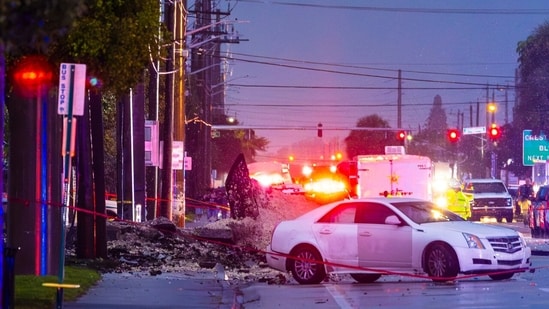
Video footage shows the business jet nosediving into a thoroughfare in Palm Beach County. It exploded in a ball of fire, killing all nine people on board and injuring a nearby driver. The impact left a large crater in the road.
The National Transportation Safety Board said the plane appeared to have broken apart as it plunged toward the ground, leaving a half-mile-long debris field scattered among ballfields, businesses and homes.
NTSB member Thomas Chapman said the weather conditions are a major focus of the investigation. The probe would also examine how the pilots and air-traffic controllers decided the plane’s flight path.
{{^htLoading}} {{/htLoading}}
“The factual details of how this transpired is exactly what we’re trying to determine,” Chapman said. “Who knew what and when and what actions were taken and whether those actions were appropriate.”
The flight was en route from Austin, Texas, to Eleuthera Island in the Bahamas, with seven passengers and two crew members. Nathalia Filgueiras, the 20-year-old co-pilot who was in the cockpit, died in the crash, her stepfather Thiago Corteleti said. Family members identified the passengers as Austin, Texas tech entrepreneur Adam Robinson, his wife Helen Sharp and their two children ages 4 and 2. The family was flying with the children’s caretaker, Anita Maria Cetina, and friends Rachael Reed and Charmi Fehr, according to a joint statement from the families.
{{^htLoading}} {{/htLoading}}
“All we know is that our daughter is down there, under the ground with that airplane,” Corteleti said Monday outside the family’s home in Boca Raton, Fla.The plane involved in the accident—a Learjet 60—was operated by Aurora Aviation, doing business as Upper Jets. An Aurora Aviation representative said the company is cooperating with the investigation.
A significant storm system capable of producing strong updrafts, heavy precipitation and icing moved over Southern Florida on Sunday. It consisted of cumulonimbus clouds with some cells reaching relatively high intensity, according to aviation data provider AirNav Systems.
One storm cell moved from west to east and intensified significantly near where the aircraft passed, according to AirNav Systems, which said its weather data indicated moderate to severe icing conditions as well as moderate turbulence in the area.
{{^htLoading}} {{/htLoading}}
Chart
Aviation safety experts said the thunderstorm appeared to play a critical role in the crash, questioning why the flight crew entered severe weather in the first place.
“The airplane was seen to have entered a very powerful, isolated thunderstorm that was high as to where that airplane was flying,” said Jeff Guzzetti, a former top U.S. aircraft accident investigator. “Typically, these business jets can fly over the weather. But in this case, this weather was building up so much that it was reaching some very high altitudes.”
{{^htLoading}} {{/htLoading}}
That exposed the aircraft to potential icing, hail and turbulence. Icing at such high altitudes is rare, experts said, and a quick buildup of ice from upward-flowing air on the wings and tail can result in a loss of aerodynamic lift and control of the airplane.
“You can accumulate ice really quickly that way, but if you are in an airplane—a jet particularly—and you see liquid water like that, it is a real big red flag that this is very unusual and very, very dangerous,” said John Cox, an aviation safety consultant and former airline pilot union official.
The Learjet 60 dates to the 1990s when it was certified by air-safety regulators. Its high thrust-to-weight ratio means it can climb rapidly to high altitudes.
{{^htLoading}} {{/htLoading}}
While the Learjet is made for high performance, its design could have made it more vulnerable to an upset in certain conditions, according to Guzzetti. “It was still certified to fly in certain conditions, but those conditions may have been exceeded,” he said.
Bombardier, which owns Learjet, declined to comment on the accident. It said it would cooperate with investigators.
The NTSB would examine whether there were any similarities between this crash and others involving the same model, Chapman said.
Maintenance records indicate the aircraft had a cockpit voice recorder installed on it, but it wasn’t clear whether the black box was still on board at the time of the accident, Chapman said.
Once the airplane started a rapid descent, it would have been difficult, perhaps impossible, for the crew to recover—particularly if the aerodynamic loads led to the loss of portions of the aircraft structure, the experts said.
BOCA RATON, Fla.—It went from a calm request for a better route to sheer panic in a matter of seconds.
PREMIUM
A Learjet 60 carrying nine people crashed into a residential area in Florida’s Palm Beach County on Sunday, erupting in a fireball and killing everyone on board. Photo: Aki Kuusisto/UGC/Reuters
A Learjet pilot called air-traffic control for clearance to fly higher Sunday at about 12:50 p.m. local time as a storm was generating ice and turbulence at an air temperature of negative 52.6 degrees Fahrenheit. The pilot said the crew was managing the ice on the business jet and noted they were picking up precipitation. Suddenly, everything changed.“Mayday, mayday, we’re descending 10,000 feet per minute,” the pilot called out from within the cockpit of the doomed Learjet, according to air-traffic audio from LiveATC.net, her voice clearly alarmed.
{{^htLoading}} {{/htLoading}}
{{^usCountry}}{{/usCountry}}
Quickly the flight stopped being able to ascend and began nosediving, falling faster and faster with every second. “Declare an emergency,” she soon shrieked. “We are in an overspeed condition descending 20,000 feet per minute!”
Deep Dive
What happened in the final seconds before the Florida Learjet crash?
The pilot reported accumulating ice and turbulence, then declared an emergency as the Learjet descended rapidly. She reported an overspeed condition and warned that the plane was about to crash before radio contact ended.
Did severe weather cause the Learjet crash in Palm Beach County?
The NTSB has not determined the cause. Investigators are focusing on the storm, icing and turbulence, as well as the crew’s flight path and decisions.
Did the Learjet break apart before it hit the ground?
Investigators said the aircraft appeared to have broken apart during its descent, leaving debris scattered across a wide area. They are examining the wreckage to establish when and how that happened.
Powered ByAsk HT
“We are going to crash into the ground,” she said, noting the plane was banking 60 degrees.
She shrieked again. “Holy f— we’re out of time.”
Silence.
Video footage shows the business jet nosediving into a thoroughfare in Palm Beach County. It exploded in a ball of fire, killing all nine people on board and injuring a nearby driver. The impact left a large crater in the road.
The National Transportation Safety Board said the plane appeared to have broken apart as it plunged toward the ground, leaving a half-mile-long debris field scattered among ballfields, businesses and homes.
{{^htLoading}} {{/htLoading}}
NTSB member Thomas Chapman said the weather conditions are a major focus of the investigation. The probe would also examine how the pilots and air-traffic controllers decided the plane’s flight path.
“The factual details of how this transpired is exactly what we’re trying to determine,” Chapman said. “Who knew what and when and what actions were taken and whether those actions were appropriate.”
The flight was en route from Austin, Texas, to Eleuthera Island in the Bahamas, with seven passengers and two crew members. Nathalia Filgueiras, the 20-year-old co-pilot who was in the cockpit, died in the crash, her stepfather Thiago Corteleti said. Family members identified the passengers as Austin, Texas tech entrepreneur Adam Robinson, his wife Helen Sharp and their two children ages 4 and 2. The family was flying with the children’s caretaker, Anita Maria Cetina, and friends Rachael Reed and Charmi Fehr, according to a joint statement from the families.
{{^htLoading}} {{/htLoading}}
“All we know is that our daughter is down there, under the ground with that airplane,” Corteleti said Monday outside the family’s home in Boca Raton, Fla.The plane involved in the accident—a Learjet 60—was operated by Aurora Aviation, doing business as Upper Jets. An Aurora Aviation representative said the company is cooperating with the investigation.
A significant storm system capable of producing strong updrafts, heavy precipitation and icing moved over Southern Florida on Sunday. It consisted of cumulonimbus clouds with some cells reaching relatively high intensity, according to aviation data provider AirNav Systems.
One storm cell moved from west to east and intensified significantly near where the aircraft passed, according to AirNav Systems, which said its weather data indicated moderate to severe icing conditions as well as moderate turbulence in the area.
{{^htLoading}} {{/htLoading}}
Chart
Aviation safety experts said the thunderstorm appeared to play a critical role in the crash, questioning why the flight crew entered severe weather in the first place.
“The airplane was seen to have entered a very powerful, isolated thunderstorm that was high as to where that airplane was flying,” said Jeff Guzzetti, a former top U.S. aircraft accident investigator. “Typically, these business jets can fly over the weather. But in this case, this weather was building up so much that it was reaching some very high altitudes.”
{{^htLoading}} {{/htLoading}}
That exposed the aircraft to potential icing, hail and turbulence. Icing at such high altitudes is rare, experts said, and a quick buildup of ice from upward-flowing air on the wings and tail can result in a loss of aerodynamic lift and control of the airplane.
“You can accumulate ice really quickly that way, but if you are in an airplane—a jet particularly—and you see liquid water like that, it is a real big red flag that this is very unusual and very, very dangerous,” said John Cox, an aviation safety consultant and former airline pilot union official.
The Learjet 60 dates to the 1990s when it was certified by air-safety regulators. Its high thrust-to-weight ratio means it can climb rapidly to high altitudes.
{{^htLoading}} {{/htLoading}}
While the Learjet is made for high performance, its design could have made it more vulnerable to an upset in certain conditions, according to Guzzetti. “It was still certified to fly in certain conditions, but those conditions may have been exceeded,” he said.
Bombardier, which owns Learjet, declined to comment on the accident. It said it would cooperate with investigators.
The NTSB would examine whether there were any similarities between this crash and others involving the same model, Chapman said.
Maintenance records indicate the aircraft had a cockpit voice recorder installed on it, but it wasn’t clear whether the black box was still on board at the time of the accident, Chapman said.
Once the airplane started a rapid descent, it would have been difficult, perhaps impossible, for the crew to recover—particularly if the aerodynamic loads led to the loss of portions of the aircraft structure, the experts said.
Get the latest World News, breaking headlines and global updates from the US, UK, Pakistan, Bangladesh, Russia and other countries. Follow major international events on Hindustan Times.
Get the latest World News, breaking headlines and global updates from the US, UK, Pakistan, Bangladesh, Russia and other countries. Follow major international events on Hindustan Times.
Home/World News/The Final Seconds Before a Learjet Plunged Into a Florida Street
{{^htLoading}}
Advertisement
{{/htLoading}}
SHARE THIS ARTICLE ON
{{#usCountry}}{{/usCountry}}
Notifications
Get breaking alerts directly from the newsroom
Notifications are on!You'll be notified when news breaks