
SINGAPORE—In 1998, a shadowy entertainment company based in the gambling hub of Macau made an unusual purchase: an aircraft carrier. Called the Varyag, it was originally ordered for the Soviet Union, but was left to rust unfinished in a Ukrainian shipyard. Its Chinese buyers said they wanted to turn their $20 million acquisition into a floating casino.That turned out to be a ruse. China, whose inexperienced navy had never built or operated a carrier, decided to make an experiment
SINGAPORE—In 1998, a shadowy entertainment company based in the gambling hub of Macau made an unusual purchase: an aircraft carrier. Called the Varyag, it was originally ordered for the Soviet Union, but was left to rust unfinished in a Ukrainian shipyard. Its Chinese buyers said they wanted to turn their $20 million acquisition into a floating casino.That turned out to be a ruse. China, whose inexperienced navy had never built or operated a carrier, decided to make an experiment of the Varyag. It took 15 years to transform the deteriorating, stripped-down hulk into a functioning vessel and figure out how to fly planes from it. Some naval analysts mocked the effort back then.Today, China has three aircraft carriers, with a fourth on its way that Western experts believe will be nuclear-powered. They’re part of the world’s largest navy, which now has a battle force of more than 400 ships and submarines, according to official U.S. numbers seen by The Wall Street Journal. That means China’s fleet is around 35% larger than the American Navy by hull count.
It is one of the largest peacetime naval buildups in modern history.
On any given day, as many as 100 of China’s navy ships are out on some of Asia’s busiest trade and transportation routes—pressuring rivals and training for a potential conflict with the U.S. The larger and more sophisticated vessels in its fleet also routinely push further out into waters long dominated by American forces.
The Chinese navy’s rise has been powered by the country’s rapid emergence as a colossus in shipbuilding and as the biggest sea-trading nation. Its massive shipyards churn out more than half of the world’s merchant vessels every year and take advantage of that staggering scale to build warships at high speed.
On top of that, Beijing has financed the construction of a vast overseas network of ports, from Sri Lanka to Israel and Peru. Its coast guard and fishing fleets are the largest of any nation. Its research vessels are meticulously mapping the oceans, from the Mariana Trench to the Arctic.For centuries, China was a continental force. Its sudden, historic emergence as one of the world’s top maritime powers is challenging the U.S. on a scale it hasn’t faced since World War II.
The transformation is driven in part by Chinese leader Xi Jinping’s conviction that the rise and fall of nations is linked inextricably to the oceans. Current and former U.S. officials say China is amassing the kind of all-round sea power that Alfred Thayer Mahan, one of America’s most influential maritime strategists, prescribed for his country over a century ago.
“Xi Jinping himself is more Mahanian than any American leader has been probably since Teddy Roosevelt,” said Michael Studeman, who spent 35 years in the U.S. Navy, retiring in 2023 as the head of the Office of Naval Intelligence. “He fully believes, as someone who has studied history, that any great power ultimately is a global maritime power.”
America, Studeman said, has “sea-blindness.” It is a naval power, but no longer a maritime one.
Little cargo moves on U.S.-flagged ships today. With a broken industrial base, America produces very few oceangoing commercial vessels and has struggled to expand its approximately 290-ship navy. Programs to build frigates, extend the lives of aging cruisers and operate a large fleet of littoral combat ships have foundered.
A recent Navy Department report said that although the shipbuilding budget has doubled over the past two decades, America has no more naval ships now than in 2003. U.S. adversaries meanwhile “built fleets at a pace not seen in generations,” it said.
“China’s rapid naval expansion raises serious concerns about Beijing’s military ambitions,” a State Department spokesman said in an emailed response to questions. Beijing is using its maritime capabilities to project military power, advance expansive territorial claims and intimidate its neighbors, posing a challenge to American interests, the spokesman said, adding that the U.S. will continue to uphold freedom of navigation and stand with its allies and partners.
The White House said the Trump administration is restoring U.S. shipbuilding capacity, reforming workforce training and eliminating burdensome regulations. “President Trump has prioritized restoring American maritime dominance unlike any of his predecessors,” spokeswoman Anna Kelly said.
China’s Ministry of Defense didn’t respond to a request for comment.
Bigger, faster, stronger
The large Chinese navy is expanding its missions in unprecedented ways and training at a fast tempo.
Early last year, the Chinese warship Zunyi looped conspicuously around Australia and staged live-fire drills around 5,000 miles from China’s coast, forcing commercial flights to divert. Months later, the 13,000-ton vessel trained for combat in a carrier strike group. After clocking 200 days and 50,000 nautical miles at sea, it set out in January to practice hunting submarines.
Surface combatants like the Zunyi are some of the most sophisticated in the world, showcasing Beijing’s ambitions for a “blue water” force capable of projecting power far from China’s shores and protecting its overseas interests. China calls these ships destroyers, but they are so large and have so much firepower that the U.S. classifies them as guided-missile cruisers.
Since the first joined service in 2020, nine others have swiftly followed. In December, one of them sailed into the West Pacific in a four-vessel task force that also included a hulking, 35,000-ton amphibious assault ship sized to carry 30 helicopters. Concerned Australian officials sent a patrol aircraft to monitor them.
“They’re not building a bunch of little corvettes,” said Thomas Shugart, a former U.S. Navy submariner and adjunct senior fellow at the Center for a New American Security. “They’re building a world-class navy.”
The U.S. Navy remains ahead by tonnage, which means its ships are on average bigger. But in recent years, China has kicked off the serial production of ever-larger and more capable vessels—ordering them at scale and building them with speed. Official U.S. data seen by the Journal shows that since 2020, it has added 71 major warships and submarines, 19 of them just last year.
On Changxing Island across from Shanghai, two neighboring shipyards are cranking out commercial ships, from natural-gas carriers to giant containerships, for a big roster of global customers. The same yards can be seen building an array of high-end warships for China’s navy.
An analysis of satellite images from May shows two amphibious ships, two cruisers, three destroyers, two frigates and other small grey-hulled navy vessels—all under construction or maintenance at the same time on the island, which China has rapidly turned into a shipbuilding juggernaut and a strategic asset.
Just five years ago, open fields stood where some of those ships are rising up. Construction on a new yard was barely complete when crew began work in 2023 on one of the world’s largest amphibious ships—the 40,000-ton Sichuan, dubbed a “drone carrier.”
Its emergence surprised naval analysts because it was bigger and more sophisticated than amphibious vessels the Chinese navy had begun receiving just two years prior.
In June this year, something even more unexpected popped up at one of the two Changxing yards: a new class of submarine, likely nuclear-powered. “We were all kind of gobsmacked,” said Shugart.
The Jiangnan shipyard where it emerged hadn’t been known to produce nuclear-powered boats, but appears to have been quietly tasked to do so. U.S. Navy leaders say shipyard expansion they’ve tracked has “dramatically increased” China’s submarine-production capacity as the country shifts from diesel-electric subs to nuclear ones.
By 2040, U.S. officials expect Chinese submarines will routinely operate in the Indian Ocean, Arctic approaches and possibly the Atlantic.
Washington believes China is also on the cusp of a carrier spree. A Pentagon report last year, which is based on classified intelligence, estimated it will have a total of nine aircraft carriers by 2035, bringing it close to parity with the U.S. carrier fleet of 11, whose total count isn’t expected to change in that period. That would be a stunning buildup for a country that didn’t operate any carriers less than two decades ago.
In the 2000s, the U.S. hosted tours of American carriers for Chinese delegations. Six to 10 Chinese military officers would fan out, asking about how everything worked, recalled Studeman, formerly of the U.S. naval intelligence office.
“The approach at the time was, if we show them how capable we are, they’ll be intimidated and they won’t ever think that they could challenge us,” said Studeman. He opposed the exchanges, he said, because “all they were doing was learning how we operated carriers so they could operate their own.”
America remains the gold standard for carrier operations, but China’s deployments have extended steadily outward, ship movements tracked by Japan and shared with the Journal show.
In June 2025, a Chinese carrier accompanied by other navy ships sailed into the ocean beyond Japan and squared off against a second carrier strike group from China in adversarial drills. It was the first time China had sent two carriers into the broader West Pacific at the same time. A J-15 jet fighter launched from one of them tailed a Japanese patrol craft for 40 minutes, at one point coming within a horizontal distance of 150 feet.
For the first time last year, a Chinese carrier sailed beyond a Pacific chain of islands that includes Guam, a U.S. military hub. Fighter jets are practicing hundreds of takeoffs and landings from flight decks. In an echo of “Top Gun,” images show crews in bright vests giving hand signals before launch.
In November, after China’s newest aircraft carrier, the Fujian, began service, Chinese state media celebrated the “three-carrier era” as a symbol of global prestige. The Fujian is equipped with electromagnetic catapults to launch aircraft, a system used in carriers only by the U.S. before then. President Trump meanwhile has directed the U.S. Navy to build its future aircraft carriers without that system and go back to steam catapults, a move American Navy officials have long fought.
Navalist statesman
The seaward shift is central to Xi’s vision for China’s rise. Shortly after he became president, Xi told the Communist Party’s senior leaders in 2013 that it was time to make their country a “maritime great power.” He noted how sea voyages had enabled Western countries to open new routes, expand overseas colonies, control trade and become world powers.
From China’s past, he cited the 15th century expeditions of Adm. Zheng He, whose “treasure fleet” delivered ceramics to the Strait of Hormuz and returned with giraffes from the eastern coast of Africa before China turned away from the oceans and entered a period of isolationism. During the 19th century Opium Wars that sped the collapse of China’s last imperial dynasty, Western attackers came from the sea, he said.
Xi fused China’s commercial maritime interests with its military ambitions.
Xi also poured resources directly into risky military projects. Around 2014, China began turning far-flung reefs in the South China Sea first into artificial islands and then into military bases, shifting the power balance in that waterway. A few years later, it inaugurated its first overseas base in Djibouti on Africa’s east coast and signed a secret pact for access to a Cambodian naval base.
China also began expanding naval bases up and down its own coast, with new piers, wharfs, drydocks, weapons depots and more constantly springing up.
Yuchi Naval Base


Before Xi, Chinese military writings often focused on the navy’s flaws, “looking at the U.S. Navy as if it’s 10-feet tall,” said Ryan D. Martinson, an associate professor at the U.S. Naval War College. Xi pushed the navy to have great ambitions of becoming a highly capable force. “And that is what it has become in a remarkably short period of time,” Martinson said.
In a paper titled “Chairman Xi’s Navy” earlier this year, Martinson wrote that Xi may rank among the greatest navalist statesmen in modern history.
Seas near and far
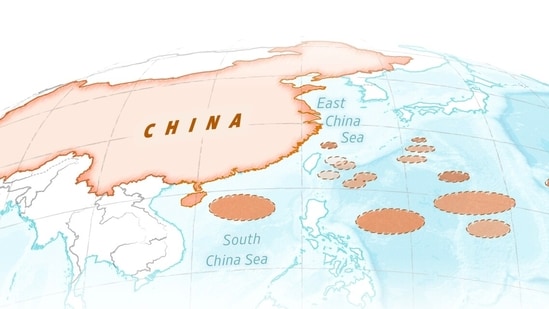
China’s core military priority today is the maritime arc off its coastline, from the Yellow Sea to the East and South China Seas. It is working to dominate these waters, absorb the island democracy of Taiwan and block U.S. forces from getting involved in any conflict.
This is potentially the world’s most dangerous maritime theater.
The U.S. wants to prevent Chinese hegemony in this arena. Vital trade arteries run through it, linking East Asia’s industrial powerhouses to the world. Bounding these waters is a trio of U.S. allies and partners—Japan, Taiwan and the Philippines—that are a part of what strategists call the first island chain. Defending that line constitutes the Pentagon’s top China strategy.
If China and the U.S. ended up in a head-to-head battle, it would likely be here—a scenario that has shaped a peacetime military buildup by Beijing that has few parallels in modern history, including a formidable Rocket Force.
“The Chinese have the ability to not just challenge but potentially defeat big portions of America’s traditional naval force, especially inside the first island chain and even outside the first island chain,” said Studeman.
China has worked methodically to tighten its grip in the strategic seas around the first island chain. Its forces maintain a dense, layered and daily presence unmatched by any other nation.
Half a dozen navy ships operate at all times all around Taiwan, surging rapidly for periodic exercises, according to security officials who track their movements. Three times as many can be found in the South China Sea to show force against the Philippines and Vietnam, with whom Beijing is embroiled in territorial disputes, the officials said.
The broader Chinese fleet trains in ever-larger numbers across this swath where it might one day be ordered to enforce a blockade or fight a war.
The navy is just one part of a sprawling network of maritime forces whose unpredictable operations have flummoxed Beijing’s opponents. A muscular coast guard presses China’s claims, at times by blasting rival vessels with water cannons or ramming them. Thousands of fishing boats, trained to work as a shadowy militia when needed, swarm contested areas without warning. Official survey vessels criss-cross disputed waters to test rival governments.
Together, they have fundamentally altered the region’s security dynamics, sharply increasing demands on the U.S. and its allies that must track these Chinese movements and be ready to respond.
Extending its operational reach, the Chinese navy is also building a regular presence beyond the first island chain and training to prevent U.S. forces from coming too close to their country’s mainland in a war. In other words, it is expanding “strategic depth,” said Martinson of the U.S. Naval War College.
The goal, he said: “conducting high-end naval operations against another great power, the U.S., as far east as possible.”
Write to Niharika Mandhana at niharika.mandhana@wsj.com, Josh Chin at Josh.Chin@wsj.com and Camille Bressange at camille.bressange@wsj.com
One Subscription.
Get 360° coverage—from daily headlines
to 100 year archives.
Archives
HT App & Website