In one desert river in the Southwest, there is a small bug and a small bird that are intertwined together. From satellite photos, it is found that when beetles were introduced to eat an invasive bush, 90 percent of the habitat required by the rare songbird has been reduced. The reason behind such reduction tells us how difficult it is to solve one issue without causing another.
The bird in question is the Southwestern willow flycatcher, an endangered songbird that spends from May to September in the rivers and streams of the Southwestern region. This bird builds its nest in tangled vegetation 10-13 feet off the ground, often near water sources. The 2007 survey numbers, as cited in the 2016 U.S. Geological Survey report by James R. Hatten, total some 1,299 territories in 288 sites.
A solution to one problem causes another
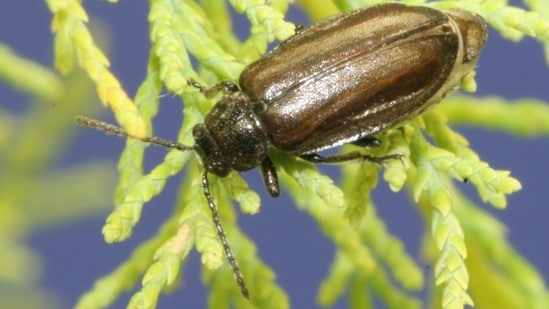
Tamarisk, which was introduced into the country over a hundred years ago, has come to occupy all riparian areas in the West, and the birds often use it for nesting purposes. In 2001, the U.S. Department of Agriculture introduced tamarisk leaf beetles at 10 sites in six states in an effort to curb the plant’s spread. The larvae eat the leaves, and repeated feeding kills the plant in about five years.
Deep Dive
How much predicted Southwestern willow flycatcher habitat was lost along the lower Virgin River after tamarisk leaf beetles arrived?
Why can controlling an invasive species create new problems for native wildlife?
How can managers reduce the risk of invasive-species control harming native habitat?
That begs the question: What would happen to a bird nesting in the plant under threat? The U.S. Geological Survey report tackles the issue, using Landsat satellite images and habitat models created in Arizona. The habitat models identify vegetation that appears similar to flycatcher habitat; the report calls this predicted habitat rather than actual nests. The model’s accuracy assessment found that it correctly classified 88% of 758 Southwestern willow flycatcher territories recorded in 2014, using a 40% probability threshold.
{{/usCountry}}That begs the question: What would happen to a bird nesting in the plant under threat? The U.S. Geological Survey report tackles the issue, using Landsat satellite images and habitat models created in Arizona. The habitat models identify vegetation that appears similar to flycatcher habitat; the report calls this predicted habitat rather than actual nests. The model’s accuracy assessment found that it correctly classified 88% of 758 Southwestern willow flycatcher territories recorded in 2014, using a 40% probability threshold.
{{/usCountry}}What the Virgin River numbers mean
The case study examined a 65-kilometer (about 40-mile) stretch of the lower Virgin River in Nevada and Arizona. Tamarisk leaf beetles were first observed along the river in 2008, but the habitat time series did not show their effects until 2011, according to a 2016 U.S. Geological Survey report. The largest habitat declines occurred between 2013 and 2015. From 1986 to 2011, predicted flycatcher habitat averaged 700.3 hectares, or about 1,730 acres, although annual estimates fluctuated between roughly 356 and 1,044 hectares. From 2013 to 2015, the average fell to 88 hectares, equivalent to 12.6% of the historical average, the report found.
Comparing two individual years shows the scale of the change. Predicted flycatcher habitat along the lower Virgin River fell from 937 hectares in 2010 to 87 hectares in 2015, a 90.7% decline, according to the USGS report. Of the habitat mapped in 2010, 94.2% was lost by 2015, while 5.8% persisted. A satellite-based measure of plant greenness also declined by nearly 49% in areas where predicted habitat disappeared. The losses varied across the river: the zone nearest Lake Mead National Recreation Area had 618 hectares of predicted habitat in 2010 and lost 99.6% of it by 2015, while the farthest upstream zone gained habitat from a baseline of less than one hectare.
The study also simulated rivers the beetles had not yet reached. By cutting the greenness values of mapped tamarisk in half, a reduction drawn from the Virgin River results, the model projected a 33.5 percent drop in predicted habitat along the lower Colorado River and a 53.1 percent drop along the upper Gila River in Arizona. When the report was published, beetles were expected to arrive on both rivers within a few years. Some managers were already preparing: along the Gila, tamarisk was being removed and replaced with native willows, and on the Colorado, the Bureau of Reclamation was replacing agricultural plantations with native vegetation.
There are limitations to these results. The destruction in the Virgin River was extensive, in large part because the entire river has tamarisk along it. Hatten also states that areas with more native species will experience less destruction. The simulation tool cannot predict which patches of land the birds will use each year. Moreover, the two simulations utilized vegetation maps that have not been validated for their accuracy. However, the larger implication extends beyond one bird.