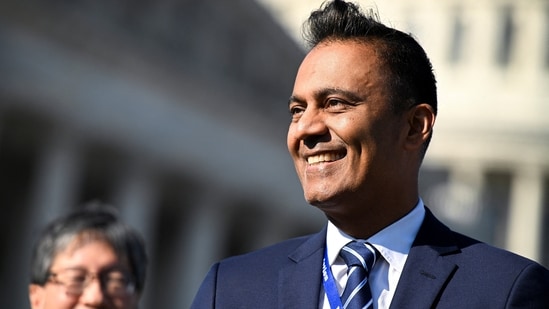
Amish Shah, a physician and former Arizona state legislator, is set to join Congress in January after flipping Arizona’s 1st congressional district, one of the most closely watched races of the US midterm elections. The son of an Indian immigrant mother who came to the US to study in 1969, Shah will be among the six Indian American members of the House of Representatives. Speaking to HT on the sidelines of a press conference in Washington, Shah discussed his family’s journey to America, the rise in anti-Indian sentiment, and the future of US-India ties.
Q: Congressman, congratulations on your victory. Could you tell us again the story of how your family first came to the United States?
It was the late 1950s, in Zaveri Bazaar in Bombay. A man named Mark Howard, a retired judge from Michigan, was wandering around. This was before cell phones. It was a hot day, he nearly passed out, and he was clearly in trouble. So my mother’s elder brothers went out, took him in, brought him into the air conditioning and gave him a can of Coca-Cola. He said, “Wow, I haven’t had Coca-Cola in some time.” If you remember, at the time you could only get Thums Up in India. And they started talking.
My uncles had expressed some interest in possibly doing business in the United States. Their jewellery business was thriving, but they knew they could expand further. Based on that conversation, and by keeping in touch, he eventually sponsored my mother to come to the United States to study. She was a student at the Milwaukee School of Engineering starting in 1969. It was an act of generosity that my mom really made sure we knew about, because it’s the reason I’m standing in front of you today.
Q: You’re coming in as one of six Indian American representatives on the Hill. There’s been a conversation about rising anti-Indian sentiment in the United States. What does that mean to you personally, what are you hearing from the community, and what do you intend to do about it?
We have clearly seen that anti-Indian hate has risen, probably more in the last six months to a year than I’ve ever seen in my lifetime. It’s surprising, because for many years we were praised as people contributing to the community: creating jobs as entrepreneurs, serving in the medical field, working in all sectors of the economy. It can be hurtful to hear, despite all of those contributions and wanting to pay back the generosity and goodwill of the American people, that some individuals have made really negative comments. Unfortunately, you can go on Twitter and see some of that, and it’s really sad to see.
{{/usCountry}}We have clearly seen that anti-Indian hate has risen, probably more in the last six months to a year than I’ve ever seen in my lifetime. It’s surprising, because for many years we were praised as people contributing to the community: creating jobs as entrepreneurs, serving in the medical field, working in all sectors of the economy. It can be hurtful to hear, despite all of those contributions and wanting to pay back the generosity and goodwill of the American people, that some individuals have made really negative comments. Unfortunately, you can go on Twitter and see some of that, and it’s really sad to see.
{{/usCountry}}Sometimes you even saw it from candidates for public office, like a gentleman from Texas running for railroad commissioner. That was particularly hurtful to a lot of people, because those kids were cheering on their football team. That could have been me in the student section at Northwestern in the 1990s. I’m still a football fan today, and the Chicago Bears are my team. So seeing that happen is disappointing to the community.
A lot of people feel scared and alone at times like this. What they want is for their elected leaders to see it, condemn it, stand with them and combat it in the ways they can: first, with the bullhorn we’ve been given in public office, and also, where there are legislative opportunities, by providing enhanced security. I know other communities have been feeling the same. I hear this a lot from Jewish Americans, who have been combating antisemitism for a long time. A lot of communities are speaking out, and I think our responsibility as elected officials is to set the moral tone.
Q: Is the US-India relationship going to be a priority for you? What’s your sense of the state of the relationship and the Trump administration’s handling of it? And will you be joining the India Caucus?
Certainly, we’ll be joining the India Caucus. But when we’re sworn in on January 3, the priority has to be taking care of the needs of my district. My district is concerned, first and foremost, about costs: the war in Iran causing costs to go up, and tariffs. The Indian American community specifically has been hit by tariffs that have been on and off, on and off. A lot of our entrepreneurs have come to me specifically and complained, and those concerns are top of mind, just as they are for all the people of Arizona. Then there’s the One Big Beautiful Bill and its Medicaid cuts, and finally water for Arizona: we’re living in a desert and we’re running out. Those are the problems we were sent here to fix, and they will be our top priorities.
Eventually, there will have to be a review of the US-India relationship. I think the tariffs were one of the big reasons we’ve had some acrimony in the relationship. And not just for India but for the rest of the world, Congress should take that authority away from the President and reclaim it for itself, as is rightfully ours. Once that happens, we believe we can actually improve the US-India relationship.