A frog introduced for hunting and food has become a threat to one of Arizona’s native snakes. A U.S. Fish and Wildlife Service species assessment traces bullfrogs’ arrival in Arizona to 1926, following a systematic introduction effort by the State Game Department to provide opportunities for sport hunting and a source of food. The assessment identifies nonnative species, particularly bullfrogs, crayfish, and sport fish, as major threats to the northern Mexican garter snake, which the document estimates occupies only about 10% of its historical habitat.
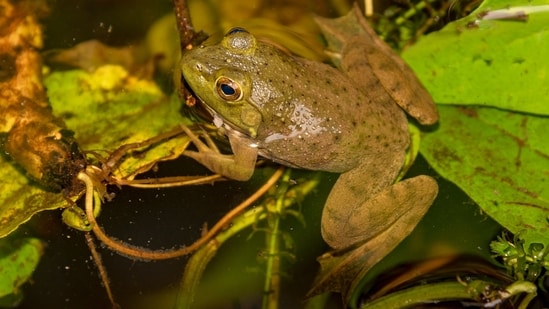
The northern Mexican garter snake can be easy to overlook. It is olive to olive-brown in color, has three stripes across its body, and can grow up to 44 inches long. It preys on frogs and fish found near the vegetated margins of ponds and streams. Bullfrogs put pressure on the snake in two ways: Larger frogs prey on young snakes, while competition and predation reduce the availability of native prey, including leopard frogs and fish. Drought and water shortages add to the pressure, but the assessment identifies invasive species as a leading concern.
Why so few young snakes survive
Field observations provide evidence of the threats facing the snakes. In areas where bullfrogs coexist with northern Mexican garter snakes, researchers have reported numerous adults but few babies and juveniles. At San Bernardino National Wildlife Refuge, 78% of the snakes observed had injured or clubbed tails associated with frequent attacks. In Scotia Canyon in the Huachuca Mountains, the proportion was even higher, at 89%. A snake's tail cannot regenerate, and injuries can impair its movement.
{{/usCountry}}Field observations provide evidence of the threats facing the snakes. In areas where bullfrogs coexist with northern Mexican garter snakes, researchers have reported numerous adults but few babies and juveniles. At San Bernardino National Wildlife Refuge, 78% of the snakes observed had injured or clubbed tails associated with frequent attacks. In Scotia Canyon in the Huachuca Mountains, the proportion was even higher, at 89%. A snake's tail cannot regenerate, and injuries can impair its movement.
{{/usCountry}}Slow reproduction may make recovery harder. The Fish and Wildlife Service assessment reports that female northern Mexican garter snakes give birth to between seven and 38 young, averaging 13.6. About half of sexually mature females in a population may reproduce in a given season. Bullfrogs can also disperse over land and recolonize nearby water bodies, making continued monitoring important. Alex Koeberle describes this challenge in a Fish and Wildlife Service case study published through the Conservation and Adaptation Resources Toolbox.
In Scotia Canyon, conservation teams have worked to control invasive bullfrogs and restore populations of Chiricahua leopard frogs, a native prey species. Before these efforts, informal surveys over eight years had recorded just one adult northern Mexican garter snake. In fall 2009, hundreds of leopard frog tadpoles and young frogs were introduced to the site. The intervention was intended to restore a native food source for the snakes. Its longer-term benefit would depend on the survival of the introduced frogs, the snakes' ability to use the additional prey, and whether bullfrogs returned to the area.
A battle for reclaiming wetlands
The Scotia Canyon project is part of a broader effort to control invasive bullfrogs in southern Arizona. The Fish and Wildlife Service case study describes the work of the Frog Team, which includes biologists, university scientists, landowners, and volunteers. The program has operated across 10,230 square miles of southern Arizona since the 1990s. The case study describes it as the largest active bullfrog control program in the western United States. A single female bullfrog can lay up to 20,000 eggs in a clutch. Bullfrogs can also carry the chytridiomycosis fungus, which causes a potentially fatal disease in amphibians, and spread it to other populations.
Much of the work takes place after dark. Crews use 30-foot seine nets to collect tadpoles, shoot adult bullfrogs with .22-caliber rifles loaded with lead-free bullets, and sometimes drain cattle tanks to prevent the frogs from spreading. Early efforts at San Bernardino stalled because crews targeted adults but left juveniles that matured quickly enough to replace them. Later projects removed bullfrogs at every life stage and involved ranchers and other landowners in control efforts.
Results can emerge quickly. Where bullfrogs have been removed, Chiricahua leopard frogs, which were listed as threatened in 2002, have frequently returned without direct reintroduction when another population was present within about five miles. The case study emphasizes the need for consistent funding to maintain surveillance in surrounding areas, which can cost less than repeating large-scale removal efforts. It also notes that the approach has proved effective in small, isolated water bodies on public lands but would be harder to implement in large, connected river systems elsewhere. A century after Arizona began introducing bullfrogs, controlling their spread remains an ongoing conservation challenge.