Most of us would probably walk past a goose without a second glance. But one goose in Hawaii went from thousands to the brink of extinction and back to thousands again. The state bird of Hawaii is the nēnē. According to a feature story from the U.S. Fish and Wildlife Service, by 1950, only 30 nēnē remained in the wild. The same story puts the number at 3,862 statewide in its 2022 annual survey. So what went wrong, and how did people turn it around?
A goose with ancient roots
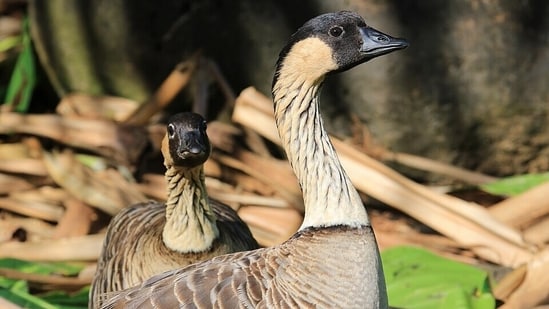
Before Polynesians settled Hawaii more than a thousand years ago, three goose species flourished there: the nēnē, the nēnē nui, and the giant nēnē. All three descended from Canada goose ancestors that arrived in Hawaii about 500,000 years ago. The giant nēnē is little known, with fossils found in 1926 under a lava flow from prehistoric times in Hawaii. It was about twice as big as today’s nēnē.
Fossil records show the nēnē nui went extinct shortly after humans arrived on the islands. Humans hunted them for food and brought in rats and dogs, which preyed on the birds and their eggs. The nēnē was faster and more agile, and escaped that fate. By the early 1800s, it was still thriving on nearly every one of the Hawaiian Islands, and Hawaii Island alone was believed to have 25,000.
Deep Dive
Why did the nēnē population fall to fewer than 30 wild birds by 1950?
How did captive breeding help restore Hawaii’s nēnē population?
Why did nēnē reintroduction succeed on Kauai?
How the nēnē fell behind
Then another round of threats came. Europeans arrived in the late 1700s. Nēnē were hunted to feed whaling ships and new settlers. During the plantation era in the 1800s and 1900s, huge areas of habitat were destroyed, and more predators, including the mongoose, were introduced. It was believed that fewer than 30 nēnē remained in the wild by 1950, all on Hawaii Island. The U.S. Fish and Wildlife Service press release says that a further 13 birds survived in captivity by the mid-20th century.
Breeding a comeback
{{/usCountry}}Then another round of threats came. Europeans arrived in the late 1700s. Nēnē were hunted to feed whaling ships and new settlers. During the plantation era in the 1800s and 1900s, huge areas of habitat were destroyed, and more predators, including the mongoose, were introduced. It was believed that fewer than 30 nēnē remained in the wild by 1950, all on Hawaii Island. The U.S. Fish and Wildlife Service press release says that a further 13 birds survived in captivity by the mid-20th century.
Breeding a comeback
{{/usCountry}}People stepped in. In 1967, the nēnē was listed as endangered on the first-ever federal list of protected species, which gave it federal protection, the press release notes. The feature story says captive breeding programs are based on private collections in Europe, Hawaii, and the mainland U.S. Between 1960 and 1997, over 2,000 nēnē were released on Hawaii Island and Maui. Results were mixed, with many of the newly released birds and their offspring being killed by introduced predators, especially mongooses. Across all the main Hawaiian Islands, nearly 3,000 captive-bred nēnē were released at more than 20 sites in the decades after the 1967 listing.
Kauai changed the game
Scientists at first held off on reintroducing nēnē to Kauai because there was no known history of the birds nesting there. Then research at Makauwahi Cave Reserve on the island’s south shore turned up nēnē bones buried deep, providing planners with the evidence they needed. Twelve captive-reared birds were released at Kīlauea Point National Wildlife Refuge in 1991, and reintroduction efforts continued through 2000. With no established mongoose population, the birds thrived, and by 2012, Kauai was home to an estimated 60% of the state’s nēnē.
The nēnē population was estimated to be 3,252 in 2019, and the species was downlisted from endangered to threatened under the Endangered Species Act, the feature story said. The press release credits 60 years of collaboration between federal, state, nonprofit, and local partners, along with captive breeding, habitat restoration, and active management. Some protections were removed with the downlisting, but conservation work continues, and Kīlauea Point National Wildlife Refuge is leading several efforts. A 2022 survey estimated there were 3,862 nēnē statewide, including 2,430 on Kauai.