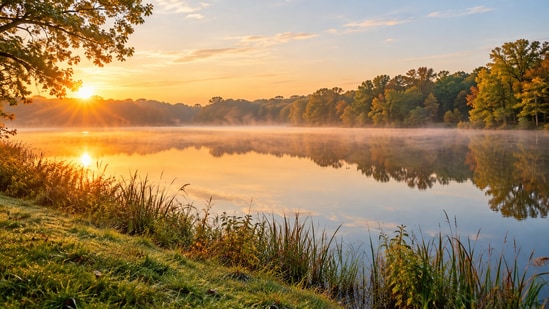
In 1986, Esther Detering left her family’s 54-acre lakeshore property near Kendallville, Indiana, to a land trust. The old farm became a nature preserve. According to the Winter 2021 issue of the ACRES Land Trust quarterly magazine, the Detering Nature Preserve is on the south shore of Round Lake. It lies in the middle of a busy commercial district in Noble County, like a green pocket in a busy place.
A family farm with a long history
Esther was the granddaughter of August Detering, who purchased the property in 1869. Through the years, it supported the family home and a large farming business. ACRES says Esther called the land “a sacred place.” In 1986, she willed it to ACRES, where it now lies in the trust’s “forever care.”
The farm changed over time. When the house was empty, the old lane became the route for local fishermen and for people who spend time on the lake. Since then, the magazine says, the land has returned to the more sustainable ecology of a natural lake shore and woods. It is a small example of farmland becoming habitat.
August Detering had come to Indiana from northwestern Germany. In 1857, he began to press and collect plant specimens in the neighborhood of the village of Haldem. The collection increased to a herbarium of 167 pages. ACRES helped bring that book back to Detering’s homeland about 160 years later.
August made his living farming land in Noble County. He raised produce and plants, selling them in Kendallville. An atlas of the county in 1874 noted sweet potato and cabbage plants as his specialty. It was not an easy life for him. Louise died in December 1877, leaving August with eight children, the youngest about 1 year and the oldest about 13 years. One of those children, Henry, was Esther’s father.
Why land trusts matter
{{/usCountry}}August made his living farming land in Noble County. He raised produce and plants, selling them in Kendallville. An atlas of the county in 1874 noted sweet potato and cabbage plants as his specialty. It was not an easy life for him. Louise died in December 1877, leaving August with eight children, the youngest about 1 year and the oldest about 13 years. One of those children, Henry, was Esther’s father.
Why land trusts matter
{{/usCountry}}ACRES is a nonprofit organization that protects the land. It is member-supported and works to protect the natural and working lands of northeast Indiana, southern Michigan, and northwest Ohio. Chris Fairfield writes in the magazine article that ACRES works on the idea of “restorative reciprocity,” a term used by author Robin Wall Kimmerer. It cites her book Braiding Sweetgrass, which says the land is not broken, but our relationship to it is. ACRES is trying to restore that relationship, one preserve at a time. This matters more as Indiana’s population grows.
ACRES protects much land that is closed to the public, either to protect sensitive habitat or at the request of a donor. Detering is now one of those closed preserves. ACRES said it takes donor intent seriously, and reviewed its acquisition records and its correspondence with Esther to make sure retiring the trail didn’t go against what she wanted.
What time in nature does for our health
The science backs up what many of us feel when we are out and about in nature. A 2018 paper in Environmental Research looked at 143 studies. Authors Caoimhe Twohig-Bennett and Andy Jones found that greater exposure to green space was associated with lower levels of stress hormones, a lower heart rate, and lower diastolic blood pressure. It was also linked with a lower risk of developing type 2 diabetes. The authors noted that some results were limited by uneven study quality.
What this means for you
Most of us probably end up spending way too much time indoors in front of one screen or the other. The two hours a week that are advised to spend in nature can be a short walk to the park near your home or even a small picnic or coffee with friends in nature. Detering shows how, amidst a bustling, busy town, a small, quiet piece of nature can exist. The public trail at Detering was permanently retired on December 31, 2021, and the preserve is now closed to the public.