A 2025 study published in Water Environment Research found that per- and polyfluoroalkyl substance levels in the Rio Grande flowing through Albuquerque, New Mexico, increased tenfold. The average concentration rose from 4 to 46 nanograms per liter (ng/L), an approximately 11.5-fold increase.
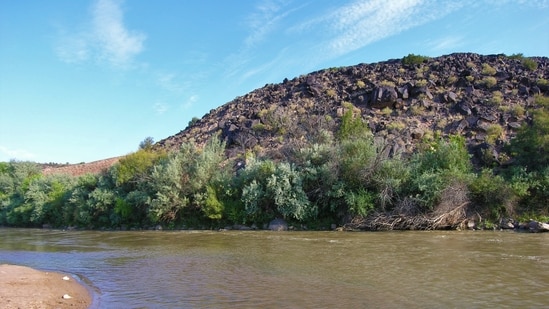
Kimberly R. Beisner, a U.S. Geological Survey researcher, analyzed 28 PFAS in eight major rivers. Samples were collected between 2020 and 2024. The study detected 13 PFAS compounds at concentrations ranging from below laboratory detection limits to about 156 ng/L. The survey involved sampling in the Rio Grande, Pecos, San Juan, Animas, Canadian, Gila, Rio Chama, and Rio Puerco rivers. Perfluorobutanesulfonic acid (PFBS) was the most common compound in terms of frequency and concentration, ranging from 1 to 93 ng/L. The second and third most common compounds in concentration were perfluorobutanoic acid and perfluoropentanoic acid, with levels ranging from 0.9 to 32 ng/L. Moreover, the researchers recorded a 58% increase in PFAS concentrations following a stormflow pulse in the Rio Grande through Albuquerque. The findings indicated that precipitation influenced variations in the river's chemical composition. Wastewater contributions also varied by time of day and season.
The 2025 paper built on a USGS Scientific Investigation Reportthat analyzed New Mexico's water sources between August 2020 and October 2021. It examined wells, springs, diversions, and river sites. PFAS in surface waters had concentrations ranging from 1.0 to 155.4 ng/L. At the Valle de Oro sampling site downstream of Albuquerque, concentrations ranged from 8.7 to 155.4 ng/L, while sites upstream of Buckman recorded levels ranging from 1 to 4.7 ng/L. The report identified PFAS in almost all of the river sites sampled, though they had different compounds and concentrations. Valle de Oro and El Paso had detections in all sampling periods. PFBS and perfluoropentanoic acid were the two compounds commonly found in surface waters.
What the river samples tell about the inputs coming from cities
{{/usCountry}}The 2025 paper built on a USGS Scientific Investigation Reportthat analyzed New Mexico's water sources between August 2020 and October 2021. It examined wells, springs, diversions, and river sites. PFAS in surface waters had concentrations ranging from 1.0 to 155.4 ng/L. At the Valle de Oro sampling site downstream of Albuquerque, concentrations ranged from 8.7 to 155.4 ng/L, while sites upstream of Buckman recorded levels ranging from 1 to 4.7 ng/L. The report identified PFAS in almost all of the river sites sampled, though they had different compounds and concentrations. Valle de Oro and El Paso had detections in all sampling periods. PFBS and perfluoropentanoic acid were the two compounds commonly found in surface waters.
What the river samples tell about the inputs coming from cities
{{/usCountry}}An earlier 2024 study, published in the journal Emerging Contaminants, also examined PFAS contamination in the Rio Grande near Albuquerque. The study made use of high-frequency sampling and the application of water chemistry tracers to identify possible sources. The researchers gathered samples at two points on the river and also in the effluent from the wastewater treatment plant that lies between them. They detected an order of magnitude increase in PFAS in the urban zone and also noticed that heavy rain periods were capable of carrying the chemicals in the urban runoff to the river. The study distinguished between various compounds and their inputs. Perfluorooctanoic acid, perfluorooctane sulfonate, and perfluorobutanoic acid were found in the urban runoff, while perfluorohexanoic acid and perfluoropentanoic acid were found in the wastewater effluent.
They used passive samplers to monitor PFAS over longer time spans. Some PFAS were present in higher amounts, some in lower amounts, and one short-chain PFAS was absent in the study. They concluded that the technique is promising; however, the sampler material might not capture certain short-chain PFAS effectively.
Importance of ongoing monitoring
As a whole, the studies presented a picture of the river system where the levels of PFAS depend on the location, time, amount of precipitation, and source of contamination. Their findings showed that levels varied across rivers and sampling periods, with urban runoff and wastewater among the potential contributors.
Moreover, the study conducted by USGS identified the presence of PFAS in the groundwater. Out of the 117 wells sampled, 27 showed concentrations above the detectable level, with total PFAS present in the range of 0.91 to 80.3 ng/L. Although the maximum total PFAS concentration was 80.3 ng/L, none of the sampled locations exceeded the EPA's 2016 health advisory level of 70 ng/L for the individual compounds PFOA and PFOS. The total PFAS figure and the advisory level are not directly comparable because the latter applies to those two compounds specifically. The researchers recommended further sampling at sites affected by wastewater and at those that showed higher-than-expected concentrations. Sampling across different seasons and locations could help researchers identify the sources and conditions associated with elevated PFAS levels.