Most generations have a magic fix they believe in. For us today, it might be planting millions of trees. For the agencies in the U.S. back in the 1930s, it was a tough little shrub called bicolor lespedeza. According to the USDA Forest Service’s Fire Effects Information System, it was promoted and widely planted for erosion control and wildlife conservation. The idea seemed simple and sensible. But now, decades later, the story looks far more complicated.
A small shrub, grown on a large scale
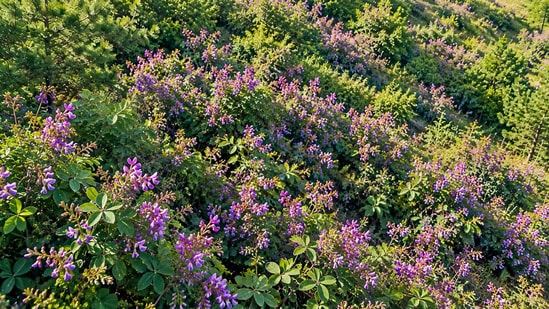
The numbers show how large the effort became. In the mid to late 1930s, three to four million shrubs were planted to stabilize gullies. In 1939, Civilian Conservation Corps camps were growing more than 1.2 million seedlings. By 1950, there were more than 50 million seedlings. In the Southeast, from the late 1930s to the 1950s, wildlife managers and the USDA Soil Conservation Service also produced and distributed millions of seeds and seedlings each year. One state example: Virginia planted nearly 7 million plants and 17,000 pounds of seed between 1948 and 1953 for the benefit of the northern bobwhite, a popular game bird.
The plant was also well suited to the task. The review states that strains were chosen based on traits such as high seed productivity, winter tolerance, and fast seed maturation. It cites a forestry handbook saying that the plant can produce as many as 300 million seeds per acre, which is an upper figure. Such traits are typical of plants meant to spread across an area and serve as food for animals. They may also help a plant spread on its own.
Deep Dive
Why did U.S. agencies plant bicolor lespedeza in the 1930s?
How can plants introduced for erosion control spread beyond planting sites?
What should be considered before planting non-native species for restoration?
How far it has spread
According to the same review, bicolor lespedeza grows on an estimated 115,550 acres of forest in the south, based on a 2008 estimate. The distribution range spans from Louisiana and Arkansas east to Virginia and Florida, which includes Georgia. That works out to about 180 square miles. Nearly 50,000 of those acres are in Georgia and Arkansas. The plant is said to have outcompeted native plants on wild lands in Georgia. In Virginia, Kentucky, and Tennessee, it is not considered a serious threat and usually requires a disturbance to become established.
What science says about the damage
{{/usCountry}}According to the same review, bicolor lespedeza grows on an estimated 115,550 acres of forest in the south, based on a 2008 estimate. The distribution range spans from Louisiana and Arkansas east to Virginia and Florida, which includes Georgia. That works out to about 180 square miles. Nearly 50,000 of those acres are in Georgia and Arkansas. The plant is said to have outcompeted native plants on wild lands in Georgia. In Virginia, Kentucky, and Tennessee, it is not considered a serious threat and usually requires a disturbance to become established.
What science says about the damage
{{/usCountry}}The review acknowledges that most of the claims about the harm of the shrub are anecdotal and there are no in-depth studies of dense stands. But it points out that several sources suggest that native vegetation, forest regeneration, and wildlife habitat may be at risk in heavily invaded areas.
For the bigger picture, there is a Forest Service guide, ‘A Field Guide for the Identification of Invasive Plants in Southern Forests.’ James H. Miller, Erwin B. Chambliss, and Nancy J. Loewenstein describe 56 non-native plants and plant groups that are invading forests throughout 13 southern states. They say these infestations are increasingly draining forest productivity, interfering with forest use and management, and degrading diversity and wildlife habitat. The guide’s entry on the shrubby lespedezas notes that they were planted widely in forest openings for wildlife food plots and soil stabilization before they spread into adjoining stands.
What this means for us
This shrub was not planted with harmful intent. Agencies were acting on the best advice of the day to protect soil and help wildlife. The lesson is not that they were careless. It’s that when you spread one plant over a huge area, it can have effects that take decades to manifest. This is important today, because tree drives and restoration projects are all the rage. Decades from now, today’s restoration plans will be judged in the same way. A useful question is how the project will look in 10 years, not just in the moment.