
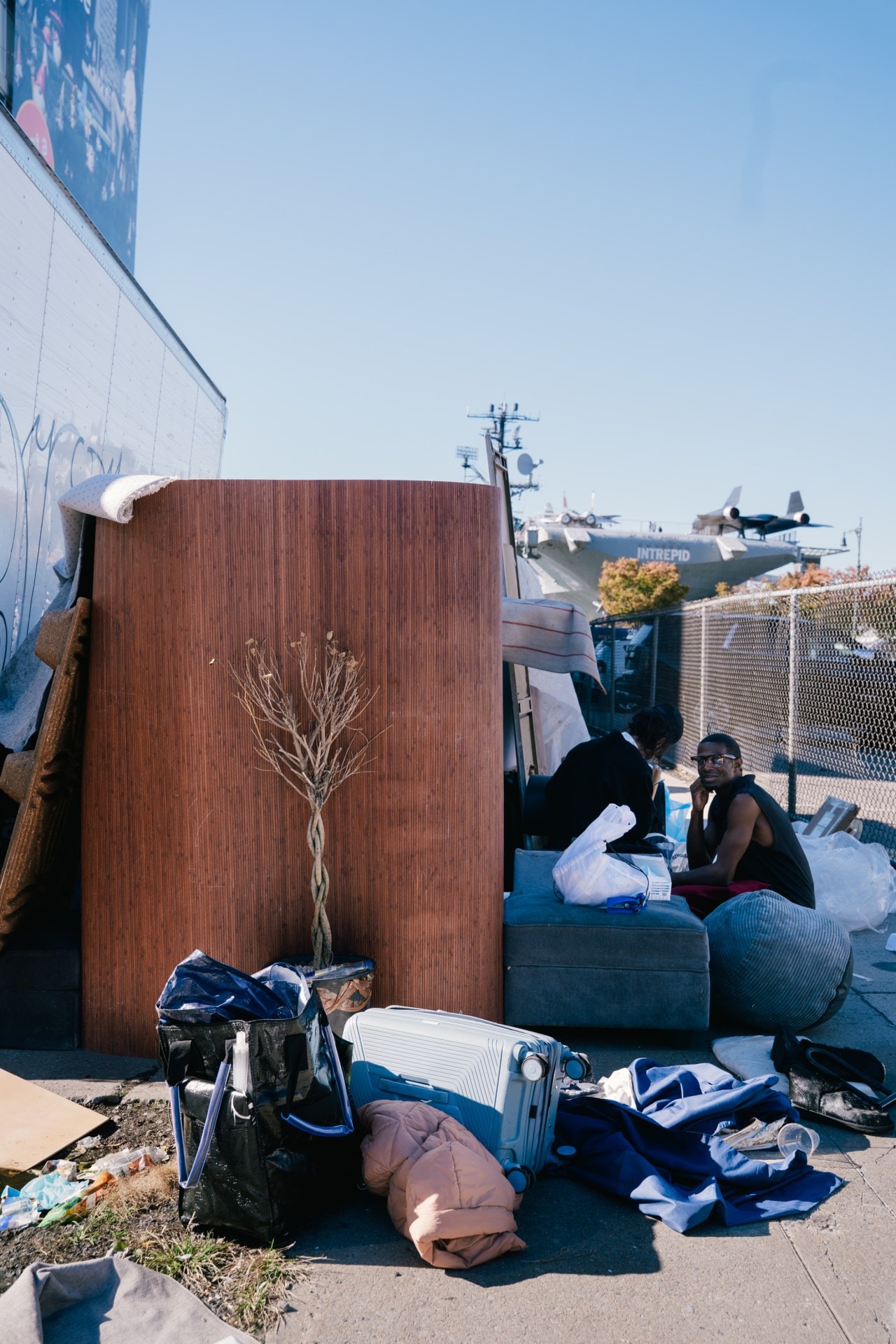
The Intrepid Museum, housed in a decommissioned aircraft carrier moored along Manhattan’s West Side, has been a popular destination for local families. This summer, as homeless encampments and drug use proliferated along streets nearby, some parents crossed the museum off their activity list.
Leslie Woodruff, founder of a Hell’s Kitchen parent-message board, said the city has been removing encampments—made out of tarps, plywood and discarded furniture—only for them to return in full sight of tourists walking in the neighborhood near
The Intrepid Museum, housed in a decommissioned aircraft carrier moored along Manhattan’s West Side, has been a popular destination for local families. This summer, as homeless encampments and drug use proliferated along streets nearby, some parents crossed the museum off their activity list.
Leslie Woodruff, founder of a Hell’s Kitchen parent-message board, said the city has been removing encampments—made out of tarps, plywood and discarded furniture—only for them to return in full sight of tourists walking in the neighborhood near Times Square. “It boggles my mind that so many people come here to visit and that’s their greeting,” she said.
New York, like other big cities, has been dealing with a sharp rise in homelessness in recent years that has bedeviled a series of mayors. Now the issue is in Mayor Zohran Mamdani’s hands, and community and business leaders say his early efforts haven’t done enough to address the problem.
The primary frustration has been the failure to clear encampments—clusters of makeshift structures that can span the length of half a city block. The communities can give rise to unsafe or unsanitary conditions, but removing people against their will raises legal and humanitarian concerns.
When Mamdani took office in January, he paused homeless sweeps, a longstanding practice that intensified under his predecessor, Eric Adams. Mamdani resumed the sweeps after a series of outdoor deaths during a cold snap, but his administration implemented a policy delaying removing the structures for at least seven days. The extra time gives outreach workers an opportunity to persuade people to accept services and offer them a chance to secure their belongings.
Residents and businesses say the approach allows individuals to, in effect, evade removal by telegraphing that if they relocate across the street on the sixth day then the seven-day clock will restart.
“I’m going to be blunt: This policy is insane. It does not help the very people it’s saying it’s helping,” said Delores Rubin, a Hell’s Kitchen resident and president of a group that acts as a community liaison to the local New York Police Department precinct.
City officials said the seven-day policy was the result of a stipulation reached after the city was sued over its handling of encampments.
Separately, the Mamdani administration has implemented a new system to better track encampments and coordinate responses. It also is expanding programs that give priority to unsheltered individuals for immediate placement into housing.
Mamdani campaigned on making the city more affordable and since has introduced a plan to build 200,000 new housing units over the next decade, which might help ameliorate the homelessness problem longer term. But community leaders have grown impatient with the Democratic socialist mayor for not providing a comprehensive strategy to combat homelessness now.
City officials say Mamdani expects to unveil a dedicated plan by the end of the year.
“Through meaningful street outreach, stabilization options and supportive housing, the Mamdani administration will help New Yorkers rebuild their lives with the dignity, care and stability they deserve,” a mayoral spokesperson said.
There were nearly 5,000 unsheltered people living on city streets in March 2026, according to a city-conducted survey, an 11% increase from the previous year’s count. However, homeless advocates have cautioned that the counts can be affected by a number of factors, including weather.
Encampment sweeps don’t do anything to solve the problem of street homelessness, advocates say, especially for people who are reluctant to accept services after bad experiences in the shelter system. “Unless you’re offering people something that’s meaningful to them, all you’re doing is chasing them around the city and making it harder to provide them with what they need in order to get stability,” said Dave Giffen, executive director of Coalition for the Homeless.
The simplest solution is to build more affordable housing, Giffen said. The Mamdani housing plan focuses on building homes for working-class New Yorkers, he said, but it doesn’t do enough for the lowest-income bracket.
Business owners say the city’s homelessness challenges are stifling commercial activity, not only in Manhattan but increasingly in other boroughs.
Michael Breslaw, the owner of a plumbing company and landlord of a residential and commercial building about a block from the Intrepid Museum, said in the last 10 months the encampments have gotten worse near him, making the area unsafe.
He worries that a family living in his building, who have complained about the encampments that they can see from their apartment, won’t renew their lease. He added that a deli that leases storefront space from him recently received a summons from the city for garbage left on the sidewalk by people who live in a nearby encampment and congregate outside the business.
“Meanwhile, directly across the street where the actual encampment is, it’s a complete disaster—but they don’t get any tickets at all,” Breslaw said. “There’s no consistency, no accountability.”
Underneath the Franklin D. Roosevelt East River Drive, an elevated highway along Manhattan’s East Side, encampments have filled public areas with debris, including propane tanks used for cooking. Some have stayed up for months because the city delayed removals based on weather or other factors, said Council Member Virginia Maloney, a Democrat who represents the area.
Residents in her district complained over the summer about one large encampment where there was an indecent-exposure incident and an assault on a residential security guard, she said. It took Maloney working with multiple agencies to have it removed and not repopulated. Several other colleagues in the council have dealt with similar issues, she said.
“Ten council members making 10 separate calls about versions of the exact same problem is evidence that this system needs to have a better structure,” she said.
Write to James Fanelli at james.fanelli@wsj.com
One Subscription.
Get 360° coverage—from daily headlines
to 100 year archives.
Archives
HT App & Website