Loose bricks were glued to pavements, thousands of police were deployed and the bustling financial hub of Hong Kong was under lockdown as a top Chinese leader from the mainland began his tour of the city that saw pro-democracy protests in 2014.
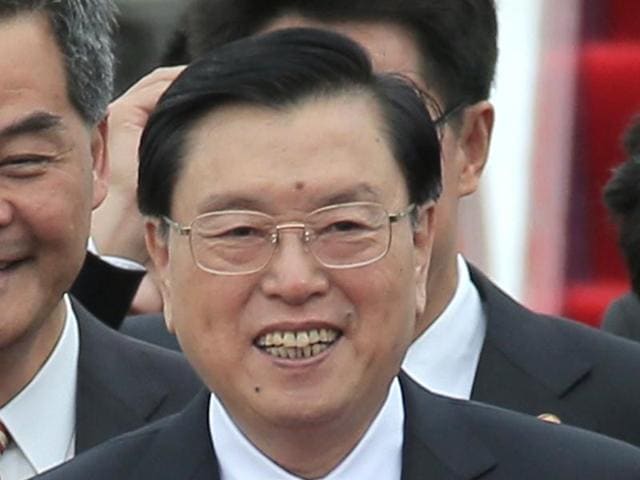
China’s top legislator Zhang Dejiang is officially in Hong Kong to attend a seminar on China’s Belt and Road initiative. But, as official news agency Xinhua pointed out , he will “also inspect” the Hong Kong Special Administrative Region (HKSAR) during his visit between May 17 and 19.
Zhang is a member of the elite Standing Committee of the Political Bureau of the Communist Party of China’s (CPC) Central Committee and chairperson of the National People’s Congress, the country’s legislature.
Reports said the HKSAR government was not leaving any room for pro-democracy protests during Zhang’s crucial visit, the first by a senior Chinese leader since 2012.
Former President Hu Jintao visited Hong Kong in 2012 to attend celebrations to mark the 15th anniversary of HKSAR’s return to the mainland from the British.
Anticipating demonstrations during the visit, police had put up barriers in many parts of the city. Loose bricks were glued to the pavements to stop protesters from using them as projectiles.
{{/usCountry}}Anticipating demonstrations during the visit, police had put up barriers in many parts of the city. Loose bricks were glued to the pavements to stop protesters from using them as projectiles.
{{/usCountry}}Hong Kong was rocked by pro-democracy protests in October, 2014, when activists, mostly led by students, demanded more say for the city’s public in electing its government.
Hong Kong is part of China’s “One country, Two systems” policy under which its citizens enjoy considerably more freedom than their brethren on the mainland.
For example, the press is relatively free in Hong Kong and citizens are allowed to gather for protests.
But the “umbrella protests” of 2014 demanded more from Beijing, fearing that it was gradually taking over the reins of the city to erode citizens’ special rights.
Thousand s took to the streets during the protests, occupying major junctions and parts of the city for days, bringing it to a halt. The protests, however, fizzled out after a few weeks and many of its young leaders were punished.
“The trip can re-emphasize the central government’s consistent policy on Hong Kong and can help boost Hong Kong’s confidence in the ‘one country, two systems’ policy,” Tian Feilong, an assistant professor at Beijing’s Beihang University, told the Global Times newspaper.
“Being part of China, Hong Kong will not be allowed to decay, as China’s economic policies will benefit Hong Kong, which holds many advantages over the mainland and could be brought into play in the Belt and Road Initiative,” Zhang Dinghuai, a professor at the Contemporary Chinese Politics Research Institute of Shenzhen University, told the newspaper.