Since Mahatma Gandhi had some views that would be considered unacceptable today, should his formidable accomplishments be ignored and his statues brought down? Should Winston Churchill also suffer the same fate?
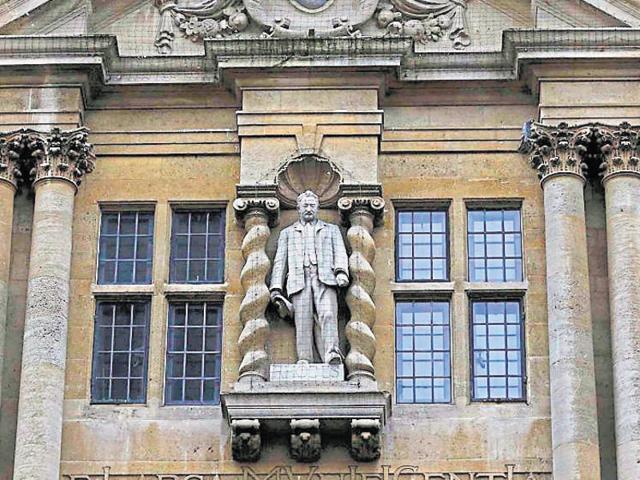
Questions about uses of history and political correctness are being passionately debated in the row over whether the statue of colonialist Cecil Rhodes (1853-1902) - who had views now considered racist - be brought down from its high position in Oriel College in Oxford.
Current Indian and other Rhodes Scholars have grouped together under a campaign called ‘Rhodes Must Fall’ that has divided the academic community. Oxford’s chancellor and vice-chancellor want the statue to stay, while Oriel College is launching a six-month ‘listening exercise’ on the issue from 1 February.
During a heated debate this week, Nigel Biggar, professor of moral and pastoral theology, cited Gandhi’s controversial views about black Africans to ask whether his many accomplishments should be ignored and his statues brought down.
Oriel College, he said, should not cave into pressure and bring down Rhodes’ statue since doing so would mean hundreds of statues of other historical figures would also have to go.
{{/usCountry}}Oriel College, he said, should not cave into pressure and bring down Rhodes’ statue since doing so would mean hundreds of statues of other historical figures would also have to go.
{{/usCountry}}Biggar said: “First, if we insist on our heroes being pure, then we aren’t going to have any. Last year the shine on Mahatma Gandhi’s halo came off, when we learned of his view that Indians were culturally superior to black Africans. Should this blot out all his remarkable achievements? I think not”.
He added: “If Rhodes must fall, so must Churchill, whose views on empire and race were similar. And so probably must Abraham Lincoln”.
Rhodes was a prosperous and controversial colonial era British businessman in South Africa, who left behind a large sum of money to Oriel College for the scholarship. There have been over 8,000 Rhodes Scholars from India and elsewhere, including leading figures.
Arushi Garg, an Indian Rhodes Scholar, is one of the founders of the ‘Rhodes Must Fall’ student movement at Oxford. It was started in South Africa, where the movement led to the taking down of Rhodes’ statue in the University of Cape Town.
Oriel College, where Rhodes studied, said it was acting on the student’s petition on removing the statue as it was keen to improve the experience of non-white students.
Recalling his historical legacy in the form of the scholarship programme, the college said: “But Rhodes was also a 19th-century colonialist whose values and world view stand in absolute contrast to the ethos of the Scholarship programme today, and to the values of a modern University”.