E-Paper



Hindu Mahasabha sets up Godse temple in MP’s Gwalior, sparks political controversy
Congress said it would move the court to press sedition charges against those who erected the temple.

 Prefer HTon Google


Sixty nine years after Father of the Nation Mahatma Gandhi was assassinated, a “shrine” dedicated to his killer Nathuram Godse was set up in Guwalior by the Hindu Mahasabha on Wednesday, kicking off a controversy.
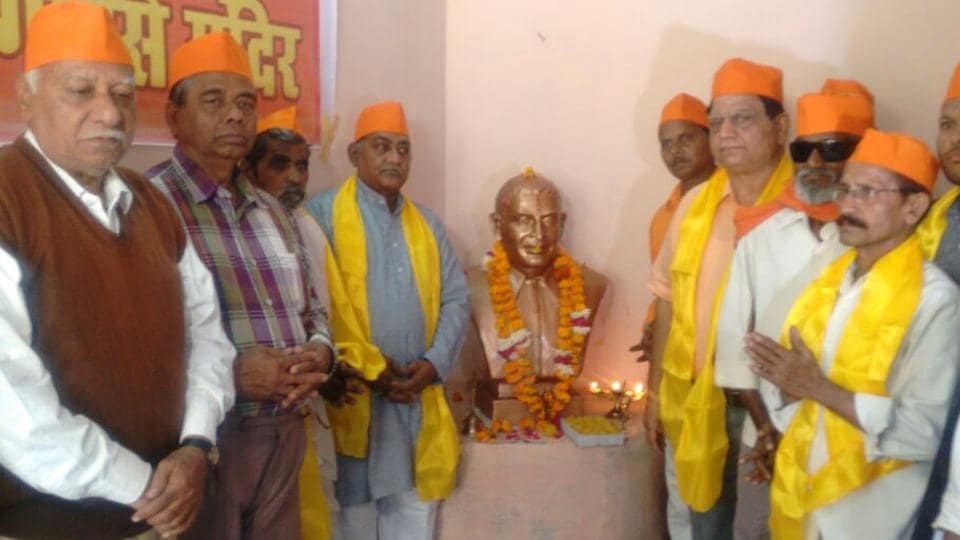
The right wing organisation installed a bust of Godse inside its office premises amid Vedic chants to mark the anniversary of the latter’s execution.
Leaders of the Mahasabha said every Tuesday they will perform “akhand bharat aarti in the temple” to apprise the younger generation about Godse’s life and vision.
Taking strong exception to the development, opposition Congress has threatened to move the court to remove the shrine.
“We are discussing future course of action with our lawyers. We are planning to file a petition in the court to press a sedition case against those involved in setting up the Godse temple ,” said state Congress chief spokesperson KK Mishra.
“How can the BJP-led state government allow a temple dedicated to killer of Mahatma Gandhi? This shows the party’s mindset,” he added.
Another senior state Congress leader said under no circumstances the party would allow the temple to function.
“We will soon meet and decide how to dismantle such a shrine. We can’t allow a shrine where killer of Mahatma Gandhi is worshipped,” senior Congress leader Manak Agarwal said.
The ruling BJP, however, tried to stay clear of the controversy, passing the buck to local administration.
“ The local administration, which is authorised to take an appropriate action as per the rule, will take a call on whether such a shrine can exist,” said state BJP chief spokesperson Deepak Vijayvargiya.
When contacted Gwalior mayor Vivek Shejwalkar said he was not aware whether permission was taken from the municipal body to set up the shrine. “If anybody wants to set up a shrine or a temple within their property, I don’t think they need any permission for it”, he added.
Sub-divisional magistrate of Lashkar area of Gwalior, where the Mahasabha’s office is located, Vijay Raj too maintained the similar stand . “If they are setting up a temple, they have to deal with the local civic body. And if they set up a shrine within their personal property, I don’t think they need any permission,” he said.
This is not the first time Mahasabha sought to glorify Gandhi’s killer. The Hindu outfit installed a similar bust at its office in Meerut in the past.
A Gwalior-based leader of the Mahasabha Jaiveer Bhardwaj told HT over phone that they were forced to set up the shrine inside their office building as the district administration did not give permission and land for the temple.
“We had applied for permission on November 9, but district authorities denied it. So we finally decided to set up the temple inside our building in the Daulatganj area of the city”, he said.
Bhardwaj said the “temple” would created awareness among the younger generation about the historical events surrounding the life of Godse, which, he claimed, is often distorted, and the role of Mahatma Gandhi in partition.
He said Godse had spent time in Gwalior and it was from here he went to Delhi to kill Mahatma Gandhi.
Godse fired three bullets to kill Gandhi on January 30, 1948 at a prayer meeting in New Delhi, a crime for which he was hanged in Ambala jail on November 15, 1949 along with his accomplice Narayan Apte.