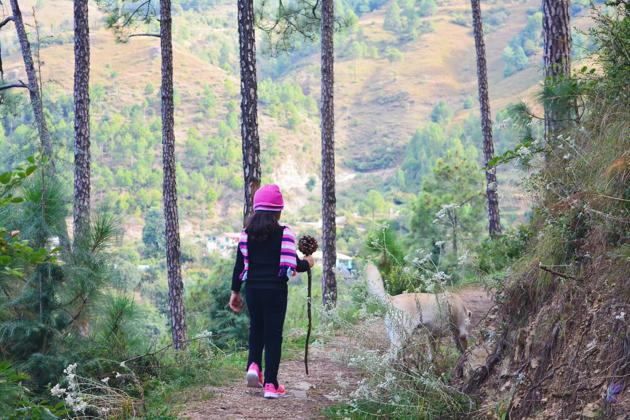
It’s a four kilometre walk through a thick Deodhar forest from my cottage to Mashobra, an almost continuous bazaar on a ridge. The slopes fall off on either side: One towards Shimla, about 20 kilometres away; the other into a wide sunlit valley, dominated by the Shali peak. Green-roofed cottages scramble down into the valley, from whose depths snatches of music float up. The road snakes onwards towards Naldhera, a spot that so charmed Lord Curzon that he named his daughter after it.
The bazaar’s lassitude is broken only by the sweet shops. The smell of hot samosas wafts out of these shops, and one of them establishes its superiority by its fresh jalebis. A tailor sits reading a newspaper, an idle sewing machine in front of him and above, a rusting board — Prince Tailors, experts in Ladies and Gents suits. Across the street, a cobbler gossips as he hammers out a rough Baluchi sandal on a heavy anvil. Everyone pretends indifference to the monkeys trapezing on the overhead wires. Two or three competing chemists and a few shops that sell everything make up the rest of the bazaar; not one shop hands out a plastic bag.
Hesitatingly, I enter the very ’70s building that houses the sub-post office, fearing that digital communications may have dented the world’s most widely distributed postal network with 1,55,000 post offices. But the smell of glue that greets me is reassuring. “We have a glue stick too,” says the fresh-faced, polite sub-postmaster “but there is something else about this glue.”
He is winding up a home-packed lunch. The bulk of the work now is the delivery of packages from e-commerce platforms to far-flung customers. The packages come from the railhead of Shimla and are farmed out to eight branch offices. Postmen walking on mountain trails then get the book or electrical gadget to the retiree’s cottage, or bed and breakfast establishments, or village households. To places without a street address, or even a street. E-post, e-money order, data registration services and postal insurance are other innovations that keep the post office alive. The old reliable postal banking — with a higher interest rate and a greater trust factor— keep the deposits coming.
{{/usCountry}}He is winding up a home-packed lunch. The bulk of the work now is the delivery of packages from e-commerce platforms to far-flung customers. The packages come from the railhead of Shimla and are farmed out to eight branch offices. Postmen walking on mountain trails then get the book or electrical gadget to the retiree’s cottage, or bed and breakfast establishments, or village households. To places without a street address, or even a street. E-post, e-money order, data registration services and postal insurance are other innovations that keep the post office alive. The old reliable postal banking — with a higher interest rate and a greater trust factor— keep the deposits coming.
{{/usCountry}}Some archival digging on the sub-post office brings up its old “order book”, with painstaking inspection reports from the seventies. All that is observed, no matter how trivial, is recorded: There’s only one 100-watt bulb, two more are required; the store could actually house the “class IV” employee. Staff matters find high priority: One postman covers 127 villages twice a week; broken window panes bring in snow-drifts; strong winds blow back the smoke from the fire stove and cause headaches (the inspector’s solution is that charcoal should be used.)
Amid this trivia, there is history. During the negotiation of the 1972 Simla Agreement, Mrs Indira Gandhi stayed in the Presidential Retreat above Mashobra. The inspector’s report of July 1972 records that, during the Summit, an additional official was posted here and notes with satisfaction that “all went on smoothly.” Things, however, did not go as smoothly during the PM’s stay a couple of years later. The Private Secretary to the PM complained that the handwriting of the sub-postmaster on the telegrams being sent up to the Retreat was “very illegible.” The inspector, noting that the offending official was in the habit of working in a casual fashion, advised him to be more careful. As my grade 8 teacher used to say: Letter formation is everything.
Navtej Sarna is the author of several works of fiction and non-fiction and formerly Ambassador of India to the United States
The views expressed are personal