
 E-Paper



Deepening India-UAE defence cooperation enlarges India's footprint in West Asia
The UAE, which has deported more than 100 fugitives to India over the last few years, has also helped India with real-time intelligence from Iraq and Syria in the past. This month, its air force will refuel the Rafale fighter jets flying in from France.

 Prefer HTon Google


Ahead of the 2020 Republic Day parade being held amid the protests against the Citizenship Amendment Act in Delhi, security officials were concerned about the possible use of drones to breach Prime Minister Narendra Modi’s security. They did have the Defence Research and Development Organization (DRDO)’s anti-drone system installed for the parade but they felt there was a gap. They needed a mobile system that could be part of the prime minister’s cavalcade to prevent an untoward incident. One country that promptly came forward to offer the mobile anti-drone system for PM Modi’s security was the United Arab Emirates (UAE).
A little over a year later as New Delhi prepares to fly at least four Rafale fighters from France to Ambala airbase, the UAE will again help out. Its air force will deploy its Airbus 330 multi-role transport tankers (MRTT) later this month to provide mid-air refuelling to the Rafale jets so that the fourth-generation-plus fighters can fly non-stop to India. The UAE will extend the facility to the next batch of eight fighters that are expected to be flagged off from France by the visiting Indian Air Chief RKS Bhadauria in April. This would enable the Indian Air Force to activate the second base of the Rafale fighters
This means that the second base of Rafale fighters, the strategically-located air force base in north Bengal’s Hasimara, will be activated by April. The deployment at this base, located close to the tri-junction of Sikkim, Bhutan and Tibet, will strengthen India’s air capability in India’s eastern sector manifold.
The decision to request UAE rather than the French air force to deploy its mid-air refuellers was taken after the Indian Air Force’s earlier experience which found that the use of the French refuellers ended up slowing down the speed of the fleet of fighter jets.
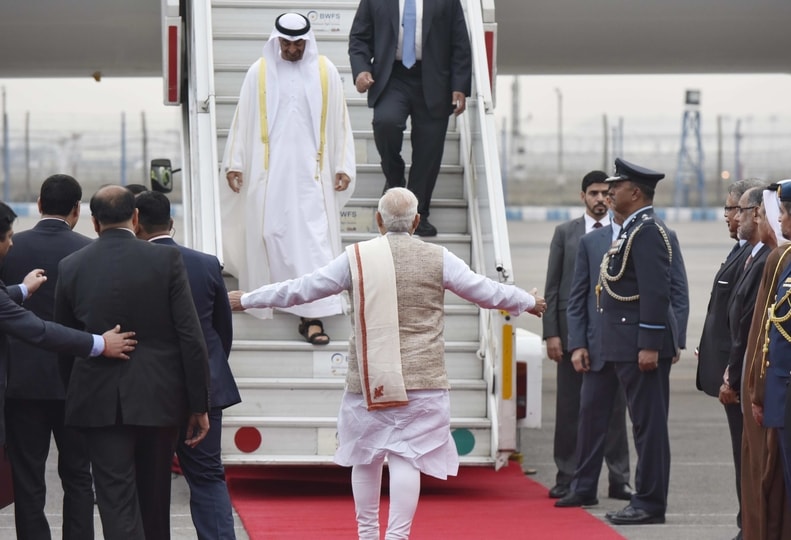
That New Delhi could turn to the UAE for help, and it agreed to extend the facility, is seen to reflect the close relationship that India and Abu Dhabi have built, particularly after PM Modi came to power in 2014. It is due to the personal connect between PM Modi and UAE de facto ruler Crown Prince Mohammed bin Zayed Al Nahyan that the Indian diaspora was looked after by the Gulf when the global pandemic was raging last year. And this is the reason why external affairs minister S Jaishankar has made it a point to keep in constant touch with the UAE and India’s other West Asia partners throughout the pandemic.
While the two countries have deepened their economic relationship over the past few years - Abu Dhabi has also invested through the sovereign fund route - it is the defence relationship that has clearly taken off.
The UAE Navy has confirmed to its Indian and French counterparts that it will, for the first time, join the Varuna naval exercises to be held around the Gulf of Oman as the third partner between April 25 and 27. The French Navy is bringing the Charles de Gaulle carrier strike force while India will bring its heavy-duty guided missile destroyers for the advanced naval exercise. Next on the agenda are air exercises between the three air forces with Mirage 2000 fighters being the common thread and IAF looking to get Airbus 330 MRTT on lease from France.
But the relationship goes beyond issues of national security too.
While India and UAE are constantly in touch with each other through institutionalised deradicalisation programmes and promote tolerance, Abu Dhabi has turned into a no-go area for anyone looking for a haven after fleeing Indian law enforcement agencies. Not only has UAE deported more than 100 Indian fugitives back, but it also helped India with real-time intelligence from Iraq and Syria during the rise of the so-called Islamic State. The UAE also helped India keep a watch on the Indian diaspora from getting sucked into the ultra-conservative Sunni movement and stopped them from joining the so-called Islamic State jihad in the Levant.
Today, Indian fugitives from the law and based in Pakistan like Dawood Ibrahim cannot play around or invest in Dubai or anywhere in the UAE, a sea change from the past when all the mafia watched sub-continental cricket and toasted with Bollywood stars in the 1990s. The India-UAE relations are now a game-changer for the future.


