
 E-Paper



Fake work orders worth ₹1,349 crore made for Nashik Kumbh projects
Eight fake work orders worth over ₹1,349 crore have allegedly been issued for various Kumbh Mela-related projects in Nashik over the past three months

 Prefer HTon Google


Eight fake work orders worth over ₹1,349 crore have allegedly been issued for various Kumbh Mela-related projects in Nashik over the past three-and-a-half months, prompting the administration to tighten scrutiny of project documents.
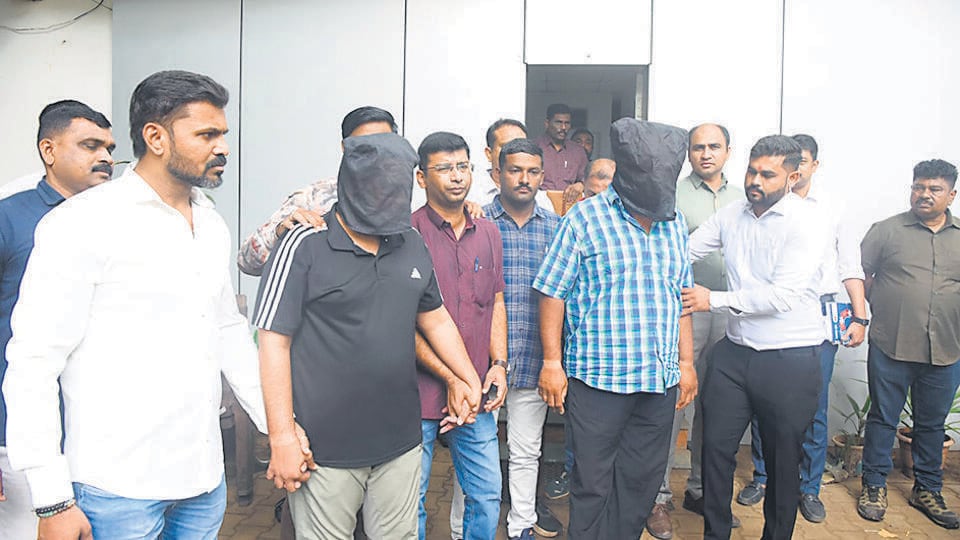
The first two cases, involving bogus work orders worth over ₹39 crore, were detected in April with Nashik Road police subsequently arresting a local resident, Abhishek Jhare, who had allegedly fabricated the documents. The remaining six fake work orders, collectively worth ₹1,311 crore, were detected by Kumbh Mela minister Girish Mahajan earlier this week. Mahajan alerted Nashik police commissioner Sandeep Karnik following which, a team of Nashik city police busted a three-member gang based in Jamner, Jalgaon, on Tuesday.
One of those arrested has been identified as Tanay Mahajan, while Narendra Mahajan has also been arrested. The third accused, Sakhil Sheikh, is allegedly absconding.
Also read: Two held for cheating man of ₹2.17 crore over kumbh mela tender
Eight bogus work orders detected in three months
According to officials of the Nashik-Trimbakeshwar Kumbh Mela Authority (NTKMA), all eight bogus work orders followed a similar pattern. The documents carried fake digital signatures purportedly belonging to Nashik divisional commissioner Praveen Gedam, who is also chairman of the NTKMA.
“Genuine work orders are digitally signed by the heads of departments in the respective government agencies entrusted with implementing the projects. The NTKMA chairman does not issue work orders for Kumbh projects,” an NTKMA official said.
Gedam was the first to detect the fraud in April when a contractor approached him to verify a work order worth ₹35 crore for a CCTV project. Jhare had allegedly approached the contractor, offering to implement the project in exchange for money.
Also read: Residents lose ₹63 lakh in three financial fraud cases
“At first glance, I realised that it was a fake work order as it carried my digitally forged signature,” Gedam said.
Following his instructions, the administration lodged a complaint, leading to Jhare’s arrest by Nashik Road police. During the investigation, the police found another fake work order worth over ₹2 crore in Jhare’s mobile phone allegedly for providing manpower to the Nashik city police to serve as traffic wardens during the Kumbh; and yet another for repairs worth ₹1.5 crore at a government hospital in Trimbakeshwar. A second complaint was subsequently filed at Bhadrakali police station.
Also read: Bengaluru man falls for ‘Kumbh Mela crisis’ scam, loses ₹1.4 lakh to fake BBMP engineer: Report
Fake orders covered food, housing and solar projects
As for the six fake work orders worth ₹1,311 crore fabricated by the three-member gang, the first three collectively worth ₹268 crore were for supplying food and drinking water to police officers and personnel deployed for the Kumbh. The accused allegedly outsourced the work to a contractor after collecting ₹1.4 crore from him. The fourth fake work order worth ₹452 crore was for supplying housekeeping staff, bedding and buckets for police personnel during the event. The accused allegedly handed the work order to another contractor after collecting ₹50 lakh. Whereas the remaining two fake work orders collectively worth over ₹591 crore were for installing a solar power plant and supplying batteries and inverters for the event. The accused allegedly collected ₹1.15 crore from another contractor and handed over the bogus work order.
Narendra Mahajan denied being related to Tanay Mahajan in any way.
“All three accused against whom FIRs have been registered are notorious elements. There are police cases against them in Jamner as well. I have asked the police not to spare anyone in this case,” he said.
Three-member gang busted, one accused absconding
Deputy commissioner of police Kirankumar Chavan said that Mahajan had alerted commissioner Karnik about the bogus work orders following which, the Nashik city police registered FIRs based on complaints lodged by three contractors who had allegedly paid money to obtain the work orders.
“Our police team is searching for the accused who is absconding,” Chavan said.
The development has also raised questions about how forged work orders could be generated for high-value Kumbh projects despite the government’s digital systems.
Mahesh Zagde, a retired IAS officer who served as Nashik district collector during the 2003 Kumbh Mela, said that he was surprised that such documents could be fabricated.
“In 2003, the government had sanctioned ₹400 crore for the Kumbh Mela, but there was no case of fake work orders. The state government has a robust system to prevent such malpractices. It is very strange that these elements have been able to create fake work orders,” he said.
QR code system introduced to verify work orders
NTKMA commissioner Sekhar Singh said that a system is already in place under which, work orders for projects awarded to bidders are uploaded on the official website, allowing anyone to verify them.
“After the first two cases of fake work orders came to light in April, we also introduced a QR code system on genuine work orders. Scanning the code redirects a person to the official website, where the authenticity of the work order can be verified,” Singh said.
.


