
 E-Paper



HistoriCity | Moidam burial mounds’ UNESCO tag highlights Northeast India’s historical heritage
The UNESCO recognition underlines the beautiful evolution of cultures, a necropolis of Tai-Ahoms who over more than 600 years localised themselves in Assam.

 Prefer HTon Google


While India’s Northeast has been globally recognised for its bio-diversity and natural wonders, the cultural heritage of this region has remained under-appreciated by even Indians.
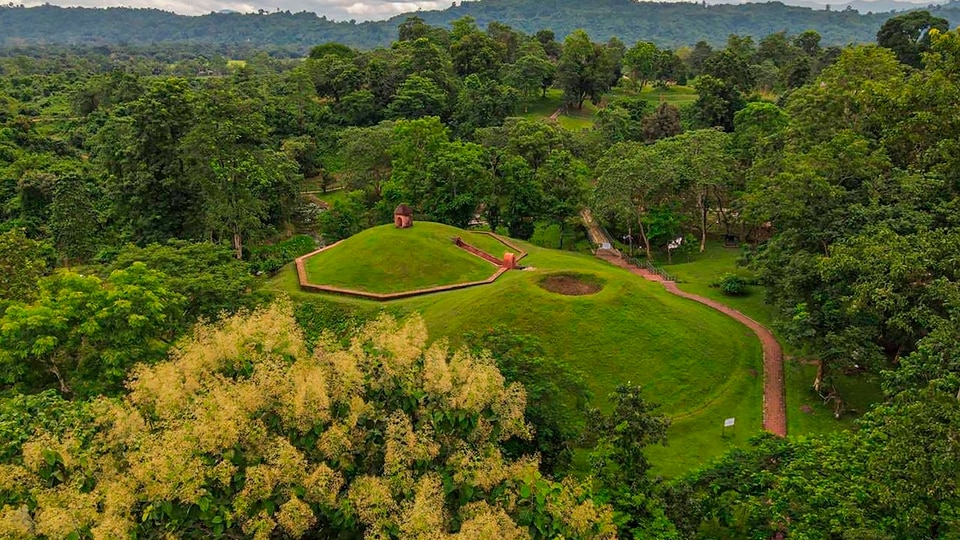
The inclusion of the Moidams or burial mounds at Charaideo (pronounced Saraideo) in the UNESCO World Heritage list marks a new beginning. It is important for two reasons: the obvious one is that it puts this far-eastern pocket of upper Assam on the world tourist map, but more importantly, it evidences the melting pot character of the sub-continent. Charaideo is a necropolis of the Ahom kings who trace their roots to the Mong Mao tribe of the Tai peoples who are spread across south China, Myanmar and Bhutan.
“In 1228 CE, some Shan or Tai warriors, led by a brave leader named Sukapha, left their homes in northern Myanmar and journeyed to Upper Assam. Here they set up the nucleus of what would become the powerful Ahom empire (1228-1826). For nearly six centuries, the Ahom kingdom spanned a greater part of the Brahmaputra Valley. The Ahom dynasty was one of the greatest political entities in medieval Asia, and left a multifaceted and abiding legacy which needs to be acknowledged by Indian historians,” wrote, Arup Kumar Dutta in his magnum opus, The Ahoms – A Reimagined History.
Charaideo, which means a shining city on the hill situated in the lush forests abounding in natural beauty was the first capital of the incipient Ahom kingdom. The burial mounds here have an elaborate design starting with the Garvha or the burial pit at the centre, a Tak or a hollow vault over it, and then a hemispherical mound of excavated earth, on its summit lies a shrine known as Sausali, which symbolised the heaven -earth continuum that the Tai Ahoms believed in.
When local tribes in present-day Assam first countered these Shan warriors they coined a word for them- Akhom or peerless, since the Shans didn’t have the ‘kh’ sound, they referred to it as Ahom which eventually became the name of the state itself: Assam. So, the history of Assam derives immensely from the Ahom kingdom which is revered for giving the people of this region a distinct identity.
“Charaideo and Ahom history holds a very special place for many Assamese people as it is both a repository of cultural heritage as well as a sense of commemoration and valour”, says author and journalist Sanjoy Hazarika.
Over the six centuries that the Ahom rule lasted, they expanded gradually and not always through conquest but through building alliances and marriage with local princesses.
In the 16th century, under the rule of Suhungmung (1497-1539 CE), the first major expansion of the hitherto small kingdom took place when the Ahoms defeated the local Dimasa and Chutia kings. Understanding the larger geopolitics of the Indian mainland, Suhungmung took a Hindu title as well, Swarganarayana. All successive kings were called Swargadeo or lords of heaven, and all of them continued the practice of adopting a Hindu title along with their own Ahom titles.
According to Dutta, one of the biggest contributions of the Ahom kings was "Bringing the Brahmaputra valley under a single administration and providing a generally enlightened and stable rule. The Ahom rulers initialized a process of homogenisation. It was therefore primarily due to the Ahom dynasty that the precolonial Assamese nation was born. To fully grasp this aspect we have to understand the complex ethnololical profile of the Brahmaputra valley prior to their entry" in the 13th century.
At Charaideo, out of the more than a hundred burial mounds, only a handful are well-kept, many of them have been ravaged by both treasure hunters and the vagaries of nature. However, the lasting legacy of the Ahom rule of more than 600 years remains unique. An important reason for this longevity was perhaps the Paik system “under which the male subjects in the kingdom instead of paying revenue to the state had to render service as workers or soldiers in lieu of being given land,” Dutta wrote.
“The Paiks were organised into groups of three or four males, one member of each group was obliged to be present in rotation for such work as was required of him and during his absence from home, the other members were expected to cultivate his land and keep his family supplied with food. In times of peace, it was the custom to employ their Paiks on public works and this is how the enormous tanks and the high-embanked roads in Assam came into existence”, Dutta added.
At the top of this tiered system of organisation were the Phukans with 6,000 Paiks, followed by Rajkhowas (3,000), Hazarika (1,000), Saikias (100) and Boras with 20 Paiks reporting to them.
Battle of Saraighat
In the 600 years of Ahom rule, the battle of Saraighat (1671) near Guwahati can easily be called the most defining, one whose legacy is still being claimed by today’s politics. In this epochal battle, the Ahom army and navy was led by Lachit Borphukan while the Mughal forces were led by the Rajput general Ram Singh I who had been sent by emperor Aurangzeb. It took place after a series of battles following the invasion of Ahom territory by Mir Jumla, the governor of Bengal, and the loss of Ahom power, treasure and pride. The battle was fought on both land and on the river making it one of the few of such scale in which the Mughal imperial forces were defeated by a regional power.
In this battle, Lachit Borphukan, an Ahom-Tai from an ordinary background outmanoeuvred the much larger enemy through clever tactics and valour securing for himself a permanent and primary place in the annals of Assamese history. He was immortalised in the collective consciousness as the hero who asserted, protected and stamped Assam’s regional autonomy against the Delhi-based empire.
Though he died a year later and was buried in a Moidam in Jorhat, he became a hero for Assamese nationalism and his legacy has been sought to be appropriated and communalised since the colonial period and this has only intensified in recent years as one of Hindu versus Muslim. Suniti Kumar Chatterjee writes in, The place of Assam in the history and civilisation of India, “The most noteworthy military achievement of the Ahom kingdom was their holding the Muslim expansion from north in India through Bengal though there were persistent efforts on the part of the Muslim rulers of Bengal… to conquer Assam all through the centuries”. This ongoing effort conveniently overlooks historical facts and that Borphukan was in fact a Tai-Ahom, employed many Muslims in his army including the legendary Ismail Siddique popularly known as Bagh Hazarika, and fought against a Hindu general who himself was leading an army for a Mughal emperor.
The UNESCO recognition clearly underlines the beautiful evolution of cultures, a necropolis of Tai-Ahoms who over more than 600 years localised themselves and came to represent the assertion of the regional versus the central or imperial, a phenomenon that remains pertinent.
HistoriCity is a column by author Valay Singh that narrates the story of a city that is in the news, by going back to its documented history, mythology and archeological digs. The views expressed are personal


