For Pakistan rulers, Kashmir is the preferred antidote to domestic troubles since independence. When Prime Minister Imran Khan says that he wants to resolve the main sticking point in bilateral relations, namely Kashmir, with Prime Minister Narendra Modi before walking into the SCO Summit at Bishkek, it sounds like a stuck record playing a bad rendition of Yesterday Once More.
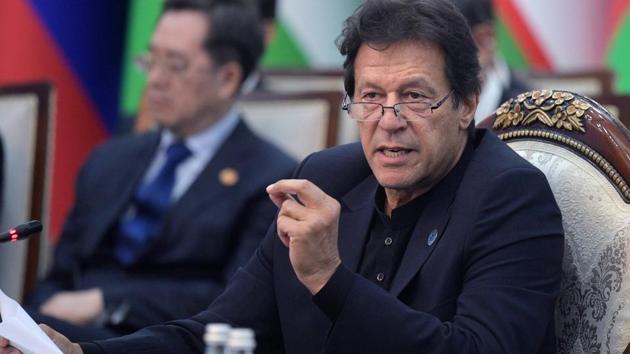
In an interview to Russian state-run media agency Sputnik, PM Khan says that Kashmir can be resolved if the two governments decide to tackle it together. Euphemistically, from Pakistan’s perspective, all it requires is some minor cartographic changes so that 15,948 square kilometres of the Kashmir Valley is handed over to Pakistan since it has a Muslim majority. And as if on auto-mode, the two globally designated terrorists Lashkar-e-Tayebba (LeT) Chief Hafiz Saeed and Jaish-e-Mohammed (JeM) Chief Masood Azhar – among many more – can then go back to their traditional occupations along with their jihadist cadre.
Interestingly, Khan in his interview says that Pakistan attempted to improve relations with India in April-May, 2019 but PM Modi successfully generated the anti-Islamabad hysteria, which appealed to its right-wing Hindu nationalists. Hence, according to him, the process was in vain. The facts are very much to the contrary. The February 14, 2019 Pulwama suicide attack using a local Kashmiri recruit of the JeM was orchestrated across the border. The aim was to cast doubt on PM Modi’s credibility. The basic move was to undermine the national security narrative built up by PM Modi since 2016 Uri surgical strikes and damage him electorally in the 2019 elections.
Just like armchair strategists who make the fundamental error of trying to understand the BJP leadership using prism of the Congress, Pakistan first deployed heavily across the Line of Control (LoC) to prevent a Uri-repeat as it was convinced that Modi will not cross the nuclear rubicon by launching attacks on terror camps located in the Pakistani hinterland. Just like the UPA-II backed off from 26/11 retaliation fearing Pakistan’s nuclear button, Pakistan Army Chief Qamar Bajwa and his protégé Khan were convinced that Modi too will buckle under the fear of its nuclear power and international pressure. This was also the line of thinking among Modi’s adversaries who simply did not understand one simple truth – this PM does not back off, he is ready to confront any crisis. The Pak gambit not only failed but rebounded on it in the form of an unprecedented electoral mandate for PM Modi.
{{/usCountry}}Just like armchair strategists who make the fundamental error of trying to understand the BJP leadership using prism of the Congress, Pakistan first deployed heavily across the Line of Control (LoC) to prevent a Uri-repeat as it was convinced that Modi will not cross the nuclear rubicon by launching attacks on terror camps located in the Pakistani hinterland. Just like the UPA-II backed off from 26/11 retaliation fearing Pakistan’s nuclear button, Pakistan Army Chief Qamar Bajwa and his protégé Khan were convinced that Modi too will buckle under the fear of its nuclear power and international pressure. This was also the line of thinking among Modi’s adversaries who simply did not understand one simple truth – this PM does not back off, he is ready to confront any crisis. The Pak gambit not only failed but rebounded on it in the form of an unprecedented electoral mandate for PM Modi.
{{/usCountry}}Rather than harbour pipedreams about Kashmir, Khan, who dreams of being a Mongol Khagan, should understand that PM Modi takes decisions after much deliberation. And once the die is cast, he sticks to them till the end. In this context, the best option for Khan is to repair Pakistan’s economy since the country’s external debt is now touching USD 103 billion and the near double digit consumer inflation. To connect to the cricketer in Imran, there are news reports stating that Pakistan’s per capita GDP in 1992---when it won the Cricket World Cup under his captaincy—was 65% higher than India’s at the time after adjusting purchasing parity of currency. Today, India’s per capita GDP is 28% higher than Pakistan and the gap is growing by the day. The International Monetary Fund (IMF) is set to give its 13th bailout to Pakistan since 1980 but does not want its rescue funds to be used to repay the Chinese for its uber-ambitious CPEC projects.
Khan will be well advised to reverse the downward spiral of Pakistan’s currency against the dollar rather than attempt to create a degree of positive atmospherics by shaking hands with PM Modi. The Pakistan PM must understand that BJP leaders led by PM Modi, Rajnath Singh and Amit Shah will not cede even an inch in a debate let alone territory in Kashmir. Unlike the Congress, there is an ideological purity within the BJP on Kashmir and beyond which includes the Northern Areas occupied by Pakistan.
The best and only option for Pakistan to enter into dialogue with India is by uprooting the terrorist groups, who have become extra constitutional stake holders in Islamabad’s Kashmir dream. The answers to Pakistan’s future lie within Pakistan and not across either the Radcliffe or Durand Line.