
 E-Paper



India should be wary of Chinese mind games
Withdrawal from the vast Tibetan and Xinjiang military region means little in an era of stand-off weapons and long-range missiles. The Chinese PLA has capacity to deploy troop divisions within a week with metalled roads and optical fibre cables up to the last military post and advanced landing grounds (ALGs) all along the LAC.

 Prefer HTon Google


A Hong Kong-based English newspaper has quoted Chinese military sources to claim that China has withdrawn 10,000 troops from its “disputed border with India” as Beijing calculated that the chances of conflict in winter are slim. According to the newspaper, all the troops were pulled back in military vehicles so that the Indian side could see and verify. The withdrawal, as per the South China Morning Post report, involved troops temporarily deployed from units in the Xinjiang and Tibet military regions.
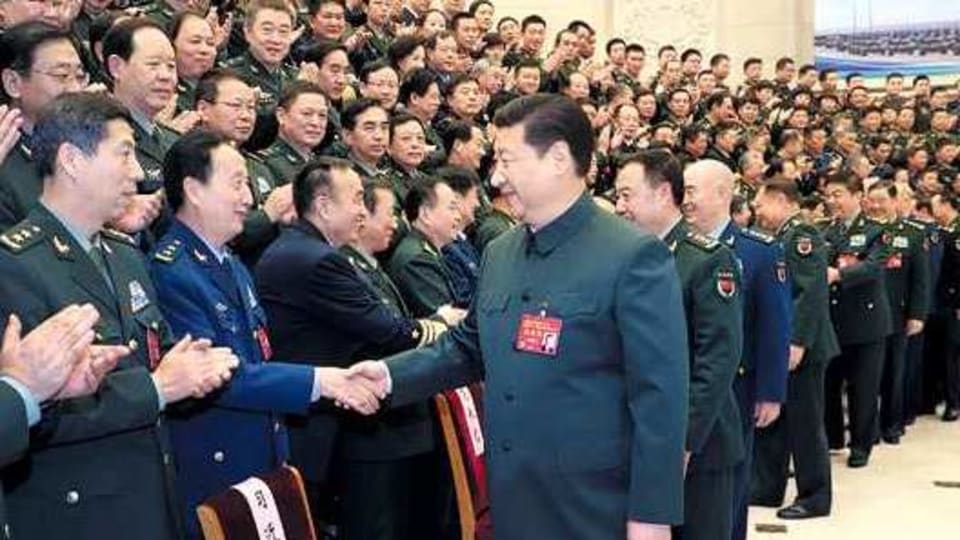
The Indian Army has also confirmed withdrawal of People’s Liberation Army (PLA) training units 1000 kilometres to 500 kilometres from the vast Tibetan plateau without giving out any numbers. The Army, however, says that there is no withdrawal from the friction points in East Ladakh with both armies locked in a stand-off since May 5, 2020.
While there is no way to verify the claims of the Chinese newspaper independently, movement of 10,000 troops or three brigades or one division in military parlance cannot be missed either by satellite imagery or by communication intercepts. The troops will have to be withdrawn either by vehicles or sent back to their barracks by transport aircraft. As the Tibetan plateau is more than two million square kilometres and is largely treeless, there would be photographic evidence of the activity. Either way, the withdrawal would largely be part of the feel-good factor since the PLA, with metalled roads to the last post and advanced landing grounds all along the 3,488 kilometre Line of Actual Control (LAC), has the capacity to fully deploy within a week.
According to national security planners, the Indian military will continue to be on alert till such time the PLA does not restore status quo ante on the East Ladakh LAC. They have also ruled out any withdrawal of Indian troops from the contested points till the agreed disengagement and de-escalation takes place.
What is interesting to note is that the PLA conducts annual exercises at Xaidulla or Shahidullah Garrison, 94 kilometres from Karakoram Pass. This pass is merely a stone’s throw from Daulat Beg Oldi. In the 19th century, Dogra general Zorawar Singh had captured all areas up to this strategically-located town. Known as Sanshili barracks and located on the caravan route between Ladakh and Tarim Basin, Xaidulla has been holding PLA training exercises annually except for 2018.
In 2020, a division plus PLA troops exercised from March to October 2020 in an area of 100-150 square kilometres with elements of six mechanised infantry division and four motorised division coming down to join their comrades in the stand-off with Indian Army. It is still not clear whether these elements have gone back. Similar training exercises take place at Phari Dzong across the Sikkim border in Chumbi Valley.
There is, however, evidence to indicate that the PLA's work and engineering force deployed to upgrade infrastructure in occupied Aksai Chin has moved back after completion of work last month.
As many as 320 vehicles moved out and some 40-45 temporary shelters were taken out after the completion of infrastructure work such as building of roads, winter shelters for deployed troops and sophisticated military equipment like surface-to-air missiles, radars, tanks and multi-barrel rocket launchers.
The Chinese news report says that the Central Military Commission is sure that it is impossible for both sides to fight in such extremely cold weather in the Himalayas and hence the troops have been sent to home barracks to rest.
The newspaper has also quoted a retired Indian diplomat, saying that the reported Chinese move could prompt India to consider a similar response. The Indian Army should be wary of such mind games.


