As I recall the famous song “Come September”, I cannot help correlate September as a possibly turbulent month in Kashmir. Undoubtedly, the reorganisation of Jammu and Kashmir (J&K) and Ladakh as Union territories has been a strategic ploy, but the greater violence that it may generate is the key concern. The aim of the spoilers led by Pakistan would not be a surprise — and their proxies, terrorists, separatists and other radical elements would be the players. The regional mainstream parties that swore by the soft separatism/special status idea would also be on the anti-reorganisation platform, with support from some national parties as well as liberals. Some of their cadres can be expected to join the agitation. Their resistance movement starts with an advantage as the spoilers have traditionally influenced the youth brigade effectively against accepting the Indian identity.
The Jammu and Kashmir Reorganisation Act and dilution/revocation of Article 370/35A passed by Parliament is a step towards strengthening the Indian nationalist embrace. This constitutional change should logically enable strengthening of the people-to-people connect and bond between the Kashmir Valley and mainstream India. Fortunately, there are many such bonds between traders and Indian tourists, between students and alumni of Indian universities, between doctors and patients undergoing treatment in Indian cities, and, of course, large numbers of Kashmiris working or having worked in the rest of the country. Not surprisingly, even the security forces have developed trustworthy relationships, especially near the Line of Control and their bases. The decision to provide employment to about 50,000 youth of J&K in the next few months will also strengthen the connect. Simultaneously, anti-Kashmiri hate voices, slogans and jingoism will also need to be curbed.
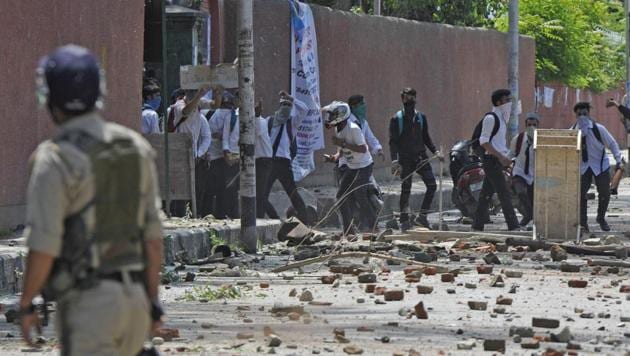
But can these connections counter the agitational machinations? Within the awaam, most Kashmiris are silent spectators. Many of them are okay with the Indian State, especially the Paharis, Gujjars, Bakharwals, Rajputs, Pathans and Shias. But what occupies the media is the violent sangbaaz, stone-pelters. They present the strident anti-India face, and those who are fine with the new status and the Indian State rarely speak up. The wait-and-watch attitude of the Kashmiri fence-sitter is notable. He swings in the direction where the tide turns. To counter the strident anti-India voice, we need many of the “okay with India” people to speak up; the newly elected panchayats can be a suitable channel. Areas like Kupwara, Baramulla, Bandipore, Ganderbal, Badgam, Poonch, Rajouri, Doda and Ramban have the ability to counter the anti-India chants from South Kashmir and downtown Srinagar.
{{/usCountry}}But can these connections counter the agitational machinations? Within the awaam, most Kashmiris are silent spectators. Many of them are okay with the Indian State, especially the Paharis, Gujjars, Bakharwals, Rajputs, Pathans and Shias. But what occupies the media is the violent sangbaaz, stone-pelters. They present the strident anti-India face, and those who are fine with the new status and the Indian State rarely speak up. The wait-and-watch attitude of the Kashmiri fence-sitter is notable. He swings in the direction where the tide turns. To counter the strident anti-India voice, we need many of the “okay with India” people to speak up; the newly elected panchayats can be a suitable channel. Areas like Kupwara, Baramulla, Bandipore, Ganderbal, Badgam, Poonch, Rajouri, Doda and Ramban have the ability to counter the anti-India chants from South Kashmir and downtown Srinagar.
{{/usCountry}}As September draws to a close, the pressures to relieve the clampdown will increase — the Internet and mobile communications would be restored. A consequent spurt in stone-pelting can be expected, as the spoilers and their agents pass on rally calls through social media and other means. Local politicians, mosques and mohalla committees are past masters at mobilising mobs. Many of these potential organisers of violence have been put behind bars at present. Yet the pervading anti-India mindset and influencers, still at large in the Valley, can be expected to generate turbulence and violence. Countering this resistance set-up is an uphill task. The Indian State must necessarily disrupt the attempts of these spoilers. We will have to use the iron fist to deal with violent extremists and stone pelters while keeping the communication lines open. That will be the challenge.
In the long-term, the education sector in Kashmir will need to be revamped, unwritten anti-India sentiments taught in schools have to be swept away, and national belonging will need to be nurtured. The Union Territory status will facilitate such intervention. It will, however, take a generation to change the prevailing mindset.
September is crucial. The ongoing United Nations General Assembly sessions adds to the strategic dimension. Hopefully, the apple harvest season should keep many young people off the streets, and if the Indian forces are able to contain the agitation below boiling point, we will have sailed through the strategic game. The mobilisation of the awaam for the Indian State, or for the Pakistan-nurtured spoilers, will be the decisive factor. Undoubtedly, the key in this struggle is the awaam.