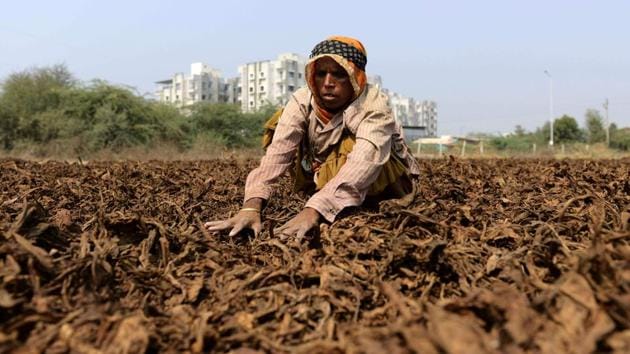
As another hot summer with drought looms, its the season of distress in vast tracts of the country. Farmers in the various dryland crop areas of the country are once again facing financial collapse and destitution. Cattle are no longer tradable and with the huge fodder and water scarcity, the vultures are circling and politicians have begun to speak of farmer distress and immediate palliatives. Every farmer suicide then becomes a cause celebre for them.
The National Mental Health Association of the USA states that “No matter the race or age of the person; how rich or poor they are, it is true that most people who commit suicide have a mental or emotional disorder”. Suicide is not a matter of economics. This is well supported by the data released by World Health Organisation in 2011: while the suicide rate in India, an agrarian economy, was 13 per 100,000; that of industrialised, rich countries were often higher or comparable– South Korea - 28.5, Japan - 20.1, Russia - 18.2, USA- 12.6, Australia- 12.5, and UK-11.8.
In India one finds that farmers who form 60% of the population account for 15.3% of suicides, while those in the secure service industry (including Government and Public Sector Undertakings) who account for about 2.4% of the population account for 9.8% of the cases! We cannot deny the grim reality of the countryside, but our politicians tend to overplay the emotional quotient of economic adversity. In those regions of Andhra Pradesh and Vidarbha where suicides are reported, there exist millions of other farmers who are in the same or possibly worse situations. Most of them cope with their adversity and suicide is not the chosen option. Clearly the issue is not suicides by farmers, but their economic plight.
The agricultural sector is facing major structural problems. We are witness to the falling share of agriculture in the country’s GDP, from 35% in 1990 to 13% in 2016; the increasing burden on land (267 people per square km in 1991 to 324 in 2001), and also low productivity, low purchasing power, poor infrastructure, and inequality of state conferred benefits. Considering the fact that agriculture is still the mainstay of the Indian economy, employing around 60% of the total workforce; this does not bode well for the country.
{{/usCountry}}The agricultural sector is facing major structural problems. We are witness to the falling share of agriculture in the country’s GDP, from 35% in 1990 to 13% in 2016; the increasing burden on land (267 people per square km in 1991 to 324 in 2001), and also low productivity, low purchasing power, poor infrastructure, and inequality of state conferred benefits. Considering the fact that agriculture is still the mainstay of the Indian economy, employing around 60% of the total workforce; this does not bode well for the country.
{{/usCountry}}The main proportion of the government’s outlay on agriculture goes towards subsidies, which contribute very little to growth . They benefit the rich farmers the most, while the marginal ones are living on the fringes. These need to be done away with to arrive at a long-term solution. There is also need to promote watershed management and massively increase the acreage under irrigation — presently only about 35% of total agricultural land is irrigated! This would reduce their susceptibility to drought and avoid crises.
A move towards the free market and an end to the government’s attempt to jawbone producer prices is required. The frequent resort to the import of wheat at higher prices, only to keep domestic prices low, is proof of this interference. While a kg of wheat retails for Rs.13-15 in India, the same goes approximately for Rs.40 in the USA, Rs. 35 in Brazil, Rs. 50 in Indonesia and Rs. 30 in China. Low prices of agricultural produce ensure that the farmer’s profit margin is reduced.
There are other infirmities, which keep most farmers at subsistence levels. The fragmentation of holdings is a major cause, with about 83% of farmers considered small or marginal with less than 2 ha each. This implies that over 80% of the farmers in India hold about 35% of the total cultivated land. To compound matters there has hardly been any new creation of irrigation potential by the State for the last 25 years. Two thirds of our farmlands are still rainfed. This makes commercial scale farming impossible and the majority of farmers depend on the rain Gods and governmental lords.
To reiterate, suicide is a matter of psychology, and not of economics – no matter how tempting that may be to exaggerate an issue. Few can deny that there is a crisis looming in the agricultural sector. True indicators of economic conditions are objective measures such as the sectoral share in GDP, availability of cheap credit, increase in area under irrigation; and not farmer suicides. It is unethical to use this as an economic index. But tell that to the politicians.
Mohan Guruswamy is an economics and policy analyst
The views expressed are personal