The UN Security Council has criticised the Myanmar government for condoning violence against Rohingya Muslims in its Rakhine State leading to a humanitarian crisis with lakhs fleeing to neighbouring Bangladesh fearing persecution. The current crisis is the fallout of a coordinated attack on multiple police posts on August 25 by more than 150 Rohingya militants in Maungdaw, Buthidaung and Rathedaung townships in the north Rakhine State.
The same night, 12 Myanmarese troopers died after militants claiming to belong to Arakan Rohingya Salvation Army tried to attack an army base. More than 80 Rohingya Muslims died in the attack. Last year on October 9, the Rohingya militants attacked three police posts in Maungdaw Township, resulting in the death of nine policemen and looting of arms and ammunition.
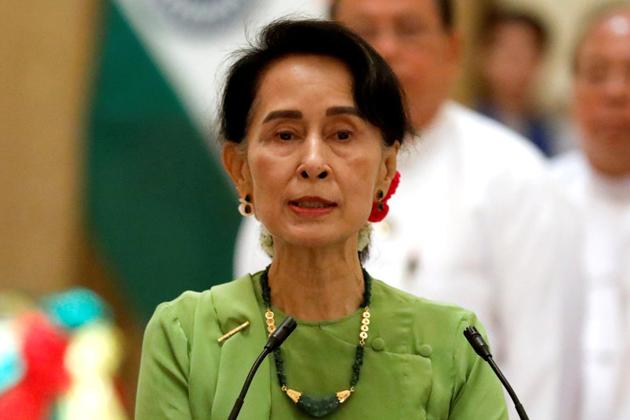
Myanmar President Htin Kyaw held Rohingya militant group Aqa Mul Mujahideen (AMM) responsible for the attack. The Rohingya crisis has turned State Councillor Aung San Suu Kyi, once a darling of the West into a devil, for not being able to stop the tribal violence against the minority community. Apart from the UNSC, Pakistan issued a statement on September 3 expressing deep concern over the growing number of deaths and forced displacement of Rohingya Muslims. Islamic fundamentalists such as the Afghan Taliban, Al Qaida’s Yemen Branch, Lashkar-e-Tayyeba, Jaish-e-Mohammed and other groups have called for attacks on Myanmar authorities in support of the Rohingyas.
There is an urgent need for de-escalation in levels of violence in Rakhine State as there is a strong possibility of other displaced Rohingyas being radicalised by Sunni fundamentalist groups including the Bangladesh chapter of the Islamic State to take to arms. The Rohingya displacement is a matter of serious concern but the root cause of increased animosity among the Burmans and other ethnic groups against the minority community should also not be glossed over. The international community has questioned Myanmar for the crisis but has forgotten the bloody contribution of Pakistan-based jihadist groups to this catastrophe. There is now evidence that little known AMM had emerged from Harkat-ul-Jihad Islami Arakan (HUJI-A), a Pakistan-based extremist outfit involved in espousing the Rohingya Muslim cause in Myanmar. The HUJI-A is headed by Abdus Qadoos Burmi, a Pakistani national of Rohingya origin, closely associated with LeT chief Hafiz Saeed for militant and explosive training for radicalised Rohingya cadres. According to information available with intelligence agencies in Bangladesh and Myanmar, AMM leader Hafiz Tohar aka Abu Aman Jununi was recruited by Burmi from Kyuak Pyin Siek village of Maungdaw and trained in Pakistan. After training a few AMM recruits, new cadres were recruited from among the Rohingya youth in Rakhine State and refugee camps in Bangladesh’s Cox’s Bazaar. The AMM cadre was trained along the Bangladesh-Myanmar border, which saw large-scale testing of improvised explosive devices in 2014. The role of Pakistan-based groups was revealed during an IED blast at Buthidaung Township on May 4 this year. Investigations revealed that two out of four killed while assembling the device were Pakistani nationals and the remaining two were local Rohingyas from the same township. The Pakistani nationals of Rohingya origin were identified as Abdul Rahim and Anarthullah, who had returned to Rakhine State after spending 20 years away in Af-Pak region.
{{/usCountry}}There is an urgent need for de-escalation in levels of violence in Rakhine State as there is a strong possibility of other displaced Rohingyas being radicalised by Sunni fundamentalist groups including the Bangladesh chapter of the Islamic State to take to arms. The Rohingya displacement is a matter of serious concern but the root cause of increased animosity among the Burmans and other ethnic groups against the minority community should also not be glossed over. The international community has questioned Myanmar for the crisis but has forgotten the bloody contribution of Pakistan-based jihadist groups to this catastrophe. There is now evidence that little known AMM had emerged from Harkat-ul-Jihad Islami Arakan (HUJI-A), a Pakistan-based extremist outfit involved in espousing the Rohingya Muslim cause in Myanmar. The HUJI-A is headed by Abdus Qadoos Burmi, a Pakistani national of Rohingya origin, closely associated with LeT chief Hafiz Saeed for militant and explosive training for radicalised Rohingya cadres. According to information available with intelligence agencies in Bangladesh and Myanmar, AMM leader Hafiz Tohar aka Abu Aman Jununi was recruited by Burmi from Kyuak Pyin Siek village of Maungdaw and trained in Pakistan. After training a few AMM recruits, new cadres were recruited from among the Rohingya youth in Rakhine State and refugee camps in Bangladesh’s Cox’s Bazaar. The AMM cadre was trained along the Bangladesh-Myanmar border, which saw large-scale testing of improvised explosive devices in 2014. The role of Pakistan-based groups was revealed during an IED blast at Buthidaung Township on May 4 this year. Investigations revealed that two out of four killed while assembling the device were Pakistani nationals and the remaining two were local Rohingyas from the same township. The Pakistani nationals of Rohingya origin were identified as Abdul Rahim and Anarthullah, who had returned to Rakhine State after spending 20 years away in Af-Pak region.
{{/usCountry}}Intelligence agencies believe that Rohingya militant activities concentrated in Bangladesh’s Chittagong area and Thailand’s Mae Sot, Tak province have the sanction of the Pakistani deep state. Frequent movements of Maulana Ustad Wazeer aka Noor Kabir and Fareed Faizullah, both Pakistani nationals of Rohingya origin, to the Thai border have been noted by intelligence agencies for getting cadres indoctrinated and trained in insurgent activities. In May 2016, Omar Faruk aka RSO Faruk of the LeT-backed Rohingya Solidarity Organization (RSO) was arrested from Chittagong for attacking the Bangladesh ANSAR camp at Teknaf, looting weapons and killing the troop commander.
While India is in touch with both Bangladesh and Myanmar to ensure that the Arakan corridor does not emerge as a new jihadi flashpoint, the international community, particularly the west, is partly responsible for the current crisis as it kept quiet when the LeT organised the Difa-e-Musalman-e-Arakan conference in Pakistan in July 2012 to highlight the Rohingya cause. Subsequently, LeT senior operatives Shahid Mehmood and Nadeem Awan visited Bangladesh to recruit Rohingyas and train them on the border with Myanmar. In fact, several new front organisations such as the Jamaat ul Arakan and Difa-e-Arakan have been formed with the help of Pakistani jihadists to coordinate the militant network along the Myanmar border with Bangladesh and Thailand.
Pakistan’s Jamaat-e-Islami, which is close to its Bangladesh chapter, moved a resolution in its Senate and the National Assembly against Myanmar for the so-called Rohingya genocide. Pakistan Foreign Minister Khawaja Muhammed Asif has also urged the Muslim world to put pressure on Myanmar.
While attacks on Rohingyas and their subsequent displacement cannot be condoned as lives of innocents are involved, the role of jihadists, their Pakistani backers for furtherance of their strategic objectives also needs to be questioned. India must not let the situation go out of hand as radicalisation of the Arakan corridor and infiltration of vulnerable Rohingyas by Sunni fundamentalists have direct repercussions on its maritime security in the Bay of Bengal area and internal security in the North-East region. Escalation of militant activities in this region poses a direct threat to international shipping lanes of communication passing through the Malacca Straits. The displaced Rohingya community needs full international support lest it falls into the lap of radicals in the name of Ummah. Myanmar also needs to retrospect. It is negotiating to buy JF-17 Thunder fighters from Pakistan, the same country which is fuelling unrest in its backyard.