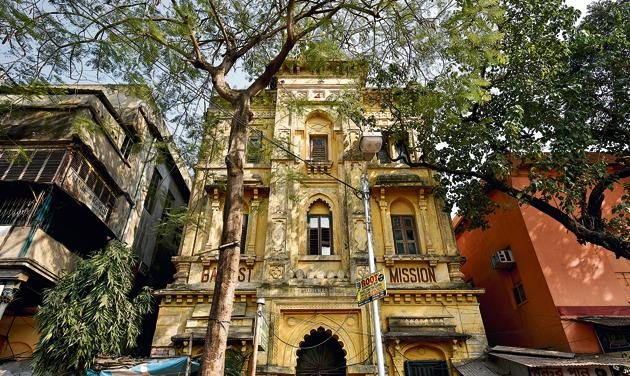
Dip into Bengali pop culture and it won’t be long before you come upon the term messbari. Byomkesh Bakshi, the famous fictional sleuth, lived in one; as did his creator, the author Sharadindu Bandyopadhyay. Classic novels have been set in the messbaris; films too. But you don’t hear the word often today, not even in Kolkata, where most of them stand.
The messbaris were some of India’s first urban hostels. By the early 1900s, they were housing and feeding thousands of young men who had headed to the rapidly industrialising colonial province of Bengal. Most were looking for jobs, some for education, says Jayanta Sengupta, a historian and curator of Kolkata’s Victoria Memorial museum.
People preferred to live with those from similar backgrounds, so the messes were organised by community — there’s a Marwari mess, an Odiya one, a Goan messbari, one for nurses, and one for refugees from China. There were even some posh boarding houses in central parts of the city for Europeans.
Today, most are crumbling and forgotten; the ornate facades that remain hide decrepit interiors. But there is hope. In January, a heritage startup called Heritage Walk Calcutta (HWC) began to document the messbaris through photographs, residents’ accounts and cultural references. They found 53 that were still standing.
{{/usCountry}}Today, most are crumbling and forgotten; the ornate facades that remain hide decrepit interiors. But there is hope. In January, a heritage startup called Heritage Walk Calcutta (HWC) began to document the messbaris through photographs, residents’ accounts and cultural references. They found 53 that were still standing.
{{/usCountry}}Some of the images they took are now on an Instagram page called The Messbari Project, and the project report is on the startup’s website.
In October, a team from HWC met West Bengal Heritage Commission chairman Subhaprasanna Bhattacharjee to discuss ways to preserve the structures. “We will submit our documentation to the heritage commission in April,” says Tathagata Neogi, an archaeologist and co-founder of HWC.
“The Messbari Project is a wonderful initiative and I will help take it forward in my capacity,” Bhattacharjee told HT.
A SECOND COMING
“In 2017, we were working on ideas for short documentaries on the history of Kolkata. That was when Dibakar Banerjee’s film Byomkesh had just come out and there was a lot of noise in the newspapers about the Presidency Boarding house being used as a model for the set,” says Neogi. “We went to see that boarding house and found it to be in a terrible state. So we did an episode on mess houses in our documentary series, Sutanuti Diaries [Sutanuti is one of the three villages that merged to become Calcutta].”
Not far from the Presidency mess is Khetra Kuthi, its bricks jutting out and heaps of garbage at its base. On the second floor is the room where the legendary Bengali author Shibram Chakraborty spent most of his life and died in 1980. It is occupied casually by new boarders.
“I only realised that someone so important lived here some months after I moved in,” says Dip Chakraborty, 27, a migrant from Paschim Medinipur who works with a travel agency and has been living here for three years. “Multiple people have come looking for his room. One man, when led to his room, bowed down and touched the floor with his forehead. It was thrilling to know someone like that has spent his life here.”
While shooting the messbari episode, Neogi and his team realised there were a lot more stories to be told. So they launched an internship project to study the messbaris. Armed with literary references, anecdotes and street directories dating back to 1915, interns began cataloguing the physical structures, and uncovering historical references to them. Like a newspaper report from November 1920 that expresses “surprise at the curious development whereby two or more men are seen to be sharing rooms in newly mushrooming boarding houses”.
Today, some messbaris, like Komala Vilas, have survived as hotels. A part of the Chinese mess for refugees in Tirretta Bazar is now a Chinese restaurant. The Parsi mess at Bow Barracks is well-maintained and still functions as a rest house but is also a Parsi takeaway joint, a rarity in the city.
STUCK IN TIME
One reason most messbaris are crumbling is because of the tangle of ownership claims. “Many are stuck in litigation as well. It becomes very difficult to act in such a situation,” says Bhattacharjee of the heritage commission. But once the stakeholders can come together the structures are easy to restore and have great commercial potential feels, conservation architect Anjan Mitra.
Take the Calcutta Bungalow, a 1920s building converted into a heritage hotel equipped with the experience of the city’s domestic life in that period. “The messbaris follow the generic style of the city mansions of that period,” Mitra says. “Most have a courtyard where people socialised, long and spacious vernadahs ringing the rooms. It wouldn’t be hard to make them commercially viable.”
As a first step, Neogi and Sengupta are hoping that the government will at least mark the messbaris that remain — perhaps they could use a model like the blue plaques in the UK to commemorate a link between a location and a famous person, Neogi says. Till then, these mansions stand by the wayside – grand and anonymous – holding within the history of a time and people.