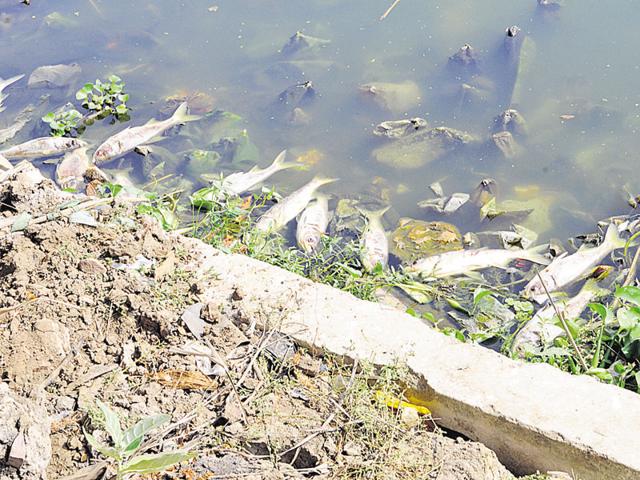
Thousands of dead fish wash up in Bhopal’s Lower Lake
Thousands of dead fish were spotted in the Bhopal’s Lower Lake, one of two lakes in the Bhoj wetland, which has been designated a wetland of international importance under the international Ramsar Convention.
Thousands of dead fish were spotted in the Bhopal’s Lower Lake, one of two lakes in the Bhoj wetland, which has been designated a wetland of international importance under the international Ramsar Convention, on Saturday morning.
Dead fish wash up in Bhopal’s Lower Lake. (Praveen Bajpai/HT)
{{^htLoading}} {{/htLoading}}
When HT visited the Lower Lake, it found hundreds of dead fish floating in the water. There were heaps of garbage and floating debris with dead fish on the lake fringe, with a foul smell repelling onlookers.
Though it is not yet clear why the fish have started dying, experts say increased pollution due to the recent immersion of hundreds of idols could have a role to play in the mass death.
Environmentalist Praloy Bagchi said most of the idols were made of plaster of Paris and painted with synthetic colours. “When all this makes its way into an already polluted lake, fish are destined to suffocate.
Authorities have failed to ensure an eco-friendly idol immersion and as a society, we need to think whether we should limit or change our traditions in such a way that they don’t harm life and environment around,” he said. “The Lower Lake has become a gutter and experts need to study how the murky waters were affecting aquatic life in it.”
{{^htLoading}} {{/htLoading}}
{{^usCountry}}
Experts from the fisheries department pointed out that during cloudy weather, the dissolved oxygen in lake water decreases, which, coupled with other factors like idol immersion, could have contributed in the death of fish.
{{/usCountry}}
{{#usCountry}}
Experts from the fisheries department pointed out that during cloudy weather, the dissolved oxygen in lake water decreases, which, coupled with other factors like idol immersion, could have contributed in the death of fish.
{{/usCountry}}
Joint director fisheries US Tomar said, “Among other factors, the health of fish in water depends on biochemical oxygen demand,” and that low dissolved oxygen primarily results from excessive algae growth.
Neeraj Santoshi is the Chief of Bureau for Hindustan Times in Uttarakhand, where he leads the state reporting team while covering government, politics, environment, wildlife, Uttarakhand High Court, and issues shaping the Himalayan region. With more than two decades in journalism across conflict zones, he has covered politically sensitive regions and environmentally fragile landscapes, and focused on stories that combine public interest with in-depth storytelling. An alumnus of Pune University with a Master’s in Communication Studies, he has reported extensively from Jammu & Kashmir (2003-2010), Madhya Pradesh (2010 to 2018 ) and Uttarakhand (Since 2018), covering subjects ranging from insurgency, elections and governance to wildlife conservation, mining, climate change, agriculture, human rights and social justice. He has covered politics and legislative assemblies of both Jammu & Kashmir and Madhya Pradesh over more than a decade. Before taking over as Chief of Bureau in Uttarakhand, he served as Special Correspondent with Hindustan Times in Madhya Pradesh and earlier reported for both Hindustan Times and The Indian Express in Jammu & Kashmir, where he covered state politics, environment and insurgency-related developments. Over the years, his stories have focused on environmental degradation, wildlife, illegal mining, governance and the changing social fabric of Himalayan states and Central India. He is particularly interested in long-form explanatory journalism, and stories that explore the intersection of ecology, conservation, governance and society. Outside the newsroom, Neeraj enjoys reading widely on neuroscience, consciousness studies, Artificial Intelligence and quantum physics, with a special interest in Kashmiri Tantric Shaivist traditions. He is also passionate about wildlife, mountaineering and the Himalayas, interests that continue to inform his reporting and deepen his understanding of the region he covers.