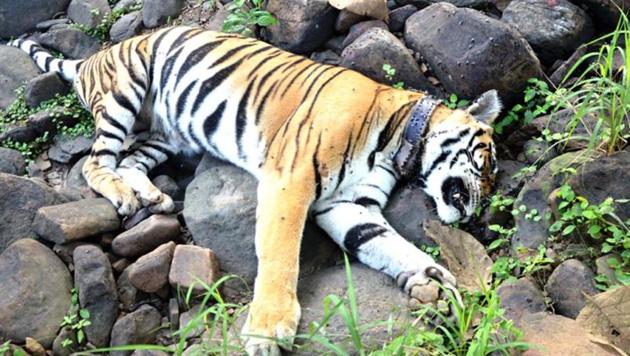
Tiger found dead in Satpura reserve, 12th this year in Madhya Pradesh
The carcass of the feline had injury marks and a dead Gaur (Indian bison) near it. Forest officials believe the tiger probably had a fight with another Gaur or with another tiger.
The carcass of a four-year-old tiger was found in Madhya Pradesh’s Satpura reserve on Saturday, making it the 12th feline death in the state this year.
A dead tigress found at Panna Tiger Reserve in Madhya Pradesh. (HT FILE PHOTO)
The field staff spotted the carcass in the core of the reserve, Ashok Mishra, joint director Satpura Tiger Reserve told HT.
{{^usCountry}}{{/usCountry}}
“The body had injury marks. There was a kill of Gaur (Indian bison) near the carcass. The post mortem showed the tiger had suffered external and internal injuries. The tiger probably died after having a fight with another Gaur or it died fighting with another tiger,” he said.
In a similar incident, in the third week of January this year, a buffalo killed a tiger cub in the buffer zone of Bandhavgarh Tiger Reserve.
This is the eighth feline death in Madhya Pradesh since April 1, and the 12th this year. Since January 2015, the state lost 53 tigers.
{{^htLoading}} {{/htLoading}}
According to the last tiger census conducted in January 2015, the tiger numbers had increased in MP from 257 in 2010 to 308 in 2015.
In 2016, MP recorded nearly one-third of the tiger deaths (30 of 97) in the country, the highest for any state.
Located 210 km from Bhopal in Hoshangabad district, the Satpura reserve is spread over 524 sqkm.
Neeraj Santoshi is the Chief of Bureau for Hindustan Times in Uttarakhand, where he leads the state reporting team while covering government, politics, environment, wildlife, Uttarakhand High Court, and issues shaping the Himalayan region. With more than two decades in journalism across conflict zones, he has covered politically sensitive regions and environmentally fragile landscapes, and focused on stories that combine public interest with in-depth storytelling. An alumnus of Pune University with a Master’s in Communication Studies, he has reported extensively from Jammu & Kashmir (2003-2010), Madhya Pradesh (2010 to 2018 ) and Uttarakhand (Since 2018), covering subjects ranging from insurgency, elections and governance to wildlife conservation, mining, climate change, agriculture, human rights and social justice. He has covered politics and legislative assemblies of both Jammu & Kashmir and Madhya Pradesh over more than a decade. Before taking over as Chief of Bureau in Uttarakhand, he served as Special Correspondent with Hindustan Times in Madhya Pradesh and earlier reported for both Hindustan Times and The Indian Express in Jammu & Kashmir, where he covered state politics, environment and insurgency-related developments. Over the years, his stories have focused on environmental degradation, wildlife, illegal mining, governance and the changing social fabric of Himalayan states and Central India. He is particularly interested in long-form explanatory journalism, and stories that explore the intersection of ecology, conservation, governance and society. Outside the newsroom, Neeraj enjoys reading widely on neuroscience, consciousness studies, Artificial Intelligence and quantum physics, with a special interest in Kashmiri Tantric Shaivist traditions. He is also passionate about wildlife, mountaineering and the Himalayas, interests that continue to inform his reporting and deepen his understanding of the region he covers.