What inspired you to start your literary journey and did you imagine you would become a celebrated writer?
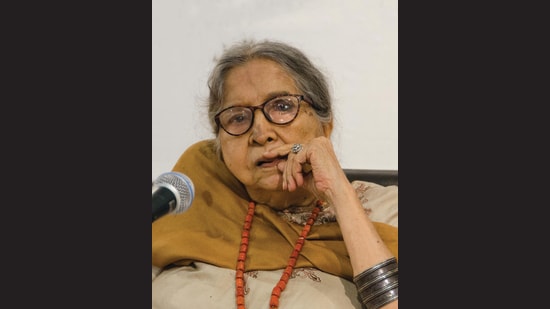
I was doing my graduation in Delhi. My professor was Baldev Singh. He used to teach us English Literature. I was so fascinated by his brilliance that I almost fell in love with him. I was hardly 16 and Baldev treated me like a child. To impress him, I wrote my first short story and presented it at an intercollege function. I got a houseful of applause and was brought a piece of paper on which was written “Brilliant story. Please give it to me to publish in the journal I edit, Naviyan Keemtan (New Values)”. It was signed by Prof. Ram Singh, a great scholar in the Punjabi world.
That was the beginning of my literary journey.
There were many hurdles. I was married at 18. My husband forbade me from writing as people would get to know me and come to meet me, which he did not like. I did not write for nine long years. Everything kept boiling inside my ribs.
Ultimately, I broke my cage and the river flowed in full force. Friends advised me to get my stories published. They were already very popular. I would get a lot of fan mail including from the renowned novelists Nanak Singh, Gurbaksh Singh and others.
I had decided that they should appear in a book form when a publisher comes to me asking for them. One day, the biggest and most renowned Punjabi publisher Navyug’s Bhapa Pritam Singh came to me and asked me to select 15 stories for a book.
My first book, Gulbano, was published in 1960 and got the Best Book of the year Award. There was no time to look back after that. Many of the stories were translated into Hindi and published in the best Hindi journal, Dharamyug, by Dharamvir Bharti.
{{/usCountry}}My first book, Gulbano, was published in 1960 and got the Best Book of the year Award. There was no time to look back after that. Many of the stories were translated into Hindi and published in the best Hindi journal, Dharamyug, by Dharamvir Bharti.
{{/usCountry}}What made you write about these specific 17 people for The Blue Potter? Also, if you’re given an option to include one more person, who would that be?
These 17 were close friends. We knew each other’s lives and struggles and achievements at different levels. I wish I could have included Bhai Vir Singh, Nanak Singh and Bhagat Puran Singh (the Mother Teresa of Punjab) but they were separated by age and distance and I did not know them personally, though I had regular correspondence with Nanak Singh and Bhagat Puran Singh. VP Singh was very close to me emotionally and I admired his poetry and paintings and devotion for the poor and deprived but he could not fit among the Punjabi stalwarts although I have written a sketch on him titled Raja Ya Fakir in the book’s Hindi edition, Neela Kumhaar.
Whose character sketch was the most difficult for you to write about and why?
Amrita Pritam was a difficult sketch because I admired her since I was a little girl. Her father, Hitkariji, taught me Gurmukhi. But when Emergency happened, she wanted me to sign in its favour, which I refused. She was also strangely silent about Bluestar and the 1984 killing of Sikhs. Later on, she got into a conflict with Krishna Sobti over the title of the latter’s book, Zindaginama, and tried to involve me in that conflict after Krishna went to the court. It was also difficult to write because of her treatment of her husband Pritam Singh, a very noble and gentle soul who loved her and financially supported her till his lonely death.
How do you see the future of Punjabi literature and is there any message that you hope readers will take away after reading this book?
Readers will know about the rich cultural heritage of Punjab through its eminent creative people who I feel are less known comparatively than English writers because of the paucity of translations. As far as Punjabi books are concerned, they are in the same turbulent boat as all other Indian language books because the government’s policy is not favourable to books any more. Raja Ram Mohan library, for example, used to buy books of all languages in bulk and distribute them to all the libraries. So did the state governments. All those book-friendly and book-buying-friendly programmes are dead and gone. Accordingly, publishers publish a fewer number of books. Books don’t reach libraries in routine as they used to.
Chittajit Mitra (he/him) is a queer writer, translator and editor from Allahabad. He is co-founder of RAQS, an organization working on gender, sexuality and mental health.