
 E-Paper



Asiya Islam: “Without women’s unpaid work, the economy would not function”
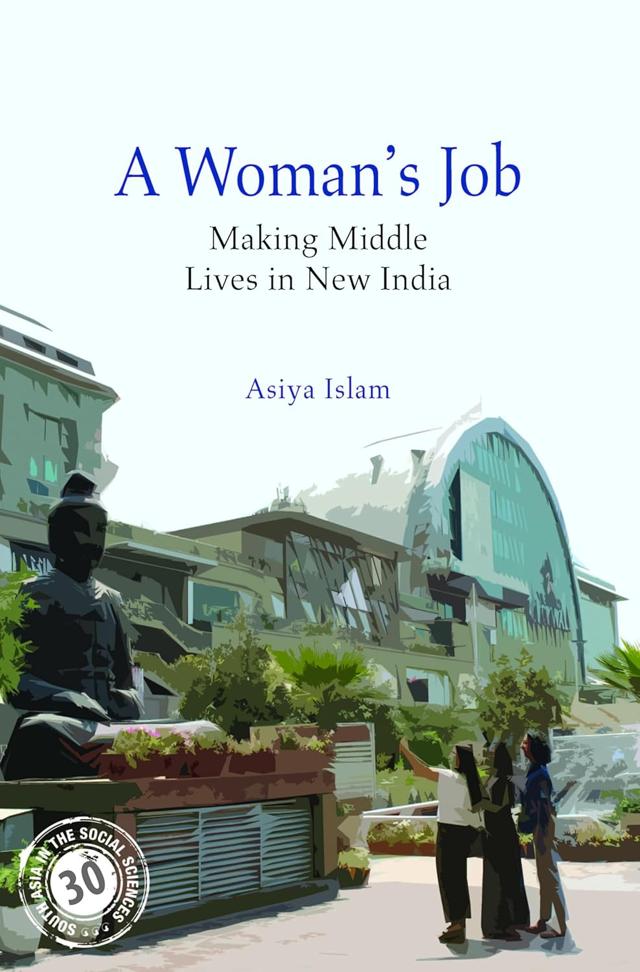
The author of A Woman’s Job; Making Middle Lives in New India on how young urban lower-middle class women are challenging assumptions about social mobility and agency even as workplaces continue to reproduce gender, class, and caste inequalities

 Prefer HTon Google


How are middle class women at the forefront of mediating a new class politics?
In recent years, there has been a lot of discussion about an emerging ‘New Middle Class’ in India, usually attributed to the socio-economic changes brought about as a result of the adoption of the New Economic Policy of liberalisation, privatisation, and globalisation in the 1990s. Some scholars critique this ‘success story’ and argue that there is a discrepancy between the imagination and the reality of the New Middle Class. Even as patterns of consumption change, as reflected in new lifestyles, particularly in urban India, most who supposedly belong to the New Middle Class are still struggling for secure lives. In this context, women are symbolically significant. They are desired in public spaces to signal global modernity, but at the same time, there are constraints around when, where, with whom, and in what activities it is acceptable for them to occupy these spaces. As such, the question of a New Middle Class is not simply (and can never be simply) a question of class – it is entangled with gender, caste, age, and so on. In my work, I turn towards young women workers in Delhi to explore these entanglements and understand not just how they participate in, but also how they may resist and speak back to the politics of class formations.
How did you come to research the lives of young lower-middle-class women working in cafes, shopping malls, call centres and offices in New Delhi? What were some of the most revealing insights into their working and domestic lives?
At first glance, as workers in work spaces that have emerged in post-liberalisation India, young lower middle class women evidence the success of India’s economic restructuring. While their parents were in more traditionally working class jobs as factory workers, domestic workers, construction workers, they have acquired higher levels of education as well as skills in English speaking and basic computers to secure ‘professional’ work. However, we know little about their experience of this work. For my research, I spent a year in Delhi, meeting and hanging out with young women workers. Within that year, several women quit their jobs, became unemployed, returned to education and skills training, and switched industries. There were several reasons for women quitting their jobs – these included friction with managers (who were mostly men), sexual harassment, mistreatment at work, not being given time off, lack of progression opportunities, and often a combination of all of these. Although there is an imagination of equal opportunities and fair treatment in the new workplaces of India, these conflicts at work suggested reproduction of gender, class, and caste inequalities. The women’s fragmented work trajectories meant that they were only working in ‘jobs’, rather than building ‘careers’.
You argue that these women adopt “middleness” as a strategy of life-making at the multiple sites of work, home and leisure. Please elaborate.
I use the term ‘middleness’ to encompass aspects of women’s lives that may seem contradictory, but are rather indicative of the strategies that women adopt to navigate the flux of socio-economic change. While ‘middleness’ is not a new idea in itself – many scholars have written about women being in the middle of tradition and modernity, home and nation, private and public, and so on – what I am arguing here is something different. Rather than see women as simply caught in between two positions, I explore how women are active agents navigating multiple positions. The book chapters do this by looking at how women engage with identities ascribed to them. We see that they desire to be fluent in English speaking, but they do not want to be mocked for trying to be English ‘madams’, so they choose their moments for English speaking wisely. They cherish employment for offering them an opportunity to travel on the Delhi metro, on motorbikes, and in cars, but they worry about being branded ‘fast-forward’, as trying to climb the social ladder in inappropriate ways, so they emphasise the virtue of hard work. They come from ‘middle class’ families, but they distance themselves from middle-class-ness through their behaviour and attitudes. They want to (and indeed have to) dress as professionals, which, in this context, is ‘Western’ clothing, but they emphasise that they do not want to deceive people about their backgrounds, that is, they do not want to be ‘heroines’ pretending to be who they are not. They are ‘working’, but they quit work to assert agency that is denied to working women.
What kind of agency do these women exercise at their workplaces and at home?
A refrain I heard often was – ‘It gets really boring if you stay at home’ – and this was elaborated upon by the women’s understanding that their education would be a waste if they did not go to work. One of the women told me that when her father opposed her going to work in a café, she effectively went on a hunger strike until he gave in. She said that he did not want her to do this work because he was not sure what it would entail, but that over time, he became comfortable with it. Some women noted that women’s employment was increasingly becoming a desirable criterion in arranging marriages, indicating the need for multiple incomes to sustain ‘New Middle Class’ lives in urban India. Through employment, women pushed back on domestic pressures, including housework and marriage, but recognised that they would have to eventually give in. At work, they resisted becoming ‘docile’ women who do as they are asked, instead refusing to do work (such as, washing dishes in the café) that they did not believe to be part of their job. This led, as noted above, to friction with their managers and, at times, to them leaving their jobs. Their agency was, as such, strategic.
Why do you think the question of women’s employment has to be examined in confluence with social relations that organize labour, including class and caste, in the Indian context?
It is important to pay close attention to inequalities that organise labour in contemporary India to challenge the popular discourse that suggests that it is only education and skills, not social location, that matters in New India. This false idea has been particularly pervasive in relation to caste, that is, to arguing that caste is no longer important, especially in urban India. My research, on the other hand, shows that work and workplace dynamics are shaped by, and indeed reproduce, gender, class, and caste inequalities. A young woman who has studied at a Hindi-medium government school and pursued undergraduate education through the Delhi University’s School of Open Learning (SOL) does not have the social and cultural capital, access to campus placement opportunities and careers advisers, or English language fluency needed to secure a multinational job. She can, however, work in a relatively low-paid job in a call centre, or café, with little progression opportunities. Within the workplace too, she would likely negotiate dynamics – both with colleagues and customers/clients – that are shaped by gender, class, and caste.
Are there any policy changes that can make these workplaces more rewarding?
I would argue that there is a need to change the terms of conversation we are having in relation to women’s workforce participation. In discussions about India’s unusually low rate of women’s employment, women are positioned as passive subjects constituting a latent workforce, with little attention to or interest in women’s well being. We have to think, as feminists have long argued, about mechanisms to value the huge amount of unpaid work that women do. This is not to reassert women’s place in the home, but to recognise that without this work, the economy would not function. Further, women’s fragmented work trajectories in the private service sector indicate the need for improved labour legislation that offers stronger protection (minimum wage, working hours, leave, etc.), as well as progression opportunities that incentivise longer-term commitment. These measures would be a starting point.
Majid Maqbool is an independent journalist based in Kashmir.


