Dear Reader,
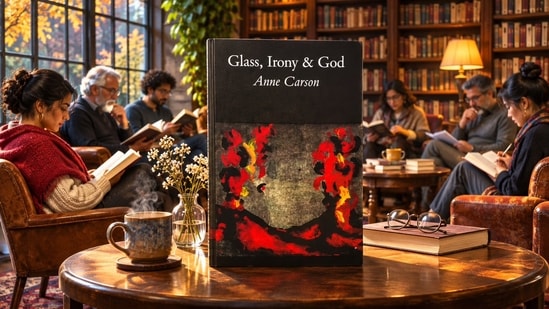
On a Saturday morning in the Kullu Valley, when the leaves on the trees are changing colour, and the winter chill has got us to pull out our sweaters and scarves, we sit across from each other reading a poem by Anne Carson, who won this year’s Nobel Prize in Literature.
In The Glass Essay, a woman travels to her mother’s home in northern Canada after a man she calls “Law” ends their relationship.
“I did this too
Dear Reader,
On a Saturday morning in the Kullu Valley, when the leaves on the trees are changing colour, and the winter chill has got us to pull out our sweaters and scarves, we sit across from each other reading a poem by Anne Carson, who won this year’s Nobel Prize in Literature.
In The Glass Essay, a woman travels to her mother’s home in northern Canada after a man she calls “Law” ends their relationship.
“I did this too after my breakup, traveled on a plane and then a bus full of villagers and chickens and livestock and a ferry, twenty-four hours to get to my mother. She cooked my favorite dishes and didn’t ask me any questions,” a reader says.
Ten of us are on two long rectangular tables set side by side –a bookshop owner, a chef, a snowboarding instructor, a wildlife conservationist, a Wall Street banker turned photographer, a retired Indian Administrative Services officer, a therapist, two writers and a librarian. We are trying to understand this complicated poem, this pastiche of memoir, of descriptions of the landscape, of dreams and an obsession with Emily Brontë.
Outside, cars and tempo travelers speed along the national highway, carrying tourists towards Manali or the Lahaul Valley, or perhaps onwards over the Shinku La Pass to Zanskar. Inside is the cosy quietness of books and the smell of freshly brewed coffee.
We take turns reading aloud the poem’s sections: ‘I’, ‘She’, ‘Three’, ‘Liberty’ and so on.
The retired IAS administrator reads ‘She’ :
‘I travel all day on trains and bring a lot of books-
some for my mother, some for me’
“Look how she differentiates herself from her mother. They have separate books,” the wildlife conservationist says.
We pause to consider whether we do this too - do we copy our parents or seeking desperately to differentiate ourselves from them?
Then the therapist reads “Kitchen” where our narrator describes the contents of her mother’s fridge:
“My mother lives alone and eats little but her fridge is always crammed.
After extracting the yoghurt container
from beneath a wily arrangement of leftover blocks of Christmas cake
wrapped in foil and prescription medicine bottles
I close the fridge door. “
Now we are truly hooked, jumping into the contents of our fridges and then our mothers’ fridges.
We chorus our comparisons: “So many plastic boxes in my mother's fridge”, “pots and pots of milk, why so much milk and nothing else” , “leftovers that stay for days and days”.
Another round of cocoa and coffee, along with mugs of hot water arrives.
The weather changes. The Wall Street banker turned photographer reads the thaw aloud:
‘the ice has begun to unclench.
Black open water comes
curdling up like anger.’
Then the cutting clarity of a winter morning:
‘on the moor all is brilliant and hard after a night of frost.
The light plunges straight up from the ice to a blue hole at the top of the sky.’
Running through these landscapes of grief and loneliness, is our narrator’s obsession with Emily Brontë whose collected works she carries around with her. The fifth Brontë sibling, a motherless girl who wrote poetry and but one novel – Wuthering Heights, which was published when she was 29. A year later, she was dead.
“Emily Brontë was good at cursing”, our poem’s narrator tells us.
Elsewhere she puzzles “How did Emily come to lose faith in humans?”
What did Emily know of evil and heartbreak? How could she write poetry and a novel like Wuthering Heights, so full of savagery and passion? Our narrator wonders.
Sitting at the table, we are trying to make sense of these interwoven worlds as well.
“What do the ‘hanged puppies’ in the poem mean?” the snowboard instructor says.
“It’s a line from Wuthering Heights,” someone replies.
“But hanging puppies-why?” the chef says.
“Emily Brontë was an animal lover, maybe that’s her way of showing villainy and the wildness in human nature, to have characters like Hareton and Heathcliff hanging puppies,” I say. I have wondered about this myself earlier and, naturally, have already researched it online.
Someone orders a black bean burger, someone else an avocado sandwich. The food arrives, the bread is broken and passed around. The conversation flows on, drifting through Brontë’s dark moors, Carson’s dreams and her grief, and back into our own lives.
I look at my watch. Somehow, three hours have passed.
It is 1 pm and we have not quite resolved the mystery of the hanged puppies, nor have we fully deciphered Carson’s glass visions. Ten readers, spanning five decades in age, sitting around two tables and sharing their mothers, their heartbreaks, and their love of a difficult poem. And that, dear reader, is the real reason we gather.
What about you, where do you fly to when the ice needs to unclench? And if you were to open your mother’s fridge today, what story would it tell about her?
Sonya Dutta Choudhury is a Mumbai-based journalist, Founder of Sonya’s Book Box, and a teacher of Storytelling in Business. Got a knot in your life, a dilemma at work, or a reading slump you can’t shake? Send your questions and book requests to sonyasbookbox@gmail.com, and she promises to give each one her most earnest consideration.
One Subscription.
Get 360° coverage—from daily headlines
to 100 year archives.
Archives
HT App & Website