There’s just no other way to say this. Dan Brown’s Origin is utterly magnetic. Like gravity, it tethers you to it so you can feel the pulsating excitement of the discovery unfolding.
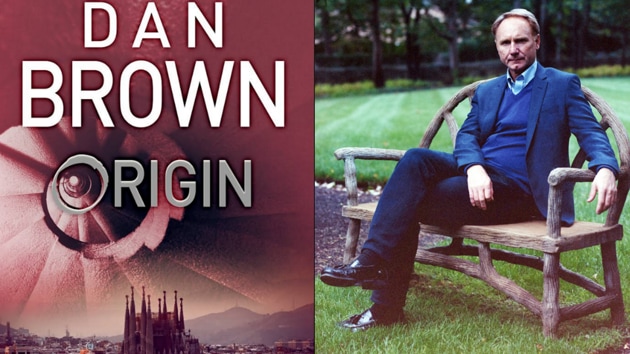
The likeable Harvard professor Robert Langdon, who deciphers signs and symbols, is for the fifth time involved in a chase to unlock a password that will hold the answers to the two philosophical questions that have been at the core of human inquiry: Where do we come from? Where are we going?
Langdon has left Roman domes and churches, and Parisian museums behind for the vibrant confluence of Spain – a country that is especially now caught in a crossfire between cultures, traditions and art. It is in Bilbao and Barcelona that Brown’s nurtured expertise shines through again. Langdon’s story flows through the seamless structure of Guggenheim Museum and into the sunlit spires of Gaudi’s La Sagrada Familia. His greatest achievement in all of his stories has been to make a city into an ancient creature that has always been breathing, evolving and hiding secrets.
The best-selling author justifies his own work rather befittingly in a dialogue in Origin. A docent that is equipped with artificial intelligence describes masterpieces of modern art as “often more about the idea than the execution”. Brown’s prose is hardly a work of beauty. In occasional paragraphs, his sentences appear to be a Wikipedia introduction rather than a novel. It is instead in the labyrinths of churches and secret societies; in the codes and patterns unearthed in modern cities that make Brown’s work profound in meaning. Not in language or technique.
{{/usCountry}}The best-selling author justifies his own work rather befittingly in a dialogue in Origin. A docent that is equipped with artificial intelligence describes masterpieces of modern art as “often more about the idea than the execution”. Brown’s prose is hardly a work of beauty. In occasional paragraphs, his sentences appear to be a Wikipedia introduction rather than a novel. It is instead in the labyrinths of churches and secret societies; in the codes and patterns unearthed in modern cities that make Brown’s work profound in meaning. Not in language or technique.
{{/usCountry}}Most of Dan Brown’s formula is intact in Origin but there’s still a difference. Most of the other books impart the notion that Langdon has been unknowingly pulled into the plot. Almost everything is the same, except that Langdon gets involved voluntarily -- obviously, with a beautiful woman as his sidekick -- to seek justice for his friend Edmond Kirsch, a genius futurist who is assassinated before he could announce his discovery that may dethrone all religions and hasten a new reality where man isn’t at the centre of the universe.
At the heart of this novel are questions about faith that seem more pertinent as Siri and Allo become more intelligent. Kirsch’s revelation about the birth of the first cell on this planet discredits the act of God in creating man.
Would humans still believe in a higher power after knowing Genesis wasn’t divine intervention? Will God be relevant in an age of scientific leaps and AI?
If not, will faith prove to be resilient in the crevices of hope? Or is it just an uncorrupted human need to believe, in religion, love or science, to make sense of the chaos?
Brown leaves these earnest inquiries loose to tell a cautionary tale about technology. Origin jumps from an utopic prediction of humanity’s future to absolute pessimism that resounds of the warnings in TV series Black Mirror.
Despite all the praises, it only took a few hundred pages to guess who was pulling the strings behind the inexplicable occurrences. There was a time Da Vinci Code, the first of the series, was unique. It brought Christian legends and folklore to popular culture and soon became the Holy Grail of mythological fiction. But Brown’s stories are now grinded, their mysteries disappearing with every twist. The thing about replicating a tested blueprint is that it becomes predictable over time. Like Umberto Eco did with James Bond, a loyal reader can just as easily list the designs of a prototypical Dan Brown story.
There’s little to say again about Brown’s skills but that doesn’t mean it shouldn’t be acknowledged that he is still, after seven cracking plots, a terrific storyteller.
Origin is written in stone. But why on Earth does that mean it isn’t absolutely riveting.
OriginBy Dan BrownPublisher: Penguin Random HousePages: 461Price: Rs 799