Munshi Premchand is considered to be among the greatest writers of Hindi-Urdu fiction in the early twentieth century. Born Dhanpat Rai Srivastava (on July 31, 1880) in Varanasi, UP, he began writing novels and short stories under the pseudonym Nawab Rai.
In 1909, he changed his pen name from Nawab Rai to Premchand after he was censured by the British government for the “seditious” content of his short story collection Soz-e-Vatan and told not to write anything without their permission. Premchand, also called ‘Upanyaas Samrat’, wrote over 250 short stories, 13 novels, and numerous essays and letters till his death in 1936 at the age of 56.
His work is admired for its social-psychological realism, progressive ideas, humanism and idealism, and for his simple yet powerful prose. On his 137th birth anniversary, here’s a guide to five of his popular novels to get you started:
Sevasadan (1918)
Counted among his most successful novels, Sevasadan was first written in Urdu in 1917 as Bazar-e-Husn, before being published in Hindi under the title Sevasadan.
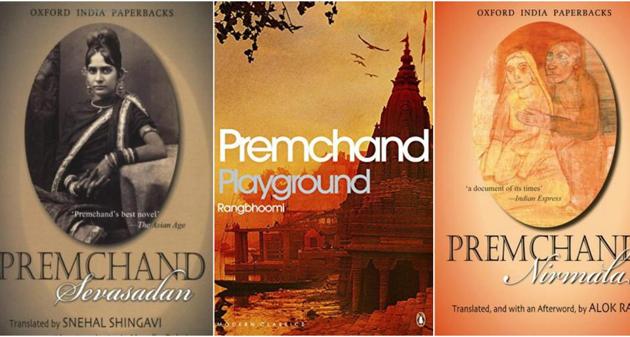
The novel maps the changing socio-economic landscape of Varanasi through the story of Suman, a beautiful, talented woman who is married off to an elderly, poor man as her family cannot afford dowry for a better match. Disillusioned with the institution of marriage, which she begins to see as prostitution but with one client, she befriends a courtesan in her area, and realises such a life would afford her greater freedom to fulfil her ambitions. Sevasadan was made into a film starring MS Subbulakshmi in the lead in 1938.
{{/usCountry}}The novel maps the changing socio-economic landscape of Varanasi through the story of Suman, a beautiful, talented woman who is married off to an elderly, poor man as her family cannot afford dowry for a better match. Disillusioned with the institution of marriage, which she begins to see as prostitution but with one client, she befriends a courtesan in her area, and realises such a life would afford her greater freedom to fulfil her ambitions. Sevasadan was made into a film starring MS Subbulakshmi in the lead in 1938.
{{/usCountry}}Rangabhoomi (1924)
The book tells the story of a blind Dalit beggar, Soordas, who is fighting against the acquisition of his ancestral land. Rangabhoomi, which Premchand believed to be his finest novel, tackles the themes of communalism, atrocities on the poor, untouchability, politics of land acquisition and development at the cost of displacement, making it a relevant read for contemporary times as well.
Nirmala (1928)
Nirmala was first serialised in Chand, a woman’s magazine, in 1928. Social critique and reform form the crux of the book’s themes. Nirmala’s fiance backtracks on marriage after her father’s death diminishes hopes that she’d bring a sizeable dowry. Her mother is forced to marry Nirmala to a widower who is old enough to be her father. Her husband is a suspicious man who begins to imagine that Nirmala is having an affair with his eldest son, who is about Nirmala’s age.
Ghaban (1931)
In this classic of psychological realism, Premchand looks at corruption – moral and otherwise – in the urban middle class. A morally weak man incurs huge debts in his attempts to satiate his wife’s desire for jewellery. To pay back the loans, he embezzles government money and then is forced to abscond.
Ghaban was adapted for the big screen by in 1966 by Hrishikesh Mukherjee. It had Sunil Dutt and Sadhna playing the lead roles.
Godaan (1936)
Premchand’s last novel, Godaan, is considered by critics to be his best work. The focus of the story is the exploitation of the Indian farmers under the British colonial rule. The plight of the poor farmers is presented through the trials of Hori and his family who are forced into debt by circumstances and political corruption. Hori fulfils a life-long dream when he buys a cow but incurs a huge debt in order to do so. Godaan was made into a film in 1963, starring Rajkumar, Mehmood and Shashikala.
Follow @htlifeandstyle for more