
Coming to terms with change and modernity
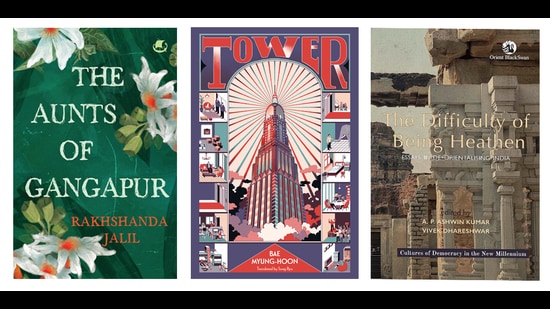
Zuby has a plan to escape Delhi’s unforgiving smog; she will take her beleagured lungs to her husband’s ancestral home in Gangapur and wait out the winter. Many years after she first arrived as a not-so-shy bride, she settles into a cottage set inside a mango orchard. But her hope for some peace and quiet is quashed soon enough, as her husband’s larger-than-life family descends, invited or uninvited.
In the days-and nights-that follow, the lines become blurred between what’s real and what isn’t, as tales unfold of broken promises and unclaimed treasures, of shocking losses and equally unexpected gains.
Tender and deeply moving, The Aunts of Gangapur shines a light into the life of a traditional Muslim household coming to terms with change and modernity. Shot through with laughter as well as piercing grief, it brings together the colours of life and love in an unforgettable chiaroscuro.*
Hypermodern dystopia
Tower is a series of interconnected stories set in Beanstalk, a 674-story skyscraper and sovereign nation. Each story deals with how citizens living in the hypermodern high-rise deal with various influences of power in their lives: a group of researchers have to tell their boss that a major powerbroker is a dog, a woman uses the power of the internet to rescue a downed fighter pilot abandoned by the government, and an out-of-towner finds himself in charge of training a gentle elephant to break up protests.Bae explores the forces that shape modern life with wit and a sly wink at the reader.*
Questioning colonial descriptions
{{/usCountry}}Questioning colonial descriptions
{{/usCountry}}There are many cultures. However, only one culture – a Western, colonial culture – has offered descriptions of the other cultures. These Western descriptions have recently been questioned by postcolonial theory/discourse, which had not, however, studied the colonial culture that produced these descriptions.The Difficulty of Being Heathen aims to radically question colonial descriptions of Indian society. It shows how such descriptions are not factual reports about Indian society, but reflections of the Western culture’s experience of Indian social realities.Instead of providing knowledge about the society it tries to describe (that is, India), colonial descriptions refer instead to the experience of the culture that does the describing (that is, the West).Creating a new framework for understanding issues relating to history, politics, law, and community formation in India, this volume challenges such colonial descriptions while providing a theory about the structure of the Western experience of Indian society.*
*All copy from book flap.