How old were you when you first encountered the Kecak form and what did you feel?
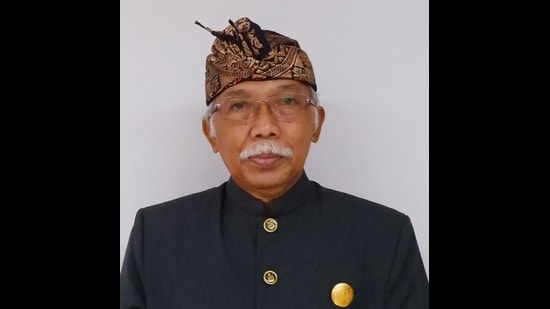
I first encountered kecak in the 1960s when I was 12. My parents took me to a performance. I was completely overwhelmed by its magical impact. I had earlier trained in playing gamelan (a traditional Indonesian percussion orchestra and musical ensemble) not kecak. After that, I became so curious about the form and its complex rhythm that 10 years later, I started performing kecak.
You learnt the form in those 10 years?
No, in those 10 years I just played gamelan. But in 1969, I was assigned to play the role of Hanuman. I became a known dancer in Bali because of my performances in several festivals – national and international. In my village, they created a new kecak group. When I joined them, I fell in love with the form. The form I was dancing earlier was an Indonesian dance drama form called sendratari.
Who were your teachers in kecak?
I learnt by participating and watching. In 1976, I got a chance to tour in Germany. One of the group members was a kecak leader in his village. I learnt details of the form from him.
{{/usCountry}}I learnt by participating and watching. In 1976, I got a chance to tour in Germany. One of the group members was a kecak leader in his village. I learnt details of the form from him.
{{/usCountry}}Does one need to have a background in percussion to learn kecak?
Not really. A sense of rhythm is more important. When you play gamelan, you have the basic structure of kecak. The skeleton melody or musical frame is there but we don’t use instruments in kecak. We vocalize the rhythm and music. This is a form that people can grow with for a long time without worrying that they cannot buy instruments.
When I attended the kecak workshop, I was struck by the power of the human voice in storytelling. Do you think it’s connected with our innate sense of rhythm that comes from having a heartbeat?
It could be but earlier, kecak was not performance – it was a ritual. It evolved from a trance dance called sanghyang that is used for exorcism. In the 1930s, a Balinese artiste, I Wayan Limbak, turned the sacred art form into a secular art form by attaching the story of Ramayana to it.
How did the Ramayana get chosen as a primary theme for this form?
Well, Ramayana is a popular epic in Bali. It is part of our itihasa – a sacred book for us Hindu Bali people. Many different forms use Ramayana as a dramatic resource. Kecak is just one of them.
Having become so popular with tourists, has the form got diluted in anyway?
The form was created mainly for tourists. That is why the form was very condensed. The story is not linear but episodic and taken from specific parts of the Ramayana. The stories performed in kecak come from three parts of the Ramayana: the Aranya kaanda – when they were in the forest and Sita was kidnapped by Ravana; the Sunadara kaanda – when Hanuman was sent by Rama to look for Sita and from the Yuddha kaanda – when the war happens.
Why only these three chapters?
The scenes from here have a lot of storytelling potential. In my first work on kecak in 1971, I tried the first book of Ramayana – the Baala kaanda. In my Mexican production, I created a kecak performance from the second book – the Ayodhya kaanda, depicting the death of Dasharatha. Later on, I almost broke all patterns and chose from the other chapters as I liked. When it comes to kecak, it is not really entertainment for Bali people. It is too short for their liking – only lasts an hour, whereas they want to watch at least for four to five hours because in the old days the performances were designed to keep people awake while attending temple festivals.
You are a writer, teacher, researcher, dancer and mentor. How do you balance all your roles and which is your favourite role to play?
I see myself as a professor of performing arts but the thing I enjoy the most is dancing on the stage.
Could you share a particularly memorable experience of performing kecak anywhere in the world?
A milestone performance was one in which I played Hanuman in India, in 1969. I was performing in New Delhi’s Kamani Theatre. The experience really built my perspective on the character that I was playing. We had come from Iran after participating in the Shiraz-Persepolis Festival of Arts. A few hours before our performance in Delhi, the leader of the group called me and told me, “This is India. Here, Hanuman is not just a monkey, he is a god.” Being a young dancer at that time, I was so nervous. Luckily one of my other teachers standing with him took me aside and guided me. He shaped my movements, changing them from ape like movements to a more dignified movement. The performance was very well received. That was my first visit to India and this one is my eighth or ninth visit. Knowing Ramayana and Mahabharata, coming to India is like coming to the home of the epics I love.
Is there any religious restriction on who can perform kecak?
Mahabharata and Ramayana are performed in Indonesia by Hindu and Muslim people, especially in Java where the majority is Muslim. There is no taboo. That has always been the case and remains so.
Women were not allowed to perform kecak earlier but now they are?
Till the 1930s, there was a stigma attached to Balinese women performing for public entertainment. After some royal families permitted women to perform for entertainment, society imitated that. In 1990, I worked with my American collaborator to develop a piece with 12 artistes from Bali – men and women. Called Boditjak, it was a combination of body music and kecak. From then, more institutions in Bali started including women in kecak. In 2005, I created an all-women kecak performance in Ubud that is still being performed.
How has your Bangalore tour been?
This is a special trip because for the first time, Balinese art is the focus of the festival that includes a variety of forms. For me, this is a golden opportunity to share the richness of Balinese culture and performing arts as also to show the ancient connection between Indian and Balinese culture. This time we performed with a Yakshagana team on stage! It went very well. I have seen Yakshagana before but this was our first onstage collaboration.
Charumathi Supraja is a writer, poet and journalist based in Bengaluru.