Four days before he died, Jeffrey Archer was making plans. “On Saturday 10th October at 7pm I will be discussing my final novel Adam & Eve at the Cheltenham Festival,” he posted on social media. “I look forward to seeing many of you there.”
PREMIUM
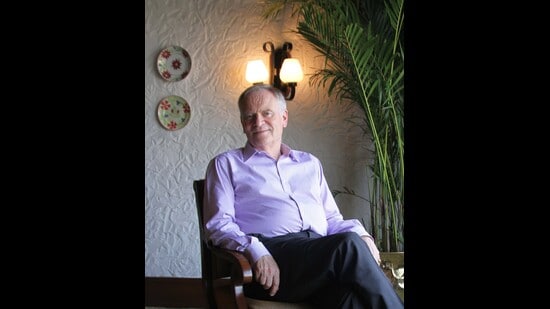
Author Jeffrey Archer (15 April 1940-5 October 2026) (HT Archive)
{{^htLoading}} {{/htLoading}}
Sadly, Archer died suddenly at home on Monday, October 5, “between writing sessions”, according to his publisher HarperCollins. He was 86. Adam & Eve, which he had spent years thinking about and had announced as
Jeffre Archer said his last novel, Adam & Eve is “the most satisfying thing I have ever written”
Adam & Eve begins on November 11, 1918, as World War I comes to a close. Two children are born on the same estate within hours of each other: Adam, the son of a shepherd, and Eve, the daughter of an Earl. Their lives and love later cross with another war and one of its turning points, September 15, 1940.
{{^htLoading}} {{/htLoading}}
Archer said the idea came from reading a speech by Adolf Hitler and Winston Churchill’s response to it. He became fascinated by Operation Seelöwe, Nazi Germany’s planned invasion of Britain, and a counterfactual question: what might have happened had Hitler made different decisions in September 1940?
{{^htLoading}} {{/htLoading}}
As part of his research, he read speeches by both wartime leaders, consulted historians, and studied Leo McKinstry’s history of Operation Sea Lion (Seelöwe). The history had to be right “so the invention could stand on it”.
The idea had stayed with him for some 20 years. The finished novel ran to around 150,000 words. What started as a love story unexpectedly became a thriller. At 86, he decided it would be his last full-length novel.
“I did not say I would stop writing,” he clarified on his website. “I said I would stop writing big novels.” He said Adam & Eve was “the most satisfying thing I have ever written”, and there was something to be said for stopping with the book he was proudest of.
{{^htLoading}} {{/htLoading}}
The first novel
Adam & Eve came 50 years after his first novel. In 1974, Archer was bankrupt and out of Parliament, after a disastrous investment in a fraudulent Canadian company.
15 publishers rejected Not a Penny More, Not a Penny Less, Archer’s first novel.
“I sat down and wrote Not a Penny More, Not a Penny Less, partly to express my anger at having been swindled, and partly because for a few hours each day I could control something on a page when I could control nothing in my life,” he later wrote.
{{^htLoading}} {{/htLoading}}
15 publishers rejected it before Jonathan Cape published it in Britain in 1976. Its first hardback edition sold just 3,000 copies.
Kane and Abel, about two ambitious men born on the same day into very different circumstances, was released in 1979. It changed his fortunes. It became an international bestseller and remained the book most closely linked to his name. By the time he was writing Adam & Eve, it had reached its 132nd reprint. Over his career, his books sold more than 300 million copies in 119 countries.
India became one of Archer’s most enthusiastic markets. He visited repeatedly and was often bemused by the size of his readership here.
The Hindi film Khudgarz (1987) drew on the story of Archer’s Kane & Abel
In a 2019 interview with Hindustan Times, he recalled being told that tens of millions of Indians had read Kane and Abel. The novel also found an afterlife on Indian screens: the 1987 Hindi film Khudgarz drew on its story, while YRF Television officially adapted it as the 2011 series Kismat, relocating the two protagonists to independent India.
{{^htLoading}} {{/htLoading}}
Archer believed Abel Rosnovski, the poor Polish immigrant who works his way to the top, appealed to Indian readers because of his ambition and drive. “The Indians love Abel,” he said. “I think in India it’s the aspirational part of the story.”
How he worked
Keeping a story moving was central to Archer’s success. He liked to call himself a storyteller rather than a writer. His bibliography ran to more than 30 novels, short-story collections, plays, prison diaries, and children’s books, including two long-running series, the seven-volume Clifton Chronicles, and the William Warwick novels.
His working method was strict.
Kane and Abel , about two ambitious men born on the same day into very different circumstances, is one of Archer’s most popular novels.
Archer wrote longhand on lined A4 pads because he liked “the slowness of the pen’s movement”. He worked in two-hour shifts, four times a day, six days a week. An hourglass given to him by his wife Mary sat on his desk. When the sand ran out, he turned it over; when it emptied again, the shift was done.
{{^htLoading}} {{/htLoading}}
“There is no negotiation with the sand,” he wrote on his website.
He was just as disciplined about revision. His novels routinely went through at least 14 drafts; Kane and Abel went through 18, while Adam & Eve went beyond 20.
His editor Kate Elton, now HarperCollins UK CEO, described him after his death as “phenomenally hard-working, utterly committed to completing draft after draft to get every word as perfect as possible”.
Politics, scandal, and prison
Born in London in 1940 and raised in Somerset, Archer entered politics young, becoming Conservative MP for Louth in 1969. He later returned to frontline politics and served as deputy chairman of the Conservative Party under Margaret Thatcher. He was made a life peer in 1992.
{{^htLoading}} {{/htLoading}}
Scandal overshadowed his political career. In 1987, Archer won £500,000 in damages after suing the Daily Star over allegations that he had paid a woman for sex. Years later, evidence emerged that he had lied during the case. In 2001, he was convicted of perjury and perverting the course of justice and sentenced to four years in prison. He served two and was released in 2003.
The three-volume A Prison Diary , recorded life behind bars
Even prison became material. Archer wrote the three-volume A Prison Diary, recording daily life behind bars. His political reputation never fully recovered, but his readership remained loyal. He stayed in the House of Lords until retiring in 2024 and continued to publish bestsellers.
The final chapter
Archer’s fiction kept returning to ambition, reversals of fortune, and people starting again.
In the prologue to Adam & Eve, he looks back over 50 years, from those 3,000 hardback copies of Not a Penny More, Not a Penny Less to the book he called his most satisfying writing endeavour.
“Allow me to end by thanking all my readers from around the world,” he writes, naming cities from Sydney and Toronto to Buenos Aires, New York, Mumbai and Tokyo, and thanking them for allowing “this simple storyteller the privilege of spending so many hours in your company”.
The prologue was written as a novelist signing off after 50 years. Published the day after his death, it reads differently.
“As Marcel Proust reminded us: ‘We always end up doing the thing we’re second best at’,” Archer writes. “I can only hope that you’ve discovered what you’re second best at.”
Teja Lele is an independent editor and writes on books, travel and lifestyle.
{{^htLoading}} {{/htLoading}}
Four days before he died, Jeffrey Archer was making plans. “On Saturday 10th October at 7pm I will be discussing my final novel Adam & Eve at the Cheltenham Festival,” he posted on social media. “I look forward to seeing many of you there.”
PREMIUM
Author Jeffrey Archer (15 April 1940-5 October 2026) (HT Archive)
Sadly, Archer died suddenly at home on Monday, October 5, “between writing sessions”, according to his publisher HarperCollins. He was 86. Adam & Eve, which he had spent years thinking about and had announced as his last, went on sale October 6.
The timing could have come from one of his own plots.
Jeffre Archer said his last novel, Adam & Eve is “the most satisfying thing I have ever written”
Adam & Eve begins on November 11, 1918, as World War I comes to a close. Two children are born on the same estate within hours of each other: Adam, the son of a shepherd, and Eve, the daughter of an Earl. Their lives and love later cross with another war and one of its turning points, September 15, 1940.
{{^htLoading}} {{/htLoading}}
Archer said the idea came from reading a speech by Adolf Hitler and Winston Churchill’s response to it. He became fascinated by Operation Seelöwe, Nazi Germany’s planned invasion of Britain, and a counterfactual question: what might have happened had Hitler made different decisions in September 1940?
{{^htLoading}} {{/htLoading}}
As part of his research, he read speeches by both wartime leaders, consulted historians, and studied Leo McKinstry’s history of Operation Sea Lion (Seelöwe). The history had to be right “so the invention could stand on it”.
The idea had stayed with him for some 20 years. The finished novel ran to around 150,000 words. What started as a love story unexpectedly became a thriller. At 86, he decided it would be his last full-length novel.
“I did not say I would stop writing,” he clarified on his website. “I said I would stop writing big novels.” He said Adam & Eve was “the most satisfying thing I have ever written”, and there was something to be said for stopping with the book he was proudest of.
{{^htLoading}} {{/htLoading}}
The first novel
Adam & Eve came 50 years after his first novel. In 1974, Archer was bankrupt and out of Parliament, after a disastrous investment in a fraudulent Canadian company.
15 publishers rejected Not a Penny More, Not a Penny Less, Archer’s first novel.
“I sat down and wrote Not a Penny More, Not a Penny Less, partly to express my anger at having been swindled, and partly because for a few hours each day I could control something on a page when I could control nothing in my life,” he later wrote.
{{^htLoading}} {{/htLoading}}
15 publishers rejected it before Jonathan Cape published it in Britain in 1976. Its first hardback edition sold just 3,000 copies.
Kane and Abel, about two ambitious men born on the same day into very different circumstances, was released in 1979. It changed his fortunes. It became an international bestseller and remained the book most closely linked to his name. By the time he was writing Adam & Eve, it had reached its 132nd reprint. Over his career, his books sold more than 300 million copies in 119 countries.
India became one of Archer’s most enthusiastic markets. He visited repeatedly and was often bemused by the size of his readership here.
The Hindi film Khudgarz (1987) drew on the story of Archer’s Kane & Abel
In a 2019 interview with Hindustan Times, he recalled being told that tens of millions of Indians had read Kane and Abel. The novel also found an afterlife on Indian screens: the 1987 Hindi film Khudgarz drew on its story, while YRF Television officially adapted it as the 2011 series Kismat, relocating the two protagonists to independent India.
{{^htLoading}} {{/htLoading}}
Archer believed Abel Rosnovski, the poor Polish immigrant who works his way to the top, appealed to Indian readers because of his ambition and drive. “The Indians love Abel,” he said. “I think in India it’s the aspirational part of the story.”
How he worked
Keeping a story moving was central to Archer’s success. He liked to call himself a storyteller rather than a writer. His bibliography ran to more than 30 novels, short-story collections, plays, prison diaries, and children’s books, including two long-running series, the seven-volume Clifton Chronicles, and the William Warwick novels.
His working method was strict.
Kane and Abel , about two ambitious men born on the same day into very different circumstances, is one of Archer’s most popular novels.
Archer wrote longhand on lined A4 pads because he liked “the slowness of the pen’s movement”. He worked in two-hour shifts, four times a day, six days a week. An hourglass given to him by his wife Mary sat on his desk. When the sand ran out, he turned it over; when it emptied again, the shift was done.
{{^htLoading}} {{/htLoading}}
“There is no negotiation with the sand,” he wrote on his website.
He was just as disciplined about revision. His novels routinely went through at least 14 drafts; Kane and Abel went through 18, while Adam & Eve went beyond 20.
His editor Kate Elton, now HarperCollins UK CEO, described him after his death as “phenomenally hard-working, utterly committed to completing draft after draft to get every word as perfect as possible”.
Politics, scandal, and prison
Born in London in 1940 and raised in Somerset, Archer entered politics young, becoming Conservative MP for Louth in 1969. He later returned to frontline politics and served as deputy chairman of the Conservative Party under Margaret Thatcher. He was made a life peer in 1992.
{{^htLoading}} {{/htLoading}}
Scandal overshadowed his political career. In 1987, Archer won £500,000 in damages after suing the Daily Star over allegations that he had paid a woman for sex. Years later, evidence emerged that he had lied during the case. In 2001, he was convicted of perjury and perverting the course of justice and sentenced to four years in prison. He served two and was released in 2003.
The three-volume A Prison Diary , recorded life behind bars
Even prison became material. Archer wrote the three-volume A Prison Diary, recording daily life behind bars. His political reputation never fully recovered, but his readership remained loyal. He stayed in the House of Lords until retiring in 2024 and continued to publish bestsellers.
The final chapter
Archer’s fiction kept returning to ambition, reversals of fortune, and people starting again.
In the prologue to Adam & Eve, he looks back over 50 years, from those 3,000 hardback copies of Not a Penny More, Not a Penny Less to the book he called his most satisfying writing endeavour.
“Allow me to end by thanking all my readers from around the world,” he writes, naming cities from Sydney and Toronto to Buenos Aires, New York, Mumbai and Tokyo, and thanking them for allowing “this simple storyteller the privilege of spending so many hours in your company”.
The prologue was written as a novelist signing off after 50 years. Published the day after his death, it reads differently.
“As Marcel Proust reminded us: ‘We always end up doing the thing we’re second best at’,” Archer writes. “I can only hope that you’ve discovered what you’re second best at.”
Teja Lele is an independent editor and writes on books, travel and lifestyle.
All Access. One Subscription.
Get 360° coverage—from daily headlines to 100 year archives.
Explore the latest Books News, author interviews, book reviews, literary events and new releases. Discover recommendations, reading lists and updates from the world of literature on Hindustan Times.
Explore the latest Books News, author interviews, book reviews, literary events and new releases. Discover recommendations, reading lists and updates from the world of literature on Hindustan Times.
Home/Books/Jeffrey Archer: The final twist in the tale
{{^htLoading}}
Advertisement
{{/htLoading}}
SHARE THIS ARTICLE ON
{{#usCountry}}{{/usCountry}}
Notifications
Get breaking alerts directly from the newsroom
Notifications are on!You'll be notified when news breaks