In American Hagwon, you extend the idea of education in a globalised world as a way to critique social norms.
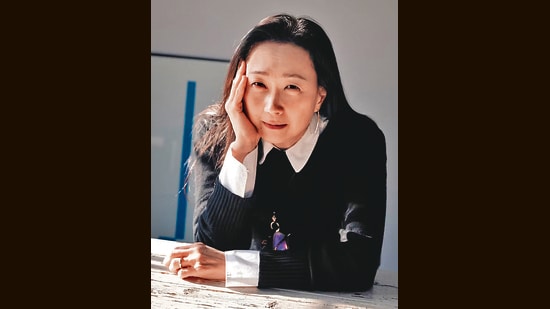
In Korean culture and for Koreans in the diaspora, education is the theme that is most important. It’s not a bad thing. It’s quite a beautiful thing to be born and to want to learn, yet it can be distorted.
For example, I was disturbed by the frequency with which people kept on talking about a person’s resume. I found it strange and unfair to consider a person’s worth be reduced to their pedigree. However, it’s rarely discussed about how these people got there. It’s only about someone’s achievement, and not the other factors. And when you add capitalism, financial crises, parenting, and rapid change, the wish for an elite education can become some sort of sickness.
The hagwon, which is the Korean word for learning centre, was my organising metaphor for all this. Hagwon isn’t a good or bad thing. It depends how much feeling you have for it. This book took me almost a decade, and I hope it will lead us to discuss about what education should mean for each of us and society.
Are hagwons a way to ensure that children are on a specific path to secure their future?
{{/usCountry}}Are hagwons a way to ensure that children are on a specific path to secure their future?
{{/usCountry}}Well, there is formal education — the state-approved education, then, private education and shadow education. Learning centres are part of shadow education because they track formal learning. They’re also supplemental, which means they’re dependent upon how much money you have.
It’s my understanding that, in India, in order to become a civil servant — say, a ticket collector on a train — you’ve got to take an exam. Similarly, in Korea, if you want to become a civil servant, you have to take an exam, and these exams are difficult. In both cases, the exams have little to do with the work required.
But this filtering of human beings, human lives, and human hopes through exams is so tragic because what people want is stability; they want to feel useful; they want to work. These examinations, on the other hand, are efficient and valuable for people in power, but it’s often a tragedy for those who aren’t the gatekeepers.
Therefore, sometimes these learning centres, they become almost like an act of resistance. They say about those gatekeepers: “We’ll get them.” We’ll get our students through. There are varying opinions about these learning centres. Whether they’re serving any good or not, I respect that parents and young people feel that they need to have these learning centres in order to have a chance at a better life.
What I’ve learnt is that the strategies that are most effective to live better are related to relationships. If you don’t have good friendships, good kinship with family members, it’s difficult to accept all the disappointments along the way. So, I think that’s my antidote to a crazy world, which is what I think American Hagwon is all about.
Let’s assume none of the structured patterns of education existed. Then, how would one’s learning be shaped and what would become of society?
One of the things I like about modern society is that we’ve a greater understanding of how the brain works. Neuroscience has helped us in recognising how learning patterns are impacted by relationships to how we learn as individuals differently, but we continue to give too much credence to the old-fashioned ways of learning. The one in which the longest you sit in the chair and memorise the most, the one in which it’s judged who can recall all that, and also handle the pressure of recalling… that person is considered the ideal learner. But we have aspects like neurodivergence, so, are we accommodating all the different ways of learning? I think that’s happening gradually. However, I think each nation needs to have a general competence.
Though I’m not a sociologist and not an education expert, for the United States, I can say that the general competence has considerably declined. Each statistical data demonstrates it, which is why there’s anxiety about education outcomes in parents. They have this fear, and they’re putting this fear on their children because they want their children to be more competent, fit, and adaptive for a very fast-changing world. This fear is increasing by the day as they feel their children aren’t ready for any of it. But the thing is, this discussion — regarding this change — isn’t happening publicly. Instead, we’re asking our children why they are not working harder. “Why are you so lazy? What’s wrong with you?” This isn’t helpful. The other thing is that governments can step in here, but I think even governments are letting people — its children — fall far behind.
Taking from what you said, immigrant parents want their children to do better than everyone else. In the book, George says that Korean children in America are lazy. What do you make of these harsh expectations?
Some immigrant parents experience a kind of unconscious wound and such parents feel that they don’t have their rightful status in this new country. They used to be somebody else somewhere, so they feel that their children should earn that status they’ve lost. I don’t think they’re even thinking about this while wishing things for their children, because as an adult, all they have is this pain. Then, their children feel this pain, and all they want to do is reclaim something for their parents.
I’ve witnessed this globally, and I think for overseas children — and the descendants of overseas children — this pain is carried and enacted. But many children cannot do this work of reclaiming their parents’ status.
The IMF-induced crisis is known as the Asian financial crisis, and Third World countries now have to bear the burden of climate change. What do you think about First-World problems being labelled as Third-World problems?
There is global inequality in blame. This misattribution and inaccuracy of history, the ignorance of what’s going on in the world, this results in an unequal distribution of pain. Diaspora is a permanent condition now. For everybody. And they’re of varying types. There’s a political diaspora. Then, there’s this environmental diaspora, which you’re getting at. Then, there’s an economic one. But the commonality is this: in all this, our bodies — human bodies, which move across borders — become targets of moral judgements.
My focus is on our shared humanity. It’s easier to blame the other for any problem. For example, the way we blame our parents isn’t always fair. When parents push their children, often, it is to wish good for a child. Isn’t that a protective wish? It isn’t necessarily bad. It may be coming from a different place, which is what I tried [depicting in the novel]. Our lives have often been decontextualised, and consequently, our humanity is misunderstood.
Or maybe someone else wishing good for a child is misunderstood. In the novel, there’s Ginny whose guardian is an old woman. She can’t take care of her in the event of her parents’ failure to provide for her because of the IMF crisis. She keeps repeating that she did all she could. It was such a humane moment when she was vulnerable in front of Lion. Tell us about this moment.
Oh, thank you so much. What happens with Ginny is that her parents used to work in America. She was born there, so she does have a US citizenship but this nine-year-old child is left behind in America with her guardian to provide for her survival.
Her parents have lost their status and everything from the Asian financial crisis, but they want to leave Ginny in America so she could learn — and have a better future of her own. But this retired guardian isn’t a wealthy person. She’s trying to take care of Ginny but her parents have stopped paying for the provisional fees of their child, so in this section you mention, we’re considering the dynamics of the two hagwon owners and their teachers. The one owned by Lion wants to take the responsibility of Ginny. But this guardian, who’s taking care of a child who’s literally dropped in to a country, trying to handle things on her own, whose crime is that she was born into a middleclass household and the one who can’t ride out the economic global storm like the IMF crisis, what must she do? And in that Lion steps up to help.
Please talk about the inherent similarities between Sonya and Danbi. Though they’re starkly different characters but they’re united by their desire to do and achieve something for themselves at any cost? However, the gaze on Danbi is entirely different to the one on Sonya.
Well, the idea of gaze is all about who’s looking. Who’s controlling this gaze? And for what purpose do we’ve this gaze, either on Sonya or Danbi?
Sonya and Danbi are both beautiful. Ages apart though, but they both grew up very poor. It’s a kind of shocking poverty that people in India and Korea can understand; other countries maybe not.
When people see women of their kind climbing to the very top of society, things are unfair for them. They’re mistreated for who they used to be, every day, and I think that level of relentless discrimination affects their philosophy on life and also their code of conduct and rules of engagement.
I admire these women, though ethically they’re different. For example, Danbi does terrible things, but a part of me understands why she does it because, for me, one of the things that was very clear was just how sexual she is. She wasn’t just using sex to have her way; she needed sex. That’s what was so interesting to me in the case of Danbi. Her behaviour is not logical because her attitude towards life is very different. Isn’t she behaving like how most men do? But they are understood. The behaviour men justify isn’t something that Danbi is afforded.
Though there’s infidelity, something almost religious binds people together in the book. Is American Hagwon about marriage as well?
Absolutely. With this novel, I was trying to understand the bonds that keep society together. So, you have these economic shocks, these kinds of monstrous things that happen at the hands of very few people, but they affect the world in different ways.
We live in this kind of decoupled world economically but our behaviours are actually linked. For example, the interest rates in America affect people in Asia, or in Fiji, or a trader in New Zealand. Vut we’re not paying attention to any of it.
Most people, when they wake up, they have their set priorities. They have to go to work, feed their child, put housing things together, get health care. Or they have to take care of their sick mother; take her to the hospital. All these things are happening and in all these scenarios, the sorts of bonds they are choosing to preserve was something that I was trying to explore. In any such scenario, what would you honour? Which bonds would you try to honour because let’s face it, most people don’t have all those bonds, so what will they choose, need or want to prioritise? Is it marriage, or chosen family, or friendship? I had to look at all that because I wanted to understand human beings who don’t have intergenerational wealth and how they survive in this world. How do they make the requisite power or social capital to survive?
Saurabh Sharma (they) is a nonbinary, queer writer, essayist, and culture critic. On X: @writerly_life; Instagram: @writerlylife.