The tributes began pouring in almost as soon as Maria Aurora Couto (1937-2022) breathed her last on 14 January 2022. If she had to choose, she couldn’t have picked a better day than Makar Sankranti with its traditional urging of Tilgul ghyaa, god god bola, for 84-year-old Maria (she would have turned 85 in August) was not only eclectic, non-dogmatic, tolerant, and free thinking in her emotional affiliation with multiple religions and cultures but restrained in expression even at her most outraged.
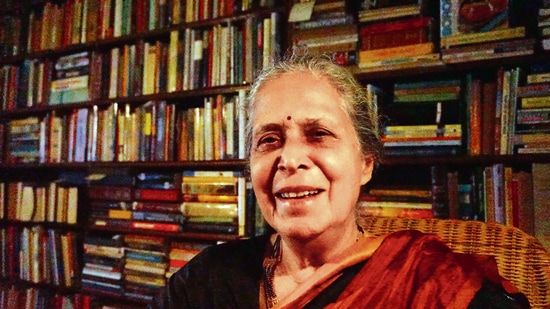
I first met Maria in the 1970s at a literature conference in Delhi, a soft-spoken, upright figure, startlingly elegant and dignified in a crisp cotton sari. Age did not diminish that Maria, even in the recent past when she was no longer as mobile as she would have liked to be. Confined to her verandah in Aldona she retained her sparkle and gentle irony, reading voraciously, conversing in a way that drew one in and made one want to listen. Critical and fearless in expression, she combined serious scholarship with sagacity, compassion, humanism, and endearing humility. It was hardly surprising that she chose Graham Greene as her subject for she was in many ways a fellow-traveller, sharing Greene’s obsession with the complexities inherent in the workings of ideology, politics, power, and the limits of Catholicism.
Graham Greene: On the Frontier, Politics and Religion in the Novels (1988) remains one of the finest scholarly studies of a literary Colossus who rattled the conscience of the fraternity at large and remained significantly deprived of the tokens of recognition the establishment bestows on more accommodating writers. Like her book on Greene, Maria’s Goa: A Daughter’s Story (2004), was unsparing in its analysis of thorny cultural and socio-political realities including the less desirable effect of the Portuguese colonial past. Part autobiography, part critique of that past, it mirrored her ability to look at her world steadily and see it whole for the most part, arousing a mixed reception in the State she now called home. Maria’s own chequered stays in parts of India both as a girl-woman and later as a spouse as well as her husband’s broadness of vision moulded many of her perceptions. Her growing concern for her own immediate environs did not blind her to the inevitability of the country’s mixed heritage. Her anguish at the current state of affairs was inseparable from her memories of life with Alban Couto and the many conversations they had about the connect between power, politics and socio-cultural realities. In a way, this was also bound up with her own sense of history as an interlinked evolutionary process.
{{/usCountry}}Graham Greene: On the Frontier, Politics and Religion in the Novels (1988) remains one of the finest scholarly studies of a literary Colossus who rattled the conscience of the fraternity at large and remained significantly deprived of the tokens of recognition the establishment bestows on more accommodating writers. Like her book on Greene, Maria’s Goa: A Daughter’s Story (2004), was unsparing in its analysis of thorny cultural and socio-political realities including the less desirable effect of the Portuguese colonial past. Part autobiography, part critique of that past, it mirrored her ability to look at her world steadily and see it whole for the most part, arousing a mixed reception in the State she now called home. Maria’s own chequered stays in parts of India both as a girl-woman and later as a spouse as well as her husband’s broadness of vision moulded many of her perceptions. Her growing concern for her own immediate environs did not blind her to the inevitability of the country’s mixed heritage. Her anguish at the current state of affairs was inseparable from her memories of life with Alban Couto and the many conversations they had about the connect between power, politics and socio-cultural realities. In a way, this was also bound up with her own sense of history as an interlinked evolutionary process.
{{/usCountry}}I reconnected with Maria at the Kala Ghoda Festival in early 2014 when we both shared a session talking about our respective memoirs, Family Fables and Hidden Heresies: A Memoir of Mothers & More (2011) and Filomena’s Journeys: A Portrait of Marriage, a Family and Culture (2013). In both the gendered experiences of women’s lives were central to the narrative, but the lives themselves were very different. We were so fascinated by these similarities and divergences, that when we came together again at the Goa Arts and Literature Festival a few months later, Maria requested the organisers to do away with a Chair and let us conduct the session ourselves (“We’ve both been Professors and like to do the talking!”). And so began one of those rare adult friendships which continued all these years, through emails, phone calls, and a constant exchange of material ranging from the quirky to the intellectual to the deeply disturbing. During all this time, she continued with her several commitments, including the setting up of a unique multi-disciplinary academic platform supported by the Department of Art and Culture and Goa University.
Over the past several years, my academic visits to Goa meant I saw a great deal of Maria. Evenings on her roomy verandah, the discovery of unique eateries like Horseshoe (“It’s a place I only take a very few people to”), musings on what to watch next on Netflix, the many distressing examples of a polity in turmoil, confidences not shared with others, our own conflicted motherhoods and good fortune in our spouses, these and much more were crammed into meetings which never seemed enough, but all these were put on the back burner by the surreal horrors of the last two years. During this time, we spoke and emailed each other as often as we could. Sharp-sighted and clear-headed to the end, Maria had begun to show signs of – not giving up but growing tired. Of her own frailty, the growing intolerance she saw around her, and the slow unravelling of what was best in the Goan identity. “The whole situation is sort of getting me down more than I like to admit,” she wrote some months back. “I need a sense of purpose and just survival seems pointless!” But overriding it all was her own ebullience, born of a lifetime of involvement in life around her.
And so, the news when it came was difficult to accept, even though one had been told she was in intensive care. It was hard at a personal level to imagine Goa without its incomparable daughter. Crumbling inside, one could only do what she would have wanted: raise a glass to her and remember the good times.
Vrinda Nabar is the author of Caste as Woman and Family Fables and Hidden Heresies: A Memoir of Mothers & More, and a former Chair of English, Mumbai University.