I fell in love with Rome long before I visited it. First through Roman Holiday, and later, as a first-year architecture student, when I spent weeks studying the city’s piazzas and domes for a case study. Then came Dan Brown’s Angels & Demons, with its churches, conspiracies, and hidden passages. It was a different Rome!
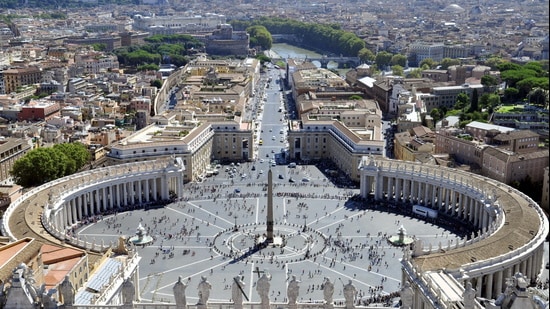
Years later, exploring those same spaces, I find that the Eternal City shape-shifts with whoever is writing about it.
From the window of my room at Anantara Palazzo Naiadi Rome, I look out at the Fountain of the Naiads in Piazza della Repubblica, espresso in hand. Four bronze nymphs recline around the basin, representing rivers, lakes, oceans and underground waters, while Glaucus, the sea god, wrestles a fish at the centre. Around it stands a city of ancient ruins, Renaissance palaces, Baroque churches and piazzas where people have gathered for centuries.
Rome is an open-air museum that people still live and work in. Even after days of walking its streets, there is always another church to step into or another courtyard to find. No single visit is enough to see it all, and no single book can capture all the Romes that have existed over the centuries.
{{/usCountry}}Rome is an open-air museum that people still live and work in. Even after days of walking its streets, there is always another church to step into or another courtyard to find. No single visit is enough to see it all, and no single book can capture all the Romes that have existed over the centuries.
{{/usCountry}}These 10 books span more than two millennia, moving from epic poetry and first-hand history to historical fiction, memoir, literary fiction and a thriller.
1. The Aeneid, Virgil
Begin with Rome before Rome. Virgil’s epic follows Aeneas, a survivor of the fall of Troy, on the long journey through Carthage and the underworld to Italy, where he fulfils his destiny as the ancestor of the Roman people. Written during the reign of Augustus, The Aeneid turns Rome’s beginnings into myth, tying them to exile, war, duty, and divine purpose. It says little about the physical Rome that survives today and a lot about how Rome imagined itself: a civilisation whose rise had been ordained long before the city was founded.
2. The Civil War, Julius Caesar
If Virgil gives Rome its founding myth, Julius Caesar takes us into its political world. The Civil War is Caesar’s account of his conflict with Pompey for control of the Roman Republic, starting with the political crisis that tipped Rome into war. The fighting spread from Gaul and Spain to Asia and Africa, but the struggle for power was still centred on Rome. Caesar took part in these events himself. That makes the book valuable, but you need to read it knowing who is telling the story.
3. I, Claudius, Robert Graves
Robert Graves turns imperial Roman history into a family story of ambition, suspicion, murder, and survival. Published in 1934 and presented as the autobiography of Emperor Claudius, the novel follows a man dismissed by his family as weak and foolish because of his physical disabilities. His apparent insignificance protects him as Augustus, Tiberius, and Caligula rule and the imperial family schemes against itself. Claudius survives to become emperor in AD 41. Graves showcases Rome from inside the imperial household, where marriages are political, relatives can be dangerous, and going unnoticed can keep you alive.
4. The Agony and the Ecstasy, Irving Stone
Irving Stone’s biographical novel follows Michelangelo from his early training in Florence through his long career as an artist and sculptor. Rome becomes central through his relationship with Pope Julius II, the painting of the Sistine Chapel ceiling, and his later work on St Peter’s Basilica. Published in 1961, the novel draws on Michelangelo’s correspondence and adds Renaissance Rome to the list, a time when artists, architects, popes and patrons shaped many of the works and buildings that still define the city.
5. The Woman of Rome, Alberto Moravia
Alberto Moravia’s Rome is a long way from Virgil’s heroic city. Published after World War II and set in Mussolini’s Italy, The Woman of Rome centres on Adriana, a young woman whose hopes for marriage, a home and children give way to a life as a sex worker. Around her are Giacomo, a student and failed revolutionary; Astarita, a secret-police officer obsessed with her; and the violent Sonzogno. Moravia shows a city of poverty, desire, political repression, and compromised choices, seen from its streets and rooms, not its monuments.
6. A Time in Rome, Elizabeth Bowen
Elizabeth Bowen spent several months in Rome in 1958, and A Time in Rome, published two years later, grew out of that stay. She moves between the city’s history and her experience of its streets, buildings, ruins, and neighbourhoods, writing about places such as the Forum and the Appian Way along with cafés and everyday Roman life. This isn’t a conventional guidebook. Bowen is interested in the layers of the city and how ancient Rome remains part of the modern one. The book is as much about living in Rome for a time as seeing its sights.
7. Four Seasons in Rome, Anthony Doerr
On the day his wife gave birth to twins, Anthony Doerr learnt that he had won the Rome Prize, giving him a year at the American Academy in Rome. Four Seasons in Rome follows that year: sleepless nights with two babies, attempts to write, neighbourhood shops, and walks through a city he is slowly getting to know. He reads Pliny, Dante and Keats, visits piazzas, temples and churches, waits at the Pantheon hoping to see snow fall through its oculus, and witnesses the vigil and funeral of Pope John Paul II. Ancient monuments are juxtaposed alongside the practical business of raising two children in an unfamiliar city.
8. Eat, Pray, Love, Elizabeth Gilbert
Rome takes up only the first part of Elizabeth Gilbert’s memoir, but it supplies the “Eat” in the title. Gilbert arrives in Italy after a painful divorce, to learn Italian and to eat -- and to let herself enjoy both. She studies the language, makes friends, and eats her way through Rome before the book moves on to an ashram in India and then Bali. Her Rome comes largely through language, food and everyday pleasures, not monuments. It’s an outsider’s view of the city, and a personal one, shaped by what Gilbert needed from Rome at that point in her life.
9. Angels & Demons, Dan Brown
Dan Brown turns Rome into the setting for a fast-moving treasure hunt. Harvard symbologist Robert Langdon arrives as the Vatican prepares for a conclave and gets caught up in a race involving the Illuminati, a deadly weapon and a trail of symbols. Crypts, churches, catacombs, and sculptures become clues as Langdon and scientist Vittoria Vetra hurry across the city. Historical accuracy isn’t the point. The appeal lies in how Brown uses Rome’s art and architecture to drive the plot: Bernini sculptures, churches and piazzas are part of the mystery, not just a backdrop.
10. Roman Stories, Jhumpa Lahiri
Jhumpa Lahiri’s Roman Stories brings the list into the contemporary city. Originally written in Italian, the nine stories are set among Rome’s apartments, staircases and neighbourhoods and explore the lives of families, migrants and outsiders. In The Steps, a public staircase connecting two neighbourhoods becomes a vantage point for watching people move through different social worlds. Elsewhere, Lahiri writes about foreignness, belonging, racism, and the uncertain meaning of home. After emperors, political intrigue and conspiracies, Roman Stories spotlights the people living in Rome now.
Teja Lele is an independent editor and writes on books, travel and lifestyle.