You’ve noted earlier that you had the story but not the characters to tell it, and the character came to you when you saw the photo exhibition by Pepa Hristova in Sofia, dedicated to the ‘sworn virgins of Albania’. What struck you that made you invent this character, Bekija/Matija?
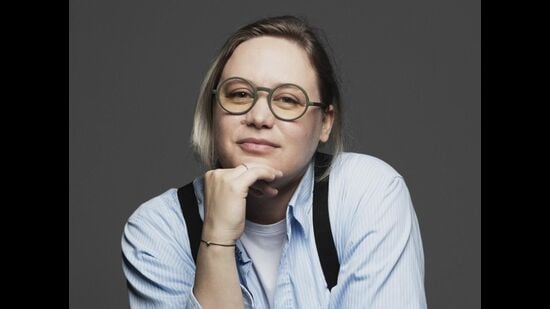
I’m interested in the female and male energies in people, and how they reflect on the body itself. How the body manifests our inner worlds.
I saw the photo exhibition of
You’ve noted earlier that you had the story but not the characters to tell it, and the character came to you when you saw the photo exhibition by Pepa Hristova in Sofia, dedicated to the ‘sworn virgins of Albania’. What struck you that made you invent this character, Bekija/Matija?
I’m interested in the female and male energies in people, and how they reflect on the body itself. How the body manifests our inner worlds.
I saw the photo exhibition of the ‘sworn virgins’: women who look like men and who live as men. I was struck by how the body responded to this external environment. It wasn’t a gender transition — something coming from the inside — but a social one; it came from the outside. Through Bekija/Matija, I wanted to, in the end, find the balance of energies, to bring back this character to her natural state of being.
The otherworldliness of She Who Remains isn’t lost on readers. Tell us about working on the project and with the translator.
While writing the book, I was in a very strange meditational state. And I think, as far as I know, Izidora also somehow entered that space when she was translating this book, because I don’t think there’s any other way of translating it. You have to really dive into it, into the deep levels of your subconscious mind. That’s why the translation turned out to be so great.
When you wrote it in Bulgarian, what sort of structure and stylization did you privilege?
I’ve been asked that quite a lot. But, let me tell you, I didn’t consciously invent it. It was more like a voice appeared out of nowhere and wanted to tell this story. And this voice was like a flow of energy, emotions, and thoughts. That’s how it was invented.
In the beginning, I had the main stones of it, the plot. I knew what was going to happen. After that, I had that vision. When I started writing, I switched off my mind, and I simply channelled. And it’s how the story came out.
Bekija’s transition to Matija in the book is not born out of feeling disassociated necessarily but being disempowered. Reading other accounts of ‘sworn virgins’, it feels that this transition’s necessity rules out the predominant gender discourse.
Well, she is disempowered. She has the “choice” to become a man, which isn’t actually a choice per se because it’s a man’s world, and women don’t have much rights at all. So, becoming a sworn virgin is an act of survival because that way she will not lose her life. She wants to escape that marriage and save her own life. So, taking the oath is the only way she can save herself. But there’s a price to pay.
By becoming a man, she gains the rights of men. In comparison to women’s rights, they’re much more but she isn’t really free, she has only survived. From another point of view, she isn’t living her life. And that’s the most important thing here: she has to give up on her life, which is contrary to any freedom. So, what does it cost to be free? To have the rights of men? To be yourself? These are the questions that are put forth in the book.
Matija notes “freedom is a dangerous thing”. Please tell us more about this.
The laws of the Kanun are the base of the story. Like the rough environment that puts constraints around my characters, creates their limits, puts them in prison. Not only of the body but also of their spirits. So, that’s the surface of the story, the laws.
But the more important thing is what’s happening inside these characters. What are their inner battles? Because it’s also a book about family dynamics, the father-daughter relationship, the sister-brother relationship. And the Kanun is the thing that creates the conditions under which they betray each other. It’s every man for himself. If you live, someone else has to die. Ultimately, we have to forgive those who betray us and those we betray.
The colour blue is crucial in the life of Bekija. It’s her way of signalling to be Matija. There’s an array of literature, invoking the colour blue, literally and metaphorically: Blue Nights by Joan Didion, Blue Is Like Blue by Vinod Kumar Shukla, translated from the Hindi by Arvind Krishna Mehrotra and Sara Rai, and Bluets by Maggie Nelson come to mind. What’s the association of blue in relation to the story, and what are your favourite stories surrounding colours?
It depends on the period of in my life. I’ve different favourite colours for different experiences, different periods.
But if I have to talk about the blue colour, I remember watching the movie, Blue Is the Warmest Colour, and also Blue Valentine, starring Ryan Gosling—it’s a sad movie about love.
Even the colour blue corresponds to different states of being, emotions in different periods. The variation of the colour blue I love the most is that of the gemstone, lapis lazuli. It’s blue with the golden ashes, so I love when there’s a story around colours. In the past Egyptians brought these gemstones, crushed them to make the blue colour for their paintings. Michelangelo did that. That colour was the most expensive one in the past. The reason why the clothes of Jesus Christ are always in that colour … and the Royal Blue, the colour for the King’s attire.
But there’s another colour in my book, red. It’s the exact opposite. That’s the colour of female energy. You can see that in the US edition of our book. Interestingly, I was at this event, presenting the Serbian edition of the book in Belgrade in Serbia, and the ambassador of Bulgaria came wearing red. And even in Sofia, in Bulgaria, so many people at the event came in red clothes. So, somehow readers are associating themselves with the colours in the book, which is nice.
If I must talk about what colours I chose in my life, then it’d be these two: black and white. I wear black a lot in the winter. I use black for protecting my energy. It’s a way of me telling people to not stay close to me, that I need my energy, so I put that invisible boundary. And there is that psychological thinking that you don’t get [closer] to a person when they’re dressed in black. The white, on the other hand, I wear during the summer. It’s God’s colour, really. It’s so pure. It also reflects the energies. The sun is much stronger on your black clothes, but when it’s white, it’s different. It reflects. It throws away the light and keep the light in yourself. So, there’s a very deep psychology about colours in life, and of course, in books too.
You are also into movie making. What is it like to dabble in these two different forms — writing books, and doing movies?
Cinema and literature are very different art forms, but, for me, it’s the first thing that I look at in a work of art: Am I making poetry with it? Because I am always looking for the poetry. As you see, She Who Remains is very cinematic but it’s because when I write, I see images and these scenes I envision, it’s like watching a movie, then I transcribe them in a language I know.
Turning these images into a book, then into a script wasn’t difficult for me. Now I’m working on a theatre adaptation of the book, so I am using the book and the script to create that. Everything I see, I see as scenes in my head, and it’s just a matter of which medium I will choose to tell those stories.
Saurabh Sharma (they) is a nonbinary, queer writer, essayist, and culture critic. On X: @writerly_life; Instagram: @writerlylife.
One Subscription.
Get 360° coverage—from daily headlines
to 100 year archives.
Archives
HT App & Website