The second edition of the India Music Retreat held at Fairmont Jaipur from September 18 to 20 showcased a diverse range of music including Hindustani and Carnatic classical to ghazals and contemporary Bollywood.
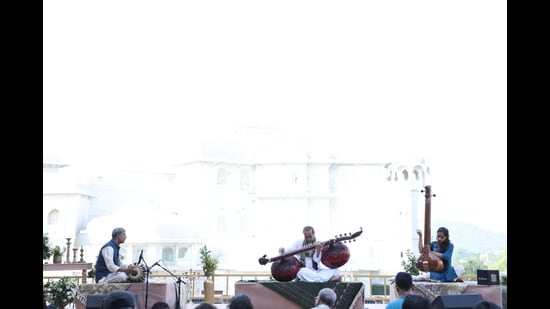
The opening act, which began with a Ganesh Vandana, was a musical conversation between Anil Srinivasan on piano, U Rajesh on mandolin and Sumesh Narayanan on mridangam. One of the tracks they performed was the upbeat Inner Child, composed and recorded by Rajesh two decades
The second edition of the India Music Retreat held at Fairmont Jaipur from September 18 to 20 showcased a diverse range of music including Hindustani and Carnatic classical to ghazals and contemporary Bollywood.
The opening act, which began with a Ganesh Vandana, was a musical conversation between Anil Srinivasan on piano, U Rajesh on mandolin and Sumesh Narayanan on mridangam. One of the tracks they performed was the upbeat Inner Child, composed and recorded by Rajesh two decades ago, that had the audience clapping along. This was followed by Raga Kapi and then a moving, timeless piece, Lotus Feet. The set concluded with Mile Sur Mera Tumhara, which earned a standing ovation.
“It was a different kind of experience, because I didn’t expect an immersive festival with music in every corner. To get some of the best artists in the country together in one place is amazing. For the audience too, to be in the midst of people who are discussing music so seriously is a great experience,” Srinivasan said afterwards.
Next, Soumik Datta took to the stage, beginning his set with Raga Surdasi Malhar. This was followed by a bandish by Radhika Mohan Maitra. Then, Aruna Sairam came on stage, accompanied by musicians on mridangam, violin and tabla and launched into the legendary Muthuswami Dikshitar’s Amritavarshini. Created during a famine in the 19th century, copious rain is believed to have followed an early performance of the composition. The expansive Raga Todi, marked by the intricate use of microtones, came next.
Sairam then sang a Tamil folk song traditionally sung by village women during festivals. Drawing on episodes from the life of Lord Krishna, some of its lines were also translated into Hindi. Then, Datta and Sairam presented a musical journey through the Bhakti movement, beginning with compositions of Shaivite saints from the sixth to the ninth centuries before moving to the 15th-century Kabir (Jheeni Jheeni Beeni Chadariya), 16th-century Guru Nanak, 16th-century Mirabai (Payo Ji Maine Ram Ratan Dhan Payo), 18th-century Tyagaraja and the Bauls of Bengal. “There are many experiences in life. Music is one dimension, community is one dimension, food is another dimension, beauty of the space is another dimension. This is not a one-sided experience. It’s a multifaceted experience with a lot of soul,” said Sairam.
After dinner, Avanti Patel and Rutuja Lad performed O Gaanewali, which traced the history of the courtesan tradition and its music. Through songs associated with Nirmala Devi, Rasoolan Bai, Begum Akhtar and Gauhar Jaan, the duo celebrated the lives of these maestros while also highlighting their contribution to India’s cultural history and freedom movement.
Day two began beautifully with Ashwini Bhide-Deshpande performing against the majestic backdrop of the reflective pool. After breakfast, her students, Patel and Lad, paid tribute to the legendary sisters, Lata Mangeshkar and Asha Bhosle with evergreen Bollywood classics like Aayega Aayega, Dum Maro Dum, Aaiye Meherban, Piya Tose Naina Lage Re, Raat Akeli Hai, Man Kyun Behka, Yeh Kahaan Aa Gaye Hum, Dil Cheez Kya Hai and Allah Tero Naam. The songs were interspersed with fascinating anecdotes from the lives of Mangeshkar and Bhosle narrated by author Yatindra Mishra.
Post lunch, the Jadunama session had poet and lyricist Javed Akhtar talking to actor Divya Dutta about the stories behind some of his celebrated songs like O Paalanhaare, Saare Sapne Kahin Kho Gaye, Tum Ko Dekha To Yeh Khayal Aaya, Pyar Hua Chupke Se, Phir Dekhiye and Kal Ho Na Ho. Many of the songs were simultaneously performed by Deepali Sahay. “99% of songs have a tune first, and then words. Good writing is not stating everything; it exists somewhere between the writer and the listener,” Akhtar said even as he entertained the audience with witty observations.
In the evening, Sandeep Narayan and his ensemble began with Tulsidas’s Ganpati Jagvandan followed by Raga Kuntalavarali, and Raga Abheri. Then came the Tamil song Oru Murai and the Kannada song Madeva. Narayan concluded with Garaj Garaj Aaj Megh from Bandish Bandits, which he sang alongside its original singer, Mohammed Aman, who was in the audience. “People look for an experience. What’s going to bring them out of their homes, and off YouTube? As musicians, we do our part, but if organisers elevate the whole experience, then this will ensure that these parts of our culture will not just survive but thrive in the future,” Narayan said afterwards.
Later, sitarist Shahid Parvez Khan took to the stage accompanied by Mithilesh Jha on tabla. The evening wound down with Pooja Goswami and Jazim Sharma regaling the audience with melodious ghazals. Highlights included Mehdi Hassan’s Mujhe Tum Nazar Se Gira To Rahe Ho, Faiz Ahmad Faiz’s Hum Dekhenge, Sarakti Jaye Hai Rukh Se Naqab Aahista by Jagjit Singh and Chupke Chupke Raat Din by Ghulam Ali.
The final day of the retreat began on a meditative note with Bahauddin Dagar on the rudra veena, accompanied by Sanjay Agle on pakhawaj and Ipsita Bichkar on tanpura. Absolutely transported, many in the audience closed their eyes and surrendered themselves to the music. After breakfast, Divya Dutta presented an emotional session titled Meri Laadli , in which she narrated her mother’s story while reflecting on her own journey – from being a doctor’s daughter in a small town in Punjab to facing rejection in Mumbai and eventually winning accolades as a National Award-winning actress. She also read out poems written by her mother. By the end of the talk and Q&A, many in the audience were visibly moved.
This was followed by a vibrant Sunday sing-along brunch with ID Rao and his band performing popular favourites such as Dil Chahta Hai, Piyu Bole, Guantanamera and Hotel California. In the evening, musical prodigy Siddartha Belmannu launched into three compositions in Raga Marwa that earned a standing ovation. His powerful voice then charmed the crowd with Raga Tilak, followed by Raga Sohini. He concluded with the bhajan Ram Govind Hari, which was met with another round of enthusiastic applause. Next, Jayateerth Mevundi took to the stage. Highlights of his performance included Raga Shuddha Kalyan and Raga Jhinjhoti.
The festival concluded on a high note with Jasbir Jassi performing a selection of Punjabi and Hindi favourites including Aaja Soniya, Abhi Na Jao Chhod Kar, Lag Jaa Gale, Ek Din Aap, Kuch Na Kaho and Gur Naal Ishq Mitha. In an iconic moment, Sairam also joined Jassi on stage to sing Kajra Mohabbat Wala.
“We try to dissolve the distance between the artist and the stage, and between the artist and the audience,” said Mala Sekhri, Founder, Muse Music, which organised the festival. While the third edition of the Retreat will return to Fairmont Jaipur in September next year, it will also travel to a new venue in Chennai in March 2027. Another Muse Music festival, Kinare Dariya, will travel to the Hooghly in February 2028. “The idea is to allow each place to give us a new musical possibility; to look at the place with admiring musical eyes, while keeping the same underlying belief in immersion, discovery, intimacy and great music,” Sekhri said.
A freelance writer based in New Delhi, Neha Kirpal writes primarily on books, music, films, theatre and travel
One Subscription.
Get 360° coverage—from daily headlines
to 100 year archives.
Archives
HT App & Website
Get more updates from Bollywood, Taylor Swift, Hollywood, Music and Web Series along with Latest Entertainment News at Hindustan Times.
Get more updates from Bollywood, Taylor Swift, Hollywood, Music and Web Series along with Latest Entertainment News at Hindustan Times.