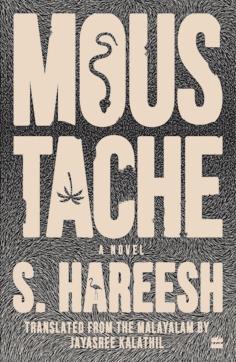
When I finished reading S Hareesh’s Moustache translated from the Malayalam by Jayasree Kalathil, I was met with a sense of befuddlement. I had to now attempt to write about a debut novel which has already been hailed as a contemporary classic in Malayalam literature. Every other friend in Kerala that I spoke to seemed to confirm this opinion. Awards and nominations don’t matter to me as much as people’s perceptions about a book. After all, where would books be without readers? Self-doubt is however not a good beginning for a reviewer.
Moustache is Hareesh’s debut novel. He has authored three short story collections and received the Kerala Sahitya Akademi Award. I had first encountered his writing through film. Lijo Jose Pellissery’s Jallikattu (2019) and Sanju Surendran’s Aedan (2017), both acclaimed Malayalam films, are based on Hareesh’s short stories. The publication history of Meesha (in Malayalam) or Moustache is an urban legend in Kerala. The novel was being serialised in Matrubhumi Weekly. Some parts of the book offended certain right wing groups who threatened the author and his family. Hareesh decided to withdraw his novel. The Kerala state government stood by Hareesh and he was soon approached by DC Books to publish the novel. Meesha is now widely available across Kerala and with its English translation, many more have read it since. A similar trajectory followed the Tamil writer, Perumal Murugan. Hareesh’s novel, however, is more expansive in its imaginative breadth and vision.
Set in the Kuttanad region of Kerala, Moustache narrates the story of Vavachan who hails from the Pulaya Dalit community of landless labourers. Vavachan is selected to perform a small role in a local play for which he is encouraged to grow his moustache. After the play, he refuses to shave off the moustache and decides to grow it further. The moustache is a marker of caste identity. Only upper caste men could sport moustaches. All attempts to persuade Vavachan to shave off his moustache are unsuccessful. Expectedly, the upper castes are angered by his misdemeanour. The village folk are terrified by his moustache. They compare him to Ravanan. A search is launched for Vavachan but he is nowhere to be found. He resurfaces in people’s stories and village gossip. The rest of the novel vividly describes Vavachan’s various attempts to escape his detractors and stories of those he meets while on the run including his love for Seetha and a desire to leave for Malaya. The primary narrator in the novel is a father who shares these stories with his five-year-old son, Ponnu, thus adding another layer of narrative complexity.
{{/usCountry}}Set in the Kuttanad region of Kerala, Moustache narrates the story of Vavachan who hails from the Pulaya Dalit community of landless labourers. Vavachan is selected to perform a small role in a local play for which he is encouraged to grow his moustache. After the play, he refuses to shave off the moustache and decides to grow it further. The moustache is a marker of caste identity. Only upper caste men could sport moustaches. All attempts to persuade Vavachan to shave off his moustache are unsuccessful. Expectedly, the upper castes are angered by his misdemeanour. The village folk are terrified by his moustache. They compare him to Ravanan. A search is launched for Vavachan but he is nowhere to be found. He resurfaces in people’s stories and village gossip. The rest of the novel vividly describes Vavachan’s various attempts to escape his detractors and stories of those he meets while on the run including his love for Seetha and a desire to leave for Malaya. The primary narrator in the novel is a father who shares these stories with his five-year-old son, Ponnu, thus adding another layer of narrative complexity.
{{/usCountry}}In many ways, Vavachan is like a local Don Quixote. There are several stories about him. Women sing about his strength while working in the fields. Men spin yarns about imaginary fights where they stood at a distance quietly observing his strength. The region is abounding with stories about the man with his ever growing moustache. The cops try to catch him and fail. Vavachan becomes a local legend. Everyone has a story about Vavachan but whose story do you want to believe? Have they seen or known Vavachan at all? Besides a strong indictment of caste hierarchies and oppression, Hareesh’s novel is also about the inner life of stories and the art of storytelling. Hareesh perhaps feels that the storyteller is also a creator. Stories are kept alive by people. Some of these stories gradually transform into myths and fables. The novel incorporates local songs, legends, myths and integrates them all in a metafictional whirlpool.
Kuttanad is a much photographed region for its lush paddy fields, backwaters and canals. It is also referred to as the rice bowl of Kerala. It is perhaps the only place where below sea level farming is practised. The region is well known for its geographic peculiarities. These geographical details are integral to the novel. Hareesh turns the geographical setting of the novel into a contemplation about the character and his actions. Vavachan’s story runs parallel with the ecological changes in the region. Landscape inhabits the character. While reading, I often thought that this was indeed a novel about the landscape.
Magic realism is a much-maligned term. While there are certain attributes that could be applied to Hareesh’s writing, his magic realist fable-like narration is more home grown and not imitative of Latin American fiction or Gabriel Garcia Marquez, a writer much loved in Kerala. OV Vijayan’s The Legends of Khasak (1969) was a path-breaking work that introduced us to new narrative possibilities. For those familiar with Malayalam cinema, some of veteran filmmaker G Aravindan’s films such as Kummatty (1979) would also augur well in this regard. Hareesh is an inheritor of this tradition though his work and artistic sensibility are not derivative. Moustache firmly demonstrates what a poor civilisation we would be in the absence of stories and storytellers. In the success of this novel lies the victory of the art of the story.
Kunal Ray teaches literary & cultural studies at FLAME University, Pune.
Follow more stories on Facebook and Twitter