In the last few years, a string of memoirs by Hollywood icons has provided a peek into how they built a life for themselves, sometimes fighting against seemingly insurmountable odds. In his 2023 memoir, Making it So, Patrick Stewart, who died on October 28, traced his path from a difficult Yorkshire childhood and years with the Royal Shakespeare Company to worldwide fame as Captain Picard, the central character of the Star Trek franchise. Anthony Hopkins has written about his early hardships and his road to stardom with great candour and characteristic belligerence in We Did Ok, Kid. In The Steps, Sylvester Stallone draws on the short span when he was down and out before Rocky threw him a ‘lifetime,’ enabling him to fulfil an impossible childhood dream.
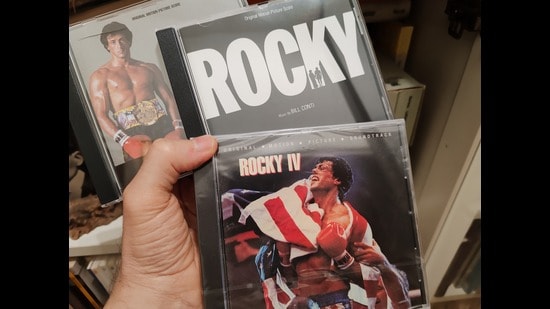
In his memoir, Stallone, who is now 80, spends considerable time in the company of his twenty-something self, analysing the difficulties he faced as a struggling actor yearning for a breakthrough. He begins with his arrival in New York in 1969 and ends with Rocky winning the Oscar for best picture in 1977. There is room along the way for the remembrance of a childhood scarred by a violent father, who was a hairdresser, and a mother with ambitions of her own to be an actor.
Stallone’s premature birth and a forceps delivery left him partially paralysed on the left side of his face and affected his speech. His mother named him Tyrone, after Tyrone Power, but his father changed it to Sylvester. When he was growing up, children mocked the name and his slurred speech. Years later, casting agents told him his mouth and voice were wrong for the leading role. Stallone recounts being judged on his face and voice before he could show what he could do.
{{/usCountry}}Stallone’s premature birth and a forceps delivery left him partially paralysed on the left side of his face and affected his speech. His mother named him Tyrone, after Tyrone Power, but his father changed it to Sylvester. When he was growing up, children mocked the name and his slurred speech. Years later, casting agents told him his mouth and voice were wrong for the leading role. Stallone recounts being judged on his face and voice before he could show what he could do.
{{/usCountry}}There are passages shot through with that pain: “I understand that people are apt to judge a book by its cover, because my whole life that’s what people have done to me. But as an actor, it’s especially frustrating, because it’s what’s inside that counts the most. At the beginning of my career, directors rarely appreciated that at my core there is this simmering cauldron of emotion that can overflow with volatility, but can also be directed toward deep artistic purpose.”
The title is a nod to the 72 stone steps of The Philadelphia Museum of Art – Stallone moved to the city after his parents divorced -- which held the blueprint of every dream he had been living for nearly a decade. He structures The Steps as a climb through his life, beginning with Step Zero: Spain, followed by three stages: New York, Los Angeles and Rocky. The 37 short chapters in the book take us through his troubled early years, humiliating rejections, financial struggles and the making of the film that changed his fortunes. The book ends with The Final Step: Philadelphia, followed by an epilogue, bringing the journey back to the steps that became an enduring symbol of perseverance.
For Stallone, those steps had been a refuge during his childhood, somewhere he would go whenever his mother threw him out of the house. “They were a sacred place for me,” he writes, recalling the comfort he found there long before he imagined making films. Years later, when he returned to shoot Rocky’s famous run, the moment carried the memory of everything he had endured. The steps represented the failures, disappointments and ambitions of his hardscrabble years. While shooting for Rocky, as he raced to the top, his legs on fire, he began dancing with sheer exhilaration. It was an unplanned moment that would become one of cinema’s most recognisable images.
Initially raised in a volatile flat in Hell’s Kitchen in the late 1940s and early 1950s, then years away from his parents: first in a Queens boardinghouse, among strangers, and later at an institution for troubled boys, he went backpacking in the Pyrenees mountains in Europe at 23. There, a Spanish fortune teller, Madame Pilar, told him the spirit of an actor was watching over him. That set him on a journey of self-discovery, prompting him to “step into the inferno” and chase his dream more fervently.
Back in New York, a loner living away from his dysfunctional family, he took whatever work he could find, including cleaning lion cages at the zoo and ushering at Baronet Theatre. He watched films extensively, studying how a scene gathered force and what a face could do in close-up. This proved to be quite an apprenticeship for the future star.
Acting had come into Stallone’s life through a school production of Death of a Salesman. He studied drama at the University of Miami leaving a few credits short of a degree. A speaking role in The Lords of Flatbush, with a young Henry Winkler, gave him enough encouragement to try Los Angeles. He and Sasha Czack, whom he would marry, drove west with a boot full of scripts. There was some work, including a part in Death Race 2000, but he was still trying to get anyone interested in what he was writing.
Before he wrote Rocky, Stallone sold the rights to a screenplay called Paradise Alley for $100; he desperately needed money and had to even sell his dog. He was still angry with himself about it when, one night in California, he got up from his table at about three in the morning and went out for a walk. Sasha was pregnant, but he was broke and he had spent another night getting nowhere on the page. In The Steps, the walk becomes part of the story of how he found Rocky Balboa.
He was thinking about how it feels to suspect you might be good at something and never get the chance to find out. The thought eventually gave him a boxer, though the first draft, which he wrote in three days, gave him a fairly hard man without much of a reason to fight. In rewriting him, Stallone made Rocky a decent person who had let his talent go to waste. A shot at the heavyweight champion gives him a reason to take himself seriously again. You can see how much that change does for the film. By the time Rocky gets into the ring with Apollo Creed, you care about how long he can stay there.
Producers Irwin Winkler and Robert Chartoff were interested in the screenplay, but Stallone insisted on playing Rocky. He remembers having $106 in the bank while the offers for the script kept climbing. The numbers have become part of Hollywood folklore, and there are different accounts of how fiercely the producers resisted casting him. What comes through in Stallone’s version is how much the earlier sale of Paradise Alley mattered to him. He already knew how it felt to walk away from a deal with a little money and wonder what else he’d given up. This time, if he sold the script and someone else played Rocky, he’d still have to go out looking for a job as an actor.
There are glimpses of Stallone’s later life, but the main story stops just as the career most readers know is beginning. That choice leaves room for the young man who studied drama, loved Edgar Allan Poe and kept writing scripts through years of indifferent auditions. It also gives the book a satisfying sense of proportion. For years, Stallone carried a photograph of himself into offices and asked strangers to picture him in a film. With Rocky, he could hand them a script and show them exactly what he had in mind
At 80, Stallone calls himself a “lucky dog” rather than an underdog, but the memoir keeps the solitary fighter at its centre. It shows the vulnerable but “battle hardened” boy inside the tough man without asking much about the limits of that familiar masculine ideal. The Philadelphia steps have become a monument to Rocky’s hope. The Steps is more affecting on the uneven ground beneath them.
Nawaid Anjum is an independent journalist, translator and poet. He lives in New Delhi.