There is something quite astonishing about the Apple Mac mini. Years ago, it was a ‘starter’ Mac on a budget, meant to plug into a display you already had. It seemed happy in that role, because it felt comfortable. Mind you, the Windows ecosystem couldn’t match the Mac mini in form factor or performance then. This year has been a transformation of epic proportions. The Mac mini is now one of Apple’s most powerful Macs. It still carries the weight of expectations in its compact, loveable footprint (introduced in 2014), but the Apple M6 chip upgrade has given it the versatility to be a powerful desktop rig, a gaming hub or, most importantly, while keeping in tune with the times, the most wanted machine for running AI models and agents on-premises. Safe to say, Windows will struggle to find an answer now, too, especially since the benchmark has shifted wildly.
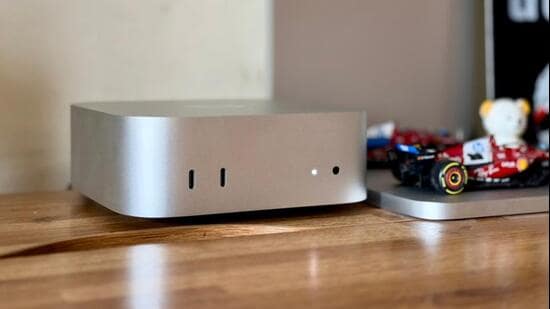
The Mac mini is still the most affordable M-series chip computing device that Apple sells, but the stakes are much higher. As are expectations. Running AI models of around 10-billion or 16-billion parameters (depending on the unified memory version you select) is no mean feat. The memory supply chain situation means Apple must start the lineup with 16GB unified memory on the M6 chip, rather than the 24GB unified memory starting point for the M5 Pro options. The Mac mini is configurable with 16GB, 24GB, and 32GB of memory, with 256GB, 512GB, 1TB, or 2TB SSDs. Important: configure carefully based on the model sizes you want to run. The dual Neural Engine improves compute, but unified memory is needed to load these models.
Alongside three M6 variants, there is also the M5 Pro silicon-based Mac mini. We are assessing the Mac mini with the M6, 24GB unified memory, and 512GB storage—think of this as mid-spec in terms of memory, and you’ll get a fair idea of the power this compact computing device (it is 5 inches by 5 inches in footprint) packs. One of the key new elements in macOS 27 Golden Gate is the Siri upgrade, which is (and I’m absolutely not overstating it) a significant upgrade over the Siri we’ve known over the past few years. This can be the AI chatbot as you’d expect it to be (and it can be invoked across apps), writing with Siri, personal context for search and responses, Safari Notify Me agentic feature, spatial reframing and extended tools for photo editing and Visual Intelligence for context about what’s on the screen.
{{/usCountry}}Alongside three M6 variants, there is also the M5 Pro silicon-based Mac mini. We are assessing the Mac mini with the M6, 24GB unified memory, and 512GB storage—think of this as mid-spec in terms of memory, and you’ll get a fair idea of the power this compact computing device (it is 5 inches by 5 inches in footprint) packs. One of the key new elements in macOS 27 Golden Gate is the Siri upgrade, which is (and I’m absolutely not overstating it) a significant upgrade over the Siri we’ve known over the past few years. This can be the AI chatbot as you’d expect it to be (and it can be invoked across apps), writing with Siri, personal context for search and responses, Safari Notify Me agentic feature, spatial reframing and extended tools for photo editing and Visual Intelligence for context about what’s on the screen.
{{/usCountry}}One of the Mac mini’s visual tricks, especially since the redesign, is minimalism. It blends into the desk layout, can be mounted behind the display, or hidden to one side if you prefer. I keep it front and centre of the work desk, with the Apple Studio Display. The chassis is exquisitely crafted, and there is no power brick to place anywhere. The back has the power port, three Thunderbolt USB-C ports, a 2.5Gb Ethernet port, and HDMI, while the front has a 3.5mm audio jack and two USB-C ports. The power port placement continues to be unique, on the underside. I’ve worked out a slightly higher central plinth for the Mac mini to sit on, so your finger can reach the button easily.
There is perhaps a case for a card reader somewhere on the Mac mini. The larger, more powerful Mac Studio has one, and given the performance leap the Mac mini has made, many creative workflows, including video editing, will find the Mac mini a perfect fit.
The Mac mini takes advantage of the M6 chip’s 40% faster CPU with super cores, compared with the M4 chip and the additional cores as part of a faster GPU as well. The highlight of course, is the dual 16-core Neural Engine for AI processing, and it begins to show that magic the more you use AI across apps. Performance all through is purposeful, and even as someone who was switching from a Mac Studio, this performance felt at par or even better at times of multitasking—that clearly illustrates the leap M6 makes as a silicon, and optimisations across the chain to ensure the Mac mini doesn’t face compromises because of its size.
Only during gaming did I hear the fans come on, because this runs absolutely silently the rest of the time. Place your finger on the circular vent at the base during heavy use, and you’ll feel a gentle breeze from the fan, but you’ll never hear it. Speaking of games for a moment, macOS is evolving as a gaming platform, and some serious titles are available—Cyberpunk 2077, Death Stranding Director’s Cut, Assassin’s Creed Shadows, Resident Evil 7 Biohazard, Baldur’s Gate, Football Manager 26, Grid Legends, and No Man’s Sky are examples. On the Mac mini, these are playable at their highest visual settings, which, at 1440p resolution and averaging close to 65 frames per second, is a serious result.
Till the Windows ecosystem gets its act together (and that remains a big if) to make a powerful mini PC that isn’t riddled with performance or spec compromises, the Mac mini remains the benchmark for exactly the sort of computing device experience that does a lot of things very nicely. It can be your rig for dabbling in AI compute and AI agents. It can also be a great home computer with plenty of headroom for longevity. It can also be the ideal machine for creative workflows, including heavy video editing. And if you have game titles optimised for macOS, there’s enough substance there, too.
Mac mini prices now start at ₹99,900 with the M6 silicon, and for most workflows, the entry-spec variant with 16GB unified memory, or the next step with 24GB memory, will be the perfect fit, depending on the balance between requirements and budget. If you want to experiment, a couple of Mac mini devices in a cluster would make a very cool AI setup. Over the years, this has got more expensive due to supply chain issues, but it is still an absolute bang for the buck. And one rarely says that for tech that costs as much.