
PARIS—Li Auto, a Beijing-based luxury carmaker, used this city’s auto show to show off a car with massage seats at the front, a 21-inch screen for passengers in the back and a unit in the central console that can keep your energy drink cool or your coffee warm.
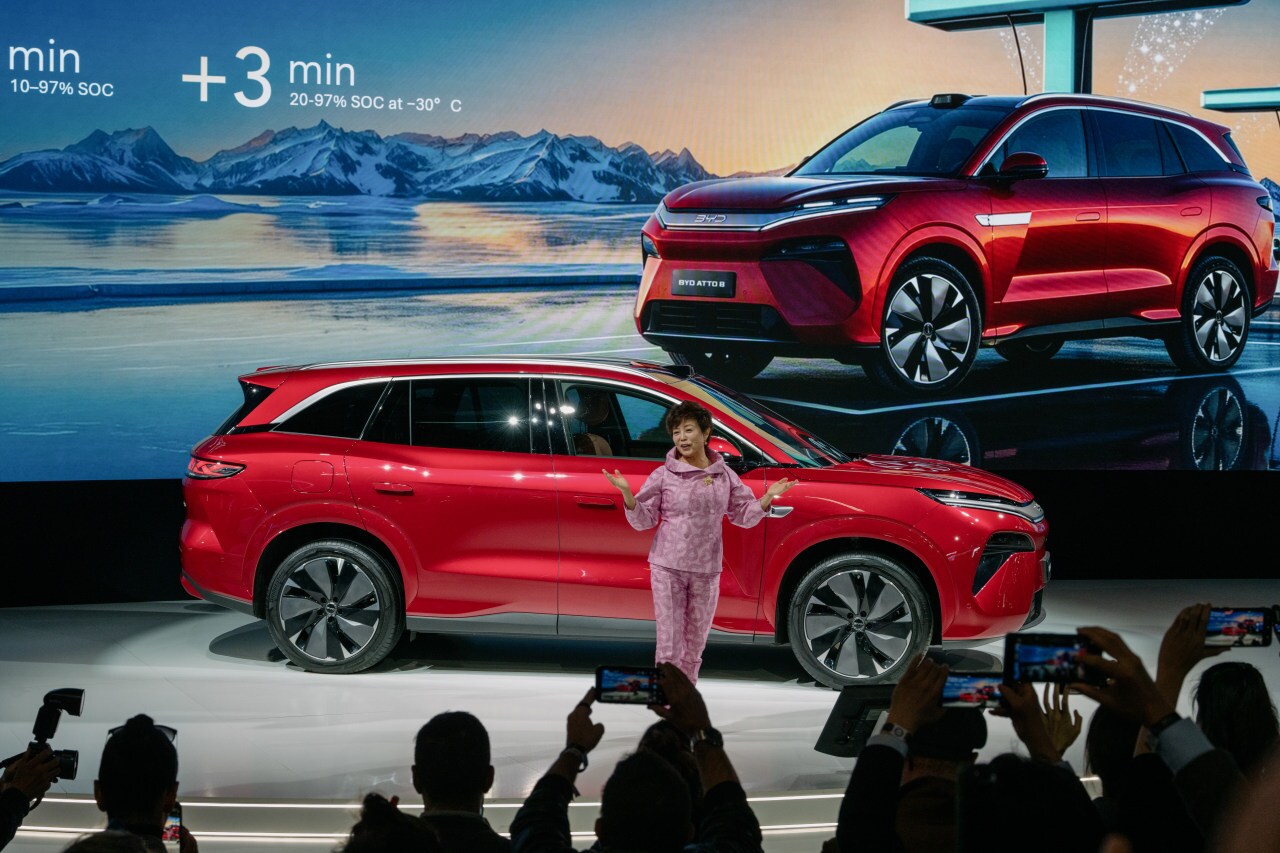
Meanwhile, BYD, the world’s bestselling electric-vehicle brand, took the veil off an SUV for Europe that can fill up much of a battery in five minutes.
And not to be outdone, XPeng
PARIS—Li Auto, a Beijing-based luxury carmaker, used this city’s auto show to show off a car with massage seats at the front, a 21-inch screen for passengers in the back and a unit in the central console that can keep your energy drink cool or your coffee warm.
Meanwhile, BYD, the world’s bestselling electric-vehicle brand, took the veil off an SUV for Europe that can fill up much of a battery in five minutes.
And not to be outdone, XPeng touted a test of autonomous-driving technology it conducted around the Arc de Triomphe, the 19th century monument commissioned by Napoleon Bonaparte on the Champs-Elysées. The vehicle, an SUV outfitted with tech that was supervised by a driver, was up for the task, Chief Executive He Xiaopeng said at an event Sunday.
“Oh, my God, it’s hard,” he said of the chaotic roundabout circling the monument.
Welcome to the Paris Motor Show—though, this year, one could be forgiven for mistaking it for a China auto show. In total, around 20 Chinese vehicle brands had stands, representing a third of all brands here. That is second to Europe and up from nine when the show last took place two years ago.
Three American brands were represented: Tesla, Ford Motor and Lucid Group.
The Chinese automakers helped make Europe’s biggest car show much more buzzy than its U.S. counterparts. Unlike recent events in Detroit and Los Angeles, the Paris show consistently had throngs of attendees crowded around stages to witness the debut of new vehicles. Carmakers held news conferences back-to-back, sometimes overlapping, as Chinese executives played up their plans to increase manufacturing in Europe.
“They are looking to not only sell here, but be perceived as good citizens,” said Adam Bernard, a U.S.-based automotive consultant.
Chinese automakers are accelerating their sales across Europe by offering vehicles packed with high-end features at competitive prices. They accounted for 11.3% of all sales in the year through August, up from 7.1% in the same period of last year.
The shift is among the reasons behind a wave of job cuts among European automakers, alarming political leaders and accelerating negotiations between Brussels and Beijing.
On Friday, the European Union and China reached a deal that the bloc said could halve its imports of Chinese hybrid vehicles. The EU will impose an annual quota of 350,000 units in the first year, EU officials said Monday, adding that the amount can increase by 6% in each of the following three years.
“The trade deficit is a mountain of a challenge for the EU,” Maroš Šefčovič, the EU trade commissioner, said last week.
French President Emmanuel Macron personally sought to inject a dose of European flair into the show. Macron admired a prototype all-electric version of Citroën’s 2CV model, a classic of the French company and a fixture of European streets in the postwar era. Like other long-established European carmakers, Stellantis, which owns Citroën, is leaning in to its 20th century heritage in response to the wave of 21st century startups from China.
So far, brands owned by five companies account for most of Chinese imports into Europe: BYD, Chery Automobile, SAIC Motor, Geely Automobile and Leapmotor, which is expanding through a joint venture with Jeep owner Stellantis.
State-owned Changan Automobile, China’s fourth-largest automaker, is following their lead. It has a target of selling 1.5 million vehicles outside China by 2030, more than twice last year’s total. The company said it hoped to sell 100,000 vehicles in Europe next year, up from a target of 30,000 in 2026.
“We aim high,” said Klaus Zyciora, Changan’s global chief executive adviser.
Chinese carmakers are also trying to edge out European brands in their closely guarded luxury market. The Aito brand made by Seres Group—tagline “Intelligence Redefining Luxury”—announced that it would launch in Europe in the fall of 2027.
“Chinese companies are known for their cost efficiency. Convincing customers that we can also do luxury will take time. But we will get there,” said Clifford Kang, a Seres board member.
Chinese cars are essentially shut out of the U.S. by high tariffs and software restrictions, but President Trump last month repeated comments that he would welcome them if they were locally built, alarming Detroit. Congress is debating a legislative ban of Chinese cars.
John Bozzella, president of the Alliance for Automotive Innovation, the top U.S. car-industry group, said: “Europe is a cautionary tale for the U.S. What American policymakers are trying to do is address the issue up front.”
Chinese cars got their foothold in Europe partly by exploiting an inadvertent loophole created in Brussels. Officials in 2024 excluded plug-in hybrids from additional European Union tariffs on Chinese electric vehicles. Chinese brands pivoted to selling those models and have since seized a disproportionate market share of a vehicle type that has emerged as a sweet spot for consumers looking for fuel economy without compromises.
European countries are hesitant to totally shut off China from its market, fearing retaliatory measures by Beijing. The continent relies on exports much more heavily than the U.S.
“I’ve got to make sure I’m protecting my export markets,” said U.K. Business Secretary Jonathan Reynolds in a recent interview.
The U.K., like the EU, has been flooded with Chinese cars, including a model made by Chery’s Jaecoo brand that became the bestselling vehicle in September.
Chinese companies are starting to localize production to avoid tariffs and smooth relations. “In Europe for Europe” was a slogan touted by many Chinese automakers at the show.
At a Sunday evening gala inside a floating art museum on the Seine River, industry executives mingled over drinks and a live jazz band while locals passed by on runs along the water.
“For Geely, globalization is not a solo sprint,” Alex Nan, vice president of Geely Auto, told the audience. “It is a marathon we run side by side with our partners.”
Write to Stephen Wilmot at stephen.wilmot@wsj.com and Ryan Felton at ryan.felton@wsj.com
One Subscription.
Get 360° coverage—from daily headlines
to 100 year archives.
Archives
HT App & Website