For most of the last decade, the trajectory was one of positivity. Affordable Android phones were becoming better experiences, with phone makers finding enough ingenuity to balance the books with powerful specs, which simply meant longevity and great value.
The last twelve months have unfortunately reversed that trend, resoundingly. AI companies hoovering up future production of storage and memory with orders often precariously placed on capricious funding, as well as geopolitical uncertainties in many regions of the world leading to supply chain inflation, are the primary reasons.
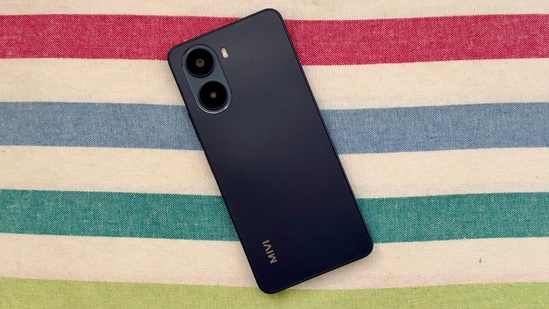
For an Indian tech company like Mivi to proceed with launch plans for its first smartphone in this backdrop is brave. Secondly, the Mivi One 5G isn’t making the mistakes some of its very recent competitors have made.
How the Mivi One 5G is priced will better illustrate where we are. There are three memory and storage options, and prices range from ₹13,999 to ₹15,999. This is a Flipkart exclusive for now (and there will be avenues for credit card discounts), and our recommendation is to buy the best possible spec, as much as your budget allows—there is a ₹1,000 increment between 4GB+128GB, 6GB+128GB, and 8GB+128GB.
Mind you, this uses a hybrid slot that also supports a microSD card to expand local storage—it is good that Mivi hasn’t ignored this flexibility.
{{/usCountry}}Mind you, this uses a hybrid slot that also supports a microSD card to expand local storage—it is good that Mivi hasn’t ignored this flexibility.
{{/usCountry}}Its direct competition will be the likes of the Xiaomi Redmi A7 (prices start at ₹12,999), with an overlap with the Redmi A7 Pro 5G (prices start at ₹14,499) as well as the recently launched Boltt Ace 5G (prices start at ₹11,499) and the aforementioned Lava Virat V1 5G (that’s priced at ₹11,999 onwards).
Spoiler alert: based on the silicon foundation, the Mivi One 5G is better positioned. And you see how difficult it is now to get affordable Android specs in place.
First things first, I must agree with the choice of processor for the Mivi One 5G. The Qualcomm Snapdragon 4 Gen 2 paired with 6GB RAM (it is good to have a mid-spec unit this time around, to get a sense of the balance) holds up significantly better than the Unisoc T8200 chip, which absolutely struggles to move anything around once your phone has the entirety of Google account elements synced and you’ve installed a bunch of apps. It is better to buy a phone a couple of generations older if budget is a strict limitation than to buy a phone powered by the Unisoc T8200.
Lava leaves Android clean and largely free from any customisations that may hit resources, and Mivi’s approach has been similar too-we have a mostly consistent software baseline with stock Android to understand each chip’s limits.
Lava used the T8200 with the Virat V1 5G, and I had noted, “this chip struggles, to put it simply, and that will significantly detract from the overall experience.” While Boltt elected not to share the Ace 5G smartphone with us for review, it's important to note that it also runs the Unisoc T8200 chip, so it’s difficult to expect the results to be any different.
The Redmi A7 runs a Unisoc T7250 chip. All these choices go on to define how component and bill-of-materials costs have driven a significant decline in the specs used by newer-generation phones. This is not good news for longevity. And that’s where the Mivi One 5G finds itself better placed than many.
This phone marks Mivi’s debut in the complex smartphone space, and for the most part, they’ve done well to get the basics right. The Snapdragon 4 Gen 2 chip maintains its performance baseline significantly better as you switch between apps, and the interface and transitions are generally more fluid than on phones with the T8200 chip. The fact that Mivi has kept the Android experience free from any preloaded apps or bloatware speaks volumes about their overall approach to phones—most affordable and mid-range Android phones rely on preloads as a revenue stream.
The phone runs Android 16 for now, and with two Android version updates promised, this is locked in for Android 18.
Efficiency takes advantage of an optimised Snapdragon chip and a clean Android, with the 6,000mAh battery lasting a day and a half with moderately heavy usage across apps, social media, music streaming and some photography plus editing. The shortcoming here is that the bundled charger (at least there is a bundled charger, which is supposed to mean something in this day and age) tops this up at 18 watts, which means you really don’t have much of an option but to leave this on the charger overnight on most weekdays.
One could note something of a complaint about the 6.75-inch HD+ in-cell LCD display. The 1600x720 pixel resolution doesn’t quite deliver the pixel density to make this display look crisp. That said, it is fairly bright and quite usable even in bright sunlight, and it even offers a 120Hz refresh rate for good measure. The bezel thickness, particularly at the chin, could have been minimised to give the phone the more premium look it deserves, all things considered.
I am particularly impressed by the 50-megapixel primary camera (think of this as effectively a single-camera setup; I’ll get to that momentarily). If I am not mistaken, this is a Samsung sensor, and that’s a solid baseline for photography. As things stand with this software version, daytime and good-light photos return a lot of detail and good colours, with a bit of headroom for editing improvements.
However, in low light, this camera struggles with speed and detail. I expect Mivi to improve either or both with future software updates, as it must, having handicapped itself with a secondary camera that is essentially a depth sensor rather than an ultra-wide or telephoto (particularly because there is no optical zoom to get close to distant subjects). You’ll lack the flexibility in photography to that extent.
The debut effort is not at all bad. The Mivi One 5G focuses on getting the basics right, and that obsessive approach has paid off to some extent. So much so that with performance, battery stamina, a clean Android experience and a capable primary camera ticked off, Mivi probably didn’t have much left in the tank for any more of the finer details, such as thinning the bezels or a better secondary camera or a higher spec display.
Those points may well be on the agenda for the next generation phone, but as things stand within the paradigm of supply chain constraints, Mivi has delivered what is an effortlessly consistent phone without any frills or complications. To do even that, seems akin to a job very well done.