
 E-Paper



June versus July: Chandigarh tricity infections already up by 46%
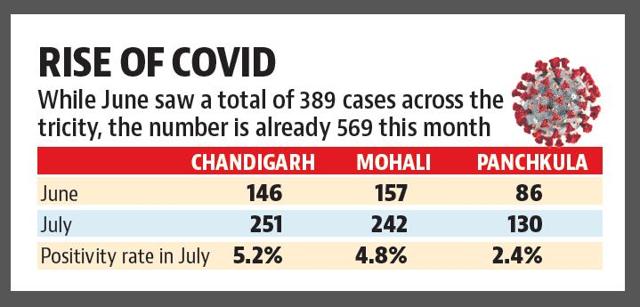
While June saw a total of 389 cases across the tricity, the number is already 569 this month.

 Prefer HTon Google


The number of Covid-19 cases reported in the first 18 days of July has already surpassed the total infections reported in June across the tricity.
While there were a total of 389 cases across the tricity in June, the number is already 569 this month – a spike of 46%.
In Chandigarh, July saw the cases rising by a whopping 72%. Similarly, Mohali had a 54% jump in cases in the same period and Panchkula 51%. (see graphic).
According to experts, health authorities should further ramp up tracing and treatment of patients. “There is a possibility that we have reached the stage of community transmission because every positive patient does not have travel or contact history, and at the same time people have gone lax. Public places are flooded with people, with no regard for precautions and social distancing rules,” said Dr Yogesh Chawla, former director, Post Graduate Institute of Medical Education and Research (PGIMER).
PGIMER director Dr Jagat Ram said the spurt in cases was on expected lines. However, which way the graph goes in the near future will depend on people’s attentiveness to norms.
“It is hard to predict the infection’s spread, but restrictions, which do not harm people’s economic interests, need to be devised and implemented,” he said.
WHAT LED TO THE SPIKE?
Chandigarh’s director of health and family welfare, Dr G Dewan said the current affairs were similar to those in the neighbouring states.
“When the lockdown was in place, the number of cases was low. As the restrictions got eased, borders were reopened and there was an overall surge in infections. In Chandigarh, there are no longer any clusters and most of the cases are limited to families and their contacts,” he said.
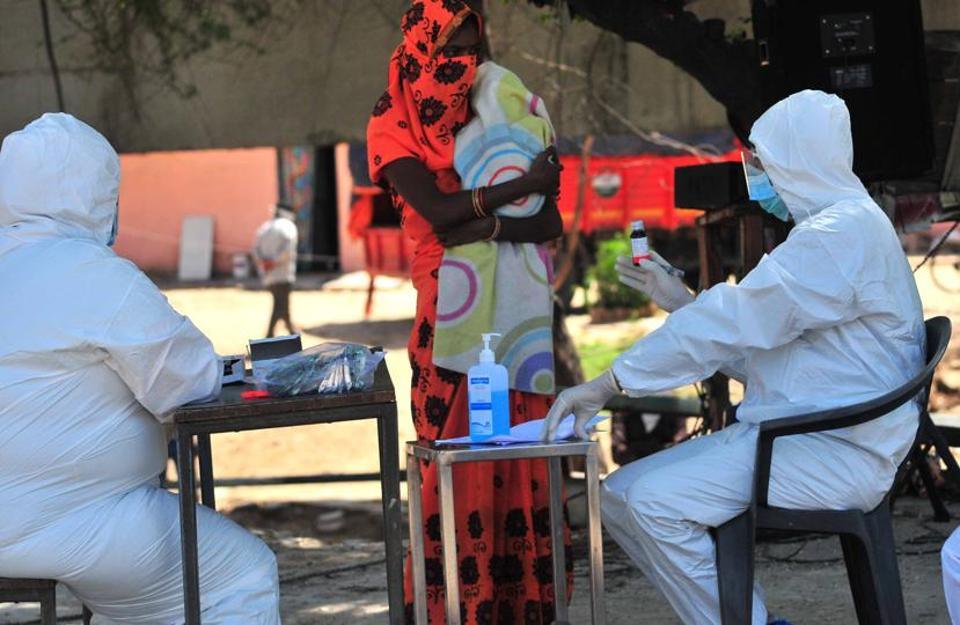
The rise in cases can also be attributed to a more liberal approach to testing, he said, adding, “Once private labs came into play, more people, irrespective of symptoms, are being tested. This was restricted to only symptomatic people at government labs. But, at the same time, our recovery and fatality rates have improved,” he said.
In Panchkula, civil surgeon Dr Jasjeet Kaur said most of the recent infections were detected at the quarantine centres established in the ITBP and CRPF stations.
“The surge is largely due to ITBP and CRPF personnel returning from various states and being tested positive at the quarantine centres. We have decided to conduct the antibody testing as well. We have received ELISA test kits from the headquarters,” she said.
Mohali civil surgeon Dr Manjit Singh said the cases in the district soared after the borders were reopened in June. “Several recent infections comprise visitors from outside Mohali,” he said.
TESTING LOWEST, POSITIVE CASES HIGHEST IN UT
While testing is the lowest in Chandigarh in July, the city’s positivity rate remains the highest at 6.3%, followed by Mohali (2.7%) and Panchkula (1.69%).
Beginning July, Chandigarh has conducted only 163 tests on average per day. Panchkula tested 269 people a day, while Mohali had the highest tests per day, at 303.


