
Sign in

Kuno National Park: India-born cheetah dies after suspected leopard encounter

Kuno National Park now has 25 cheetahs, nine adults (six females and three males), and 16 Indian born.

Updated on: Sep 16, 2025, 08:45:50 IST
Share
Share via
  • facebook
  • twitter
  • linkedin
  • whatsapp
Copy link
  • copy link

A 20-month-old female cheetah, born in India, was found dead on Monday evening at the Kuno National Park in Madhya Pradesh’s Sheopur following a suspected encounter with a leopard, forest officials said.
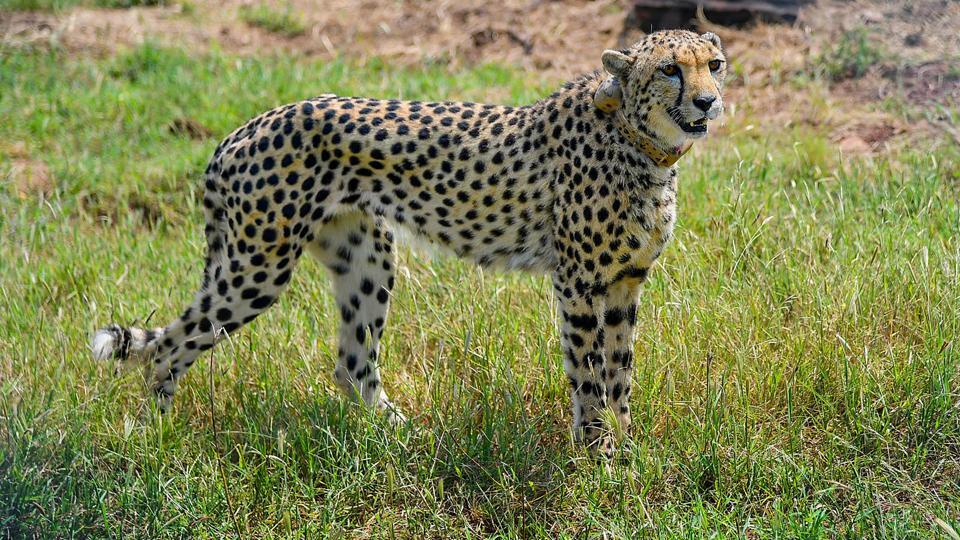
A cheetah after being released inside a special enclosure of the Kuno National Park in Madhya Pradesh. (PTI File Photo)

If verified by the post mortem report, this would mark the first recorded cheetah death due to a leopard attack in the park, said a senior forest official who didn’t wish to be named.

On Monday evening at around 06.30pm, forest officials found the carcass of one of four cubs born to Jwala, a cheetah translocated from Africa. She had been released into the wild along with her three siblings and mother Jwala on February 21, 2025.

She got separated from her mother over a month ago and had recently parted ways with her siblings.

Cheetah Project field director Uttam Sharma confirmed the death and said, “Preliminary injury marks suggested the sub-adult cub died following a fight with a leopard. Further details will be known after the PM report is received.”

In response, forest officials have intensified monitoring of three other sub-adult cheetahs of Asha and the remaining three of Jwala. These six sub-adult cheetahs have been roaming independently in different directions for the past one month, raising concerns about their safety.

Kuno now has 25 cheetahs, nine adults (six females and three males), and 16 Indian born.

Out of total cubs born in India, 11 were in the wild for the past eight-nine months. Now, 10 cheetahs have left while six were in a soft release enclosure with their mothers Gamini and Veera after their birth in February and April this year.

  • Shruti Tomar
    ABOUT THE AUTHOR
    Shruti Tomar

    I have spent over a decade chronicling Madhya Pradesh’s political and social landscape, covering politics, investigative journalism, crime, human interest, and government policy, blending sharp insight with ground‑level depth. I have closely tracked three assembly elections, three Lok Sabha elections, leadership transitions in MP while exposing governance lapses, tender irregularities, and flawed policy rollouts. My reports have revealed gaps in the Cheetah project, irregularities in medical education, rigging in recruitment exams, and loopholes in policy implementation. In crime reporting, I have moved beyond FIRs to map systemic patterns — from organised crime networks and gender‑based violence to custodial accountability — balancing urgency with sensitivity. My journalism is defined by a commitment to human interest. I have profiled the marginalised Bancchda community, documented atrocities against tribal groups, and highlighted efforts to preserve their culture through heritage liquor and revival of spiritual practices. I have reported on farmers struggling with failed MSP promises, giving voice to those often reduced to statistics in policy files. Passionate about field reporting, I have reported on rampant sand mining in Chambal and Narmada, pharmaceutical companies supplying medicines under altered names, the dire condition of schools and colleges, the plight of commercial sex workers, and skewed sex ratios in specific districts. Beyond deadlines, and as HT’s state correspondent and assistant editor in Madhya Pradesh, I engage with ministers, farmers, students, and activists, believing the best policy stories begin with a single human voice. A postgraduate in Journalism and Mass Communication, I also hold a diploma in sports journalism.Read More