When orchardist couple Rani and Sankalp Parihar planted two mango saplings years back, they thought they will grow like other trees in their orchard in Madhya Pradesh’s Jabalpur. The saplings developed and bore unusual ruby-coloured mangoes. To the couple’s pleasant surprise, the mangoes turned out to be Japanese Miyazaki.
Miyazaki mangoes are among the most expensive in the world and sold at ₹2.70 lakh per kilogram in the international market last year, according to the Japanese media reports.
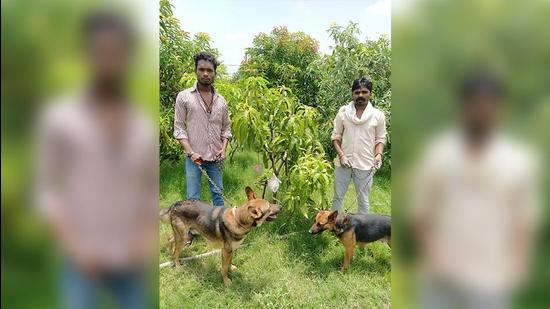
Parihar said thieves last year broke into their orchard and stole the mangoes after it became locally known that they have started growing this rare fruit. He said they somehow managed to save the trees. Parihar added they have this year employed four guards and six dogs to guard the rare trees and seven mangoes, which are rarely grown in India and are also known as an egg of the sun.
Parihar said he was on his way to Chennai to buy some saplings when he met a man on a train, who offered him what later turned out to be Miyazaki. “He offered these saplings to me and asked to take care of these plants like our babies. We planted in the orchard without knowing what variety of mangoes it will produce.” He added last year when the saplings started bearing fruits, they found them to be very different. “As I did not know the name of this variety, I named the fruit after my mother Damini. Later, we researched about this variety and found the real name. But it is still Damini for me.”
Rani said mango cultivators and fruit lovers were contacting them and a businessman has offered ₹21,000 for a mango. “...a jeweller from Mumbai is ready to pay whatever price we quote. But I have clearly said that we will not sell it to anyone. We will use the fruits to grow more plants,” said Rani Parihar.
{{/usCountry}}Rani said mango cultivators and fruit lovers were contacting them and a businessman has offered ₹21,000 for a mango. “...a jeweller from Mumbai is ready to pay whatever price we quote. But I have clearly said that we will not sell it to anyone. We will use the fruits to grow more plants,” said Rani Parihar.
{{/usCountry}}Madhya Pradesh horticulture department joint director RS Katara said he has inspected the orchard and found the fruit is rare in India. “It is costly because its production is very low, and its taste is very sweet. It looks very different. People abroad give these mangoes as gifts.” He said they will check the fruit again before promoting it among the farmers.
G S Kaushal, a former director of Madhya Pradesh’s horticulture department, said after Noor Jahan variety of mangoes of Afghanistan, this Japanese mango has been hitting headlines due to cost not due to taste. “I asked some local scientists to go and inspect the tree and fruits to know whether it is a real one or a hybrid one and why it is so expensive,” said Kaushal. “People should grow it only after scientists approve the quality of this mango.”
Jabalpur’s Jawaharlal Nehru Agriculture University scientists were planning to study the mangoes, said its registrar Rewa Singh Sisodia.