The refugee deluge into India triggered by the Pakistan army’s ruthless crackdown on March 25, 1971, created an unprecedented socio-economic crisis. The lukewarm response of the international community to persuade Pakistan for a political settlement catalysed India’s propensity towards military intervention to return the refugees to their homeland and liberate Bangladesh.
The Indian Army, learning from the 1965 war experience, factored in the likely international pressure besides the traditional terrain and relative military capabilities in planning the offensive. Considering that the international community would impose an early ceasefire, India strategised a swift multi-pronged offensive into East Pakistan to capture substantial territory with Khulna and Chittagong ports as the principal military objectives and install a provisional Bangladesh government. It appreciated that the rapid offensive and effective blockading would forestall any outside assistance, leading to the eventual liberation of East Pakistan.
As a prelude to the war, India, from October onwards, conducted synchronised military activities along the borders and intensified harassing tasks in the interior. Pakistan army, discerning India’s intention to install a puppet government, denuded the interior and strengthened the border towns.
The army did not specify Dacca (now Dhaka) as a military objective. Nor was it even earmarked as a contingency task. The army considered the capture of Dacca by crossing either the Padma, Yamuna, or Meghna rivers as an ambitious proposition in the face of enemy opposition. Major general KK Singh, the director of military operations, felt that “the Indian Army with its inherent inhibitions against anything unorthodox and a speedier manoeuvre was ill-suited for attempting the capture of Dacca”.
{{/usCountry}}The army did not specify Dacca (now Dhaka) as a military objective. Nor was it even earmarked as a contingency task. The army considered the capture of Dacca by crossing either the Padma, Yamuna, or Meghna rivers as an ambitious proposition in the face of enemy opposition. Major general KK Singh, the director of military operations, felt that “the Indian Army with its inherent inhibitions against anything unorthodox and a speedier manoeuvre was ill-suited for attempting the capture of Dacca”.
{{/usCountry}}General Sam Manekshaw, the Indian Army chief, overruling the Eastern Command’s proposal to keep Dacca as the final objective, emphasised the significance of capturing Khulna and Chittagong ports to render Dacca militarily untenable. The scarcity of enormous water crossing resources was a significant constraint. Regrettably, the army did not consider the availability of air assets in their armoury.
Securing the surrender of Pakistani forces
India, unsure of its military capability and apprehensive of international pressure to impose an early ceasefire, opted to secure the geographical space instead of the nerve centre of Dacca. It pushed the army to fight attrition battles to capture insignificant tactical objectives.
Then, how did the Indian Army secure the surrender of the Pakistani forces in Dacca and the liberation of Bangladesh? The threat of US intervention, likely intensifying of world pressure, and Dacca falling within the army’s reach convinced India to modify its plan.
The Indian military’s rapid progress and the vetoing of the US-sponsored Security Council resolution by the USSR on December 5 for a ceasefire, and withdrawal of forces, rattled the US. Secretary of state Henry Kissinger said: “We have Indian-Soviet collusion, raping a friend of ours.” Believing Pakistan’s dismemberment would adversely impact the stillborn relationship with China, Kissinger advocated some demonstrative capability to support Pakistan. The US’s unsuccessful attempt to pressure China to amass troops on the borders to scare India prompted it to arm-twist the USSR, threatening it with a global escalation should it not support the cessation of hostilities and withdrawal of Indian forces from East Pakistan. It spread a false narrative of having credible inputs of India’s cabinet meeting to dismember West Pakistan after liberating Bangladesh. Giving effect to the escalation narrative, it simultaneously despatched its Seventh Fleet, comprising an aircraft carrier to the Bay of Bengal, on December 10. Russia, after that, began to tow the US narrative.
Battlefield progress emboldened India
Meanwhile, the significant battlefield progress emboldened India to capture Dacca. Lieutenant general Sagat Singh, the dynamic 4 Corps commander, grabbed the opportunity to exploit the success of securing the eastern bank of the Meghna river by December 9. The army, employing helicopters and river crafts, built up almost a division-sized force across the Meghna by December 12. It airdropped a parachute battalion at Tangail on December 11. The master-stroke of this brilliant manoeuvre set the stage for the capture of Dacca.
The Indian Navy carried out extensive bombing of Pakistan naval assets to render them ineffective for use by the US Seventh Fleet. The Indian Air Force launched a successful airstrike at the governor’s house on December 14. Targeting the enemy’s fragile state of mind, India intensified its psychological pressure on the Pakistan army to surrender; which was desperately looking for an UN-sponsored ceasefire as a face-saver.
A failed UN resolution and a walkout
Time was of utmost essence. Poland, with the apparent backing of the USSR, tabled a resolution in the Security Council on December 15 that called upon India and Pakistan to accept an immediate ceasefire, withdraw forces from each other’s territory, renounce claims to any occupied territories, and transfer power to the elected representatives in East Pakistan. The passage of the resolution before the capture of Dacca would have deprived India of securing the Pakistani forces’ surrender and liberating Bangladesh smoothly. Fortunately, the resolution failed.
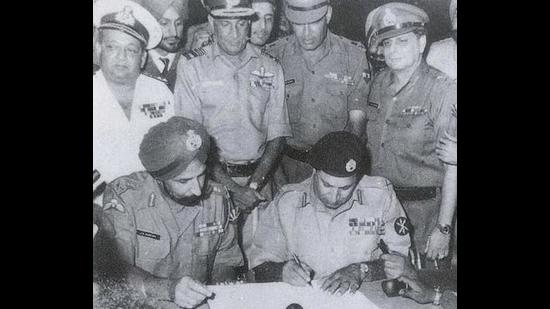
ZA Bhutto, the foreign minister of Pakistan, driven by self-interest for political ascendancy by shaming its armed forces, condemned the UN Security Council for not acting on time. He tore the resolution and walked out of the session, ending any further discussion. Five Indian Army brigades, in the meantime, encircled Dacca with four infantry battalions and an armoured squadron entering the city by December 16 afternoon. With the UN resolution dead and the Indian Army entering Dacca, the Pakistan army had no option but to surrender on December 16, 1971.
In the final analysis, the international pressure did not restrain India from securing Dacca. The successful execution of the military manoeuvre across the Meghna river, underestimated in the planning stage, made the Pakistani position militarily untenable. jagbircheema@yahoo.co.in
The writer is vice-chancellor of The Maharaja Bhupinder Singh Punjab Sports University, Patiala