Over 700 two-wheeler hopefuls, who have placed bookings for Dhanteras on November 10, are holding on to the glimmer of hope that the UT administration may once again relax the cap on the number of fuel-run two-wheelers under its Electric Vehicle (EV) Policy.
On October 29, the administration had stopped registration of two-wheelers running on internal combustion engines (ICE) after the target fixed for 2023-24 in the amended EV Policy was achieved. As a result, only electric two-wheelers will be registered in the city till April 2024.
This left the people who had booked their two-wheelers for delivery on the auspicious occasion of Dhanteras at a loss.
“I booked a petrol two-wheeler and was planning to buy it on Dhanteras, but I am not sure whether I will be able to get the delivery as the administration had shut down the registration portal,” said Vinay Kumar, a resident of Manimajra.
Around 20,000 non-electric two-wheelers are sold each year in Chandigarh — around 1,600 each month — of which 4,000 vehicles are bought in the festive season alone.
A senior UT officer said the administration was considering to review the policy.
{{/usCountry}}A senior UT officer said the administration was considering to review the policy.
{{/usCountry}}Ram Kumar Garg, finance secretary of the Federation of Automobile Dealers’ Association, Chandigarh, criticised the administration for not feeling the pain of the people, adding that apart from the harassment to consumers, even automobile dealers were suffering a huge loss.
Policy amended twice already
UT had rolled out its EV Policy in September 2022, applicable for five years, during which it plans to gradually stop registering conventional vehicles to dissuade people from buying vehicles that cause pollution.
In the first year, after achieving the target for 2022-23, the administration had suspended the registration of non-electric two-wheelers from February 10 to March 31, 2023.
For 2023-24, in June, UT had decided to stop the registration of non-electric two-wheelers after achieving the target of 6,202.
But after facing criticism for stringent capping, the administration in July had relaxed the target substantially, taking it to 12,076. The target was met by October 6, when UT put an immediate stop on registration of non-electric two-wheelers.
Under pressure from various quarters, the administration amended the policy once again on October 18, taking up the number of permitted non-electric two-wheelers from 12,076 to 13,685 — opening 1,609 more registration slots. But these were exhausted in just 11 days.
Only 2,400 four-wheeler slots left
Even in the case of fuel-run four-wheelers, new registrations will not be done after their number reaches 17,000. Seven months into the financial year, only 2,400 of the total slots are left, which are expected to be filled by November end, following which UT will stall registration of non-electric four-wheelers as well.
UT’s EV policy is aimed at making Chandigarh a “Model EV City” by achieving one of the highest penetrations of zero-emission vehicles within the policy period of five years.
To promote EVs, the administration has waived registration fee and road tax for five years, while owners of vehicles running on conventional fuels have to pay both.
Also an incentive ranging from ₹3,000 to ₹2 lakh is being offered for up to 42,000 vehicles of different categories, including 25,000 e-cycles, 10,000 e-bikes and 3,000 e-cars, purchased between September 20, 2022, and September 19, 2027.
The incentive is available for EVs bought anywhere across the country, but only permanent residents of Chandigarh are eligible for it.
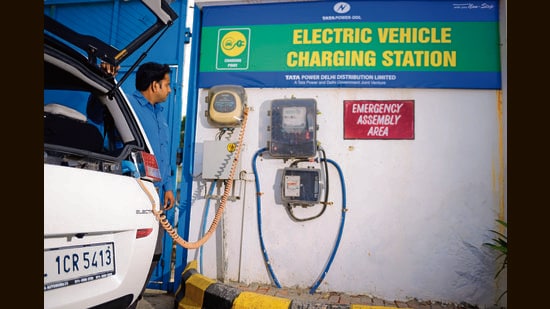
But at the same time, the administration has failed to ensure adequate public charging infrastructure, a key enabler for large-scale EV adoption. With no functional charging stations in the city, owners of over 7,000 EVs registered in the past five years are compelled to rely on home electricity before commencing their daily commute.
Currently, it is in the process of installing public charging stations at parking lots to enable visitors to charge their vehicle while it is parked.